

Toxicology and Applied Pharmacology Insights(TAPI)
ISSN: 2641-0451 | DOI: 10.33140/TAPI

Research Article - (2019) Volume 2, Issue 1
Aid for Personal Identification: Stereomicroscopic Morphological Patterns of Lip Print
2Defence Services Medical Academy, Myanmar
Received Date: Oct 01, 2019 / Accepted Date: Oct 09, 2019 / Published Date: Oct 21, 2019
Copyright: ©Copyright: ©2019 Kyaw Soe Htun, et al. This is an open-access article distributed under the terms of the Creative Commons Attribution License, which permits unrestricted use, distribution, and reproduction in any medium, provided the original author and source are credited.
Abstract
The lip prints being uniform throughout the life and characteristics of person can be used to verify the presence or absence of a person from the crime, provided there has been consumption of beverages, drinks, usage of cloth, tissues or napkin etc., at the crime scene. The objectives of this study were to find out the distribution of different lip print patterns among Myanmar males and females and to determine the relationship between lip prints and blood group. Thin layer of lip-stick was applied on the lips of these subjects. The hinged portion of a folded paper was inserted between the lips and the sub-jects were asked to press their lips onto it. Only middle 10 mm of both upper and lower lips were taken as study area. The lip prints, thus obtained were studied on the basis of Tsuchihashi’s classification. There was significant difference between male and female lip print patterns. Type II was most common in both gender. Type I was more common in male and Type II, III and IV were more common in female. The most common lip print patterns in left lower quadrant was Type III and Type II pattern was most common in other three quadrants. The least common pattern was Type V in all quadrants for both gender. No correlation was found between lip print patterns and ABO blood group system. Lip print pattern can be used as an additional tool for personal identification and gender determination. Further work on the subject can help to make cheiloscopy a practical reality in the forensic identification process.
Keywords
Fingerprint, Ridge density, Gender, Crime, Personal Identification
Introduction
Identification of humans is prerequisite for personal, social and legal reason. The wrinkles and grooves on the labial mucosa (called sulci labiorum) form a characteristic pattern called lip prints, the study of which is referred to as Cheiloscopy. It can be defined “as a method of identification of a person based on characteristic arrangements of lines appearing on the red part of lips or as a science dealing with lines appearing on red part of the lips”. The lip prints being uniform throughout the life and characteristics of person can be used to verify the presence or absence of a person from the crime, provided there has been consumption of beverages, drinks, usage of cloth, tissues or napkin etc., at the crime scene. However, studying in depth and establishing further facts and truth in lip prints will certainly help as useful evidence in forensic dentistry [1-3].
Personal identification is becoming increasingly important not only in legal medicine but also in criminal investigation, identification and Genetic Research. A wide range of methods are available for this purpose out of which, the best and most often used is fingerprints. An alternative method of identification is cheiloscopy, which is the study of the grooves and furrows present on the red part of the human lips. These grooves occur as distinct patterns or types and are unique to each individual and thus can be used to fix the identity of a person [3-5].
This biological phenomenon was first noted by anthropologists. R. Fischer was the first to describe it in 1902. Lip prints are unique as finger prints and do not change during the life of a person. It has been verified that they recover after undergoing alterations like trauma, inflammation and diseases like herpes and that the disposition and form of the furrows does not vary with environmental factors. The lip prints of parents and children and those of siblings have shown some similarities. Research studies and information regarding the use of lip prints as evidence in personal identification and criminal investigation in dentistry, although age old, are scanty. It has also been suggested that variations in patterns among males and females could help in sex determination [1,5,6].
A lip print at the scene of crime can be a clue for the character of the event, the number of the people involved, sexes, cosmetics used, habits, occupational traits, and the pathological changes of the lips themselves, which help in the reconstruction of the crime. The existence of different patterns of grooves between men and women in a single population has great value for human identification. The same idea is valid for different arrangement patterns between different populations.
Research and applications of lip prints are scanty, in spite of its role in forensic investigations. The objectives of this study were to find out the distribution of different lip print patterns among Myanmar males and females and to determine the relationship between lip prints and blood group.
Material and methods
This study was cross sectional descriptive study, conducted on 110 males and 110 females who were randomly selected. Participants were between 18 years and 60 years. Any participants who have injury to lips, any congenital anomalies (cleft lip, ulcers, traumatic injuries on lips), hypersensitive to lipsticks were excluded. The study was conducted from May to September, 2018.
The subjects had been properly explained about the objectives of the intended study. All of the participants were asked to complete the consent form to perform the study. Lipstick was applied in a single direction. Then with the help of a white filter paper, the center portion of lips was dabbed first and then left and right corners of lips were pressed, applying uniform pressure, taking care to avoid sliding of lips to prevent smudging of the lip print. The lip prints were studied based on the classification given by Suzuki and Tsuchihashi as shown in Figure 1. Blood groups of the subjects were analysed by doing individual drops of blood on slides with anti-A and anti-B sera.
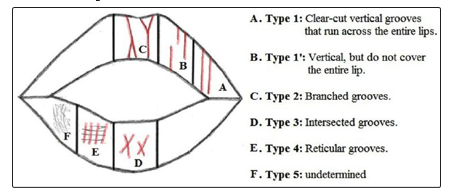
Figure 1: Suzuki and Tsuchihashi's classification of lip prints
After the lip print patterns were counted both upper and lower lip prints with Stereomicroscope as shown in Figure 2, the mean value is calculated. This value represented the approximate number of ridges for the particular individual. The significance of this value was determined.
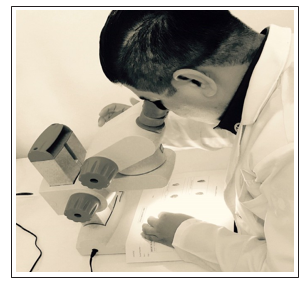
Figure 2: Stereomicroscope (Stemi DV4)
Data analysis was done using IBM SPSS version 22 to get distribution of lip print patterns between male and female. Ethical approval was obtained from Institutional Review Board of Defence Services Medical Research Centre (DSMRC, IRB, FWA - 00023030, IORG - 0009413, IRB - 00011205).
Results
The present study was conducted to access the quadrant wise and gender wise predilection of Lip print patterns. Lip print impressions were obtained from both males and females and were classified by Suzuki’s classification. The distribution of lip print types in males and females in each quadrant were compared. Table 1 depicts the overall results of the present study. The Type I’ pattern did not occur both males and females among all quadrants. The distribution of various types of lip prints in all the four quadrants of both males and females were summarized (Table 1 and Figure 3).
Table 1: Frequency of lip print patterns among males and females
|
Quadrants |
Type I |
Type II |
Type III |
Type IV |
Type V |
P value |
|||||
|
Male |
Female |
Male |
Female |
Male |
Female |
Male |
Female |
Male |
Female |
|
|
|
RUQ |
50 |
6 |
28 |
73 |
26 |
24 |
5 |
4 |
1 |
3 |
0.001 |
|
LUQ |
34 |
15 |
38 |
57 |
29 |
28 |
4 |
7 |
5 |
3 |
0.14 |
|
RLQ |
39 |
17 |
41 |
26 |
24 |
49 |
5 |
13 |
1 |
5 |
0.001 |
|
LLQ |
28 |
17 |
37 |
29 |
30 |
35 |
10 |
24 |
5 |
5 |
0.04 |
RUQ = Right Upper Quadrant RLQ = Right Lower Quadrant
LUQ = Left Upper Quadrant LLQ = Left Lower Quadrant
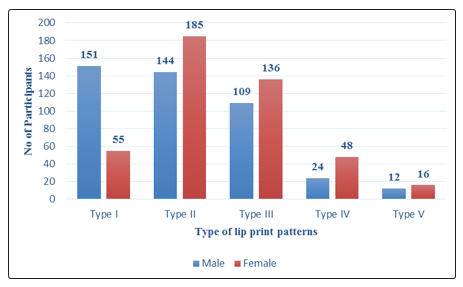
Figure 3: Frequency of lip print patterns among males and females
Right Upper Quadrant
Type I pattern was seen in 45.45% of males and 5.46% of females. Type II pattern was observed in 25.45% of males and 66.36% of females. Type III pattern was noted in 23.64% of males and 21.82% of females. Type IV pattern was seen in 4.54% of males and 3.64% of females. Type V pattern was seen in 1% of males and 2.72% of females. The distribution of the Lip print types was seen to be statistically significant with P< 0.001.
Left Upper Quadrant
Type I pattern was seen in 31% of males and 13.63% of females. Type II pattern was observed in 34.54% of males and 51.82% of females. Type III pattern was noted in 26.36% of males and 25.45% of females. Type IV pattern was seen in 3.64% of males and 6.36% of females. Type V pattern was seen in 4.55% of males and 2.72% of females. The distribution of the Lip print types was not statistically significant p> 0.05.
Right Lower Quadrant
Type I pattern was seen in 35.45% of males and 15.45% of females. Type II pattern was observed in 37.27% of males and 23.64% of females. Type III pattern was noted in 21.82% of males and 44.54% of females. Type IV pattern was seen in 4.55% of males and 11.82% of females. Type V pattern was seen in 1% of males and 4.55% of females. The distribution of the Lip print types was seen to be statistically significant p< 0.001.
Left Lower Quadrant
Type I pattern was seen in 25.45% of males and 15.45% of females. Type II pattern was observed in 33.64% of males and 26.36% of females. Type III pattern was noted in 27.27% of males and 31.82% of females. Type IV pattern was seen in 9.09% of males and 21.81% of females. Type V pattern was seen in 4.55% of males and 4.55% of females. The distribution of the Lip print types was statistically significant p< 0.05.
Table 2: Relationship between lip print patterns and blood groups
|
Lip Print Patterns |
Blood Groups |
p value |
||||
|
A |
B |
C |
D |
|||
|
RUQ |
Type I |
7 |
16 |
7 |
26 |
0.390 |
|
Type II |
20 |
27 |
16 |
38 |
||
|
Type III |
12 |
8 |
5 |
25 |
||
|
Type IV |
2 |
4 |
0 |
3 |
||
|
Type V |
2 |
0 |
1 |
1 |
||
|
LUQ |
Type I |
6 |
15 |
8 |
20 |
0.412 |
|
Type II |
20 |
24 |
12 |
39 |
||
|
Type III |
13 |
12 |
6 |
26 |
||
|
Type IV |
0 |
4 |
2 |
5 |
||
|
Type V |
4 |
0 |
1 |
3 |
||
|
RLQ |
Type I |
14 |
17 |
7 |
18 |
0.220 |
|
Type II |
12 |
16 |
11 |
28 |
||
|
Type III |
12 |
13 |
7 |
41 |
||
|
Type IV |
3 |
7 |
4 |
4 |
||
|
Type V |
2 |
2 |
0 |
2 |
||
|
LLQ |
Type I |
7 |
16 |
7 |
15 |
0.273 |
|
Type II |
14 |
16 |
10 |
26 |
||
|
Type III |
12 |
12 |
8 |
33 |
||
|
Type IV |
5 |
8 |
4 |
17 |
||
|
Type V |
5 |
3 |
0 |
2 |
||
Discussion
Crimes challenge the society in detection, diagnosis and identification of criminals. Establishing a person’s identity can be a very difficult process. Dental, fingerprint and DNA comparisons are probably the most common techniques used. One of the most interesting methods of human identification is human lips recognition. Lip prints can be obtained at the crime scene from clothing, cups, glasses, cigarettes, windows and doors. In the present study Type II lip print pattern was common in all the quadrant of males and females.
Amith V in their study found Type I’ to be the most predominant pattern in first and second quadrant, Type II in third and fourth quadrant among males and females, Type I pattern was predominant in all the quadrants. Manypady compared Indian and Chinese individuals and found that the incidence of Type II pattern was highest among Indians.
In our studied Myanmar population, we found Type II as the most predominant pattern in all the four quadrants followed by Type I, Type III, and Type V. Unfortunately, Type I’ pattern was not seen in all quadrants.
Annie J, et al. in their study among people of Kerala found Type IV (reticular) pattern to be the most predominant pattern in the middle portion of upper lip. Tsuchihashi Y, et al. found type III pattern as the most predominant pattern in their study population (31.3% males and 33.3% females) followed by Type I, Type II, Type IV then Type V pattern.
In this study, there was significant difference between male and female lip print patterns. Type II was most common in both genders. Type I was more common in male and Type II, III and IV were more common in female. The most common lip print patterns in left lower quadrant was Type III and Type II pattern was most common in other three quadrants. The least common pattern was Type V in all quadrants for both genders. No correlation was found between lip print patterns and ABO blood group system. Lip print pattern can be used as an additional tool for personal identification and gender determination.
Our finding was not similar to any other studies. Various studies have shown that the lip print patterns formed revealed a population wise dominance that is a particular population is showing predominance of a particular lip print type. This is potentially useful tool for identification. One common problem that is encountered during the cheiloscopy study is that of smudging or spoiling of lip prints leading to unidentifiable marks.
But in our study, none of the impression was spoiled. The use of lip prints is not limited to visible traces left at a scene of crime. Latent or invisible prints can be developed or made visible in a manner similar to that used for fingerprints. Ball stated that latent lip prints would be available at all crime scenes as the vermilion borders of lips have minor salivary glands and sebaceous glands with latter being principally present around edges of the lip associated with hair follicles, sweat glands in between, and secreting oils. It is these secretions and continual moisturizing by the tongue due to occasional sebaceous glands present on the lip, there are chances for the presence of the latent lip prints on items such as glass. Lip prints can be obtained up to 30 days after being produced.
Conclusion
From the current study, it was concluded that there are significant between gender and lip prints but no significant correlation exists between blood group and lip prints. Lip prints play a vital role in identification because they are unique. The importance of this study is that lip prints may be of great use in criminal cases, similar to fingerprints. Different patterns of lip prints should be studied further, and their relation with blood groups must be studied well in large population samples [7].
Acknowledgement
We would like to express our thanks to Brigadier General Tin Maung Hlaing, Colonel Thein Zaw for their opinions and guidance. We have to pay special thanks to Lt. Col/ Major Khun Htun Hlaing for their kind support and invaluable suggestions. Lastly, we owe our sincere and earnest thanks to participants who had actively cooperated and participated during the whole period of this study.
References
- Sharma P, Saxena S, Rathod V (2009) Cheiloscopy: The study of lip prints in sex identification. J Forensic Dent Sci 1: 24-27.
- Prabhu RV, Dinkar AD, Prabhu VD, Rao PK (2012) Cheiloscopy: Revisited. J Forensic Dent Sci 4: 47-52.
- Randhawa K, Narang RS, Arora PC (2011) Study of the effect of age changes on lip print pattern and its reliability in sex determination. J Forensic Odontostomatol 29: 45-51.
- Annie J Verghese, M Somasekar, Umesh Babu R (2010) A study on lip print types among the people of kerala. J Indian Acad Forensic Med 1: 6-7.
- Rachana V Prabhu, Ajit Dinkar, Vishnudas Prabhu (2012) A study of lip print pattern in Goan dental students - A digital approach. Journal of forensic and legal medicine 7: 390-395.
- Amith HV, Anil V Ankola, Nagesh L (2011) Lip prints- can it aid in individual identification. J Oral Health Comm Dent 3: 113-118.
- L Vamsi Krishna Reddy (2011) Lip Prints: An overview in Forensic Dentistry. J Adv Dental Research 1: 17-20.