

Advancements in Journal of Urology and Nephrology(AJUN)
ISSN: 2689-8616 | DOI: 10.33140/AJUN
Impact Factor: 1.0


Research Article - (2022) Volume 4, Issue 2
Age Distribution of Cancer in Jamaica 2008
Received Date: Dec 17, 2022 / Accepted Date: Dec 24, 2022 / Published Date: Dec 29, 2022
Copyright: ©LA McLish. This is an open-access article distributed under the terms of the Creative Commons Attribution License, which permits unrestricted use, distribution, and reproduction in any medium, provided the original author and source are credited
Citation: Mclish, L, A. (2022). Age Distribution of Cancer in Jamaica 2008. Adv J Uro Nephro, 4(2), 60-65.
Abstract
Objective: To investigate the age distribution of cancer occurrence in Jamaica during 2008.
Methods: The distribution of cancer in Jamaica was investigated in the year 2008. The study included all fourteen parishes. Data was obtained from the Jamaica Cancer Registry located in the Pathology Department of the University of the West Indies. Population denominators were obtained from the 2011 census taken by the Statistical Institute of Jamaica. The statistical package which was used to analyze the data was SPSS.
Results: A total of 2491 cases of cancer were examined across all parishes. It was determined that the crude incidence rate (178.6) was largest in Kingston and St Andrew. In St. Catherine, St. Thomas, Clarendon, Portland, St. Mary and Manchester the crude incidence rates were 118.9, 80.9, 67.7, 62.3, 58.1 and 54.8 respectively. Hence there were parishes such as St. Thomas and St. Mary having large crude incidence rates. It was determined in 2008 that the leading cancers in Jamaica were the following in descending order, prostate cancer, cancer of the breast, cancer of the cervix, cancer of the lung, cancer of the colon and metastatic disease.
Conclusion: When all cancer cases in Jamaica for 2008 were considered, the highest frequency occurred in the age group 65 to 69 years. The mean age at which cancer was diagnosed was 59.1 years.
Introduction
Since the inception of the Jamaica Cancer Registry in 1958 the in¬cidence of cancer in Jamaica has been monitored by reports being produced regularly [1]. These reports are based upon the incidence of cancer in males and females in Kingston and St. Andrew which forms the population base of the registry [1,2]. Gibson et al. (2008) determined that the leading sites of cancer were prostate, breast, large bowel, bronchus, cervix uteri and lymphoma [1]. They ascer¬tained that in males prostate was the leading site in those aged 60 years and above, cancer of the lung for those aged 25 – 59 years [1]. They also determined that breast cancer was the commonest site in women aged 25 years and over. They reported that the ma¬jority of cases of both breast cancer and cancer of the cervix uteri occurred between the ages of 25 and 59 years. Based upon the discourses, this present study has been undertaken to examine the distribution of cancers in Jamaica in the year 2008. This study en¬capsulated all fourteen parishes.
Methods
Study Population
This research project consists of persons from all parishes in Ja-maica. A map of Jamaica is shown in Figure 1 [3].

Figure 1: Map of Jamaica showing all the parishes
Data was obtained from the Jamaica Cancer Registry located in the Pathology Department of the University of the West Indies. The methodology of the registry has been previously stated [4,5]. Cases are registered from information gleaned from public and private hospitals and general practitioners in Kingston and St. An-drew then verified by pathologists at Jamaica Cancer Registry in accordance with standard techniques of registration [6].
Data Extraction
Variables that were obtained from the Jamaica Cancer Registry included cancer code, date of diagnosis, age at diagnosis, perma-nent residence, parish of birth, diagnosis, gender, smoker, source of case and date of death. The codes used for classification of the various types of cancers were cross-checked using the tenth edi¬tion of the International Statistical Classification of Diseases and Related Health Problems (ICD – 10) [7]. Population denominators were obtained from the 2011 census taken by the Statistical Insti¬tute of Jamaica, Kingston, Jamaica [8].
Statistical Analysis
The statistical package which was used to analyze the collected data was SPSS and Microsoft excel. The data was initially stored in an excel database. The crude incidence rate was also determined.
Results
Table 1: Frequency table showing grouped data of persons diagnosed with Cancer in Jamaica 2008
|
Age (yr) |
Frequency |
|
0 – 4 |
18 |
|
5 – 9 |
8 |
|
10 – 14 |
9 |
|
15 – 19 |
11 |
|
20 – 24 |
29 |
|
25 – 29 |
52 |
|
30 – 34 |
79 |
|
35 – 39 |
112 |
|
40 – 44 |
156 |
|
45 – 49 |
201 |
|
50 – 54 |
231 |
|
55 – 59 |
262 |
|
60 – 64 |
288 |
|
65 – 69 |
302 |
|
70 – 74 |
273 |
|
75 – 79 |
216 |
|
80 – 84 |
145 |
|
85 – 89 |
73 |
|
90 – 94 |
17 |
|
95+ |
9 |
|
TOTAL (N) |
2491 |
Table 2: Frequency table showing grouped data of men diagnosed with Prostate cancer in Jamaica 2008
|
Age (yr) |
Frequency |
|
0 – 4 |
0 |
|
5 – 9 |
0 |
|
10 – 14 |
0 |
|
15 – 19 |
0 |
|
20 – 24 |
0 |
|
25 – 29 |
0 |
|
30 – 34 |
0 |
|
35 – 39 |
0 |
|
40 – 44 |
2 |
|
45 – 49 |
10 |
|
50 – 54 |
25 |
|
55 – 59 |
50 |
|
60 – 64 |
99 |
|
65 – 69 |
86 |
|
70 – 74 |
96 |
|
75 – 79 |
54 |
|
80 – 84 |
40 |
|
85 – 89 |
27 |
|
90 – 94 |
4 |
|
95+ |
0 |
|
TOTAL (N) |
493 |
Table 3: Frequency table showing grouped data of women diagnosed with Breast Cancer in Jamaica 2008
|
Age (yr) |
Frequency |
|
0 – 4 |
0 |
|
5 – 9 |
0 |
|
10 – 14 |
0 |
|
15 – 19 |
0 |
|
20 – 24 |
1 |
|
25 – 29 |
3 |
|
30 – 34 |
10 |
|
35 – 39 |
26 |
|
40 – 44 |
40 |
|
45 – 49 |
52 |
|
50 – 54 |
41 |
|
55 – 59 |
39 |
|
60 – 64 |
35 |
|
65 – 69 |
29 |
|
70 – 74 |
25 |
|
75 – 79 |
20 |
|
80 – 84 |
18 |
|
85 – 89 |
5 |
|
90 – 94 |
2 |
|
95+ |
1 |
|
TOTAL (N) |
347 |
The crude incidence rate (CIR) was calculated by dividing the cancer frequency in a specific parish by the population size and multiply-ing the result by 100000. The data was displayed in increasing order in Figure 2.
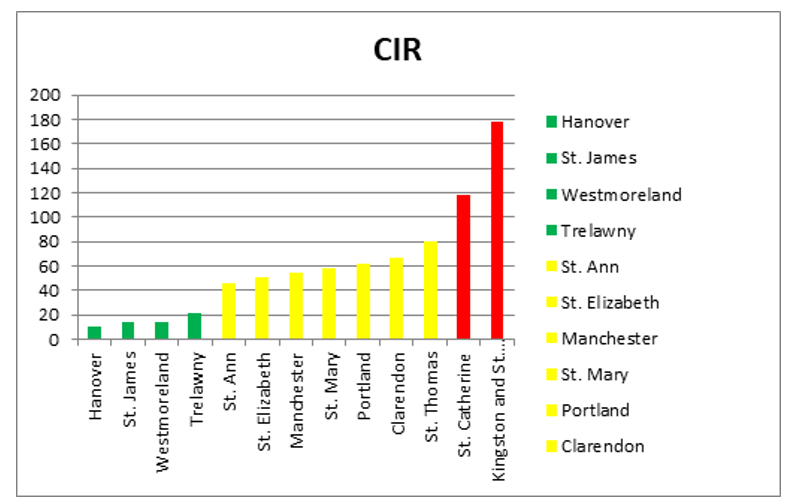
Figure 2: Bar chart comparing the crude incidence rate of all parishes
Table 4: The top five cancers in Jamaica 2008
|
Type of Cancer |
Frequency |
Population |
Crude Incidence Rate |
Mean Age |
|
Prostate Cancer |
489 |
1334533 |
36.6 |
68.27 yr |
|
Cancer of the Breast |
351 |
1363450 |
25.7 |
56.19 yr |
|
Cancer of the Cervix |
317 |
1363450 |
23.2 |
45.64 yr |
|
Cancer of the Lung |
190 |
2697983 |
7.0 |
65.43 yr |
|
Cancer of the Colon |
142 |
2697983 |
5.3 |
63.97 yr |
Discussion
Figure 2 shows a bar chart illustrating the CIR for all parishes. When the parishes are analyzed based on the CIR it can be clearly seen that persons are more prone to develop cancer in parishes such as Kingston and St. Andrew and St. Catherine and are least prone to develop cancer in Trelawny, Westmoreland, St James and Hanover. Jahn, Giovannucci and Stampfer (2015) stated that sev¬eral risk factors such as high body mass index, smoking, reduced lycopene intake have been observed to produce lethal or aggres- sive prostate cancer [9]. When all cancers were combined for 2008 it was determined in descending order that the top five cancers were prostate cancer, cancer of the breast, cancer of the cervix, cancer of the lung and cancer of the colon. Metastatic disease was sixth in that list. Table 4 displays a list of the top 5 cancers in Jamaica 2008, the crude incidence rate for each type of cancer has been included. Table 4 shows that prostate cancer, breast can¬cer and cancer of the cervix are extremely dangerous cancers in Jamaica. They are more than 3 times more dangerous than lung cancer and colon cancer. In the case of prostate cancer it is more than 5 times more dangerous than colon or lung cancer when they are compared using the crude incidence rate. This agrees with the study done by Gibson et al. (2008) who stated that prostate cancer is the leading cancer in Jamaican men [1]. Blake et al. (2002) stat¬ed that prostate cancer was the commonest cause of cancer death in this gender [10].
The results in table 4 also agrees with Gibson et al. (2010) who determined that in males the leading site for cancer was prostate followed by bronchus and large bowel and that in females breast was the leading site followed by cervix uteri and large bowel [2]. Table 4 displays some descriptive statistics regarding the major cancers identified in Jamaica prior to this discourse. The mean age shows that breast and cervical cancer appear early in the popula-tion however prostate, lung and colon cancers are more pervasive later in life.
All cancers across all parishes were summed. Table 1 shows the frequency distribution of ages which were grouped so that the width of each interval is 5. The total number of cancer cases in Jamaica in 2008 was 2491. The highest frequency occurred in the age group 65 to 69 years. The mean age at which cancer was diag¬nosed was 59.1 years. The median was 61 years and the range was the difference between 61 years and 0.5 years.
Table 2 shows the distribution of prostate cancer in Jamaica 2008. The number of men diagnosed with prostate cancer in 2008 was 493. Their ages ranged from 40 to 92 years. The mean age was 68.3 years and the median was 68 years. The largest frequency occurred in the age group 60 to 64 years.
The frequency table displaying the distribution of breast cancer in Jamaica 2008 is shown in table 3. The number of women diag-nosed with breast cancer in 2008 was 347. Their ages ranged from 23 years to 95 years. The largest frequency occurred in the age group 45 to 49 years. The mean age was 56.2 years and the median was 55 years.
Limitations
In 2008 and earlier there were two major cancer treatment centres in Jamaica for the public. These were Kingston Public hospital in Kingston and Cornwall Regional hospital in St. James. The ma¬chines they had at that time were cobalt machines. Hence, many cases would be referred to Kingston Public hospital from other parishes or to Cornwall Regional hospital. This would depend on the proximity and the accessibility, meaning the length of the wait¬ing list. Staff at the Jamaica Cancer Registry only gets data from hospitals and private sources in Kingston and St. Andrew Jamaica. Hence, some patients from the western end of the island such as the parishes of St. James, Westmoreland, Trelawny and Hanover would not be recorded based on the present practise. Hence, these would contribute to errors in the data from parishes in those re¬gions of the island. In Kingston at that period, there was the Radi¬ation Oncology Centre of Jamaica which was established in 2001.
This is a private centre for the treatment of cancer. Hence, the lim¬itation here would be your socioeconomic status. There would also be persons who would seek alternative ways to treat their cancer.
Conclusion
This study showed that when all cancers were considered in Ja-maica in 2008, the highest frequency occurred in the age group 65 to 69 years. When grouped data were analyzed, no age group was immune to cancer. Hence, there is a multiplicity of factors that predisposes an individual to develop cancer. This research also extracted the top 5 cancers in Jamaica in 2008 which agreed with other studies [1,2]. It can be deduced from these results that screening is vital in reducing the mortality associated with cancer.
Acknowledgement
I wish to thank Professor Mitko Voutchkov for his continued guid¬ance. I also wish to express posthumous thanks to Professor Barrie Hanchard who provided insightful suggestions and access to the Jamaica Cancer Registry located in the Pathology Department of the University of the West Indies.
Synopsis
This study examined the age distribution of cancer in Jamaica 2008. A survey of the most prevalent cancer in Jamaica 2008 was included.
References
- Gibson, T. N., Blake, G., Hanchard, B., Waugh, N., & Mc-Naughton, D. (2008). Age-specific incidence of cancer in Kingston and St Andrew, Jamaica, 1998–2002. West Indian Med J, 57(2), 81-89.
- Gibson, T. N., Hanchard, B., Waugh, N., & McNaughton, D. (2010). Age-Specific Incidence of Cancer in Kingston and St Andrew, Jamaica, 2003-2007. West Indian Medical Journal, 59(5), 456-464.
- https://maps-jamaica.com/map-of-jamaica-parishes-and-cap-itals
- Bras, G. (1966). Cancer incidence in Jamaica, Kingston and St Andrew 1958–1963. Cancer incidence in five continents, 1, 84-89.
- Brooks, S. E., & Wolff, C. (1991). Age-specific incidence of cancer in Kingston and St. Andrew, Jamaica. Part I: 1978-1982. The West Indian Medical Journal, 40(3), 127-128.
- Skeet RG. Quality and quality control. In: Jensen OM, Parkin DM, MacLennon R, Muir CS, Skeet RG, eds. Cancer Registration: Principles and methods (IARC Scientific Publications no. 95). Lyon; 1991: 101 – 107.
- The International Statistical Classification of Diseases andRelated Health Problems (ICD – 10), 10th edition.
- http://statinja.gov.jm/Census/PopCensus/Populationbyfive-yearsagegroup.aspx
- Jahn, J. L., Giovannucci, E. L., & Stampfer, M. J. (2015). The high prevalence of undiagnosed prostate cancer at autopsy: implications for epidemiology and treatment of prostate cancer in the Prostateâ?specific Antigenâ?era. International journal of cancer, 137(12), 2795-2802.
- Blake, G., Hanchard, B., Mitchell, K., Simpson, D., Waugh, N., Wolff, C., & Samuels, E. (2002). Jamaica cancer mortality statistics, 1999. The West Indian Medical Journal, 51(2), 64-67.