

Archives of Epidemiology & Public Health Research(AEPHR)
ISSN: 2833-4353 | DOI: 10.33140/AEPHR
Impact Factor: 1.98


Review Article - (2026) Volume 5, Issue 2
Ad Hoc Early Lessons Extracted from Search for Legionella Data in Sicily and Cyprus: An Evidence-Based Experience
 , Layla Rahimpour 2 and Lee P. Gary, Jr 3,4 *
 2Department of Public Health, University of Malta, Msida, Malta
3Office of Faculty Research, University of Makeni, City of Makeni, Sierra Leone
4Current Address: Department of Public Health, Faculty of Medicine and Surgery, University of Malta, Msida, Malta
Received Date: Jun 29, 2026 / Accepted Date: Jul 24, 2026 / Published Date: Jul 31, 2026
Copyright: ©2026 Lee P. Gary, Jr. et, al. This is an open-access article distributed under the terms of the Creative Commons Attribution License, which permits unrestricted use, distribution, and reproduction in any medium, provided the original author and source are credited.
Citation: Pavlova, E., Rahimpour, L., Gary Jr., L. P. (2026). Ad Hoc Early Lessons Extracted from Search for Legionella Data in Sicily and Cyprus: An Evidence-Based Experience. Arch Epidemiol Pub Health Res, 5(2), 01-05.
Abstract
Our research project was started to ascertain and to document the extent of public information vailable in Sicily and Cyprus for Legionella Bacteria, seeking to extend our Maltese Legionella Project begun in Malta. The paucity of documented information in Sicily and Cyprus about Legionella Diseases was surprising, halting and sidetracking our vision of creating a Mediterranean Legionella Impact Spectrum, specifically to monitor and to quantify sources of Legionella Diseases and theirrelated impact on the population among Mediterranean Islands, advancing our research from Malta to its island neighbors, Sicily and distant Cyprus.
Challenged byane unexpected dearth of public information about Legionella Bacteria in Sicily and Cyprus, we offer our Lessons Learned from early research, enhanced with an evidence-based analysis with added explanation and interpretation.
Keywords
Legionella Bacteria, Legionnaires’ Disease, Sicily, Cypress, Malta, Mediterrarian Legionella Impact Spectrum, and Evidence-Based Analysis
Legionella Bacteria: Sicily Experience
Legionnaires’ Disease has been under Italy’s enhanced national surveillance since 1993, Sicily has been part of that system from the beginning. Publicly accessible Surveillance Summaries from the Istituto Superiore di Sanita (ISS) and European Centre for Disease Prevention and Control (ECDC) do not identify a specific “first case” in Sicily, although Sicilian notifications appear in the early years of the national surveillance system. Our curiosity was peaked that no credible source isolates the exact first Sicilian case by date or municipality.
ISS analyses consistently show that central and southern Italian regions, including Sicily, notify only about 30 percent of expected cases, while six northern regions account for the roughly 78 percent of all national notifications. This real pattern reflects structural under ascertainment, we believe, not genuinely low incidence. In Sicily, reported numbers do remain low largely since diagnostic testing has historically been inconsistent, with many hospitals relying on general pneumonia diagnoses rather than Legionella-specific testing.
For many years, urinary antigen tests and PCR were not uniformly adopted across Sicilian facilities, meaning a substantial proportion of true cases were never laboratory-confirmed.
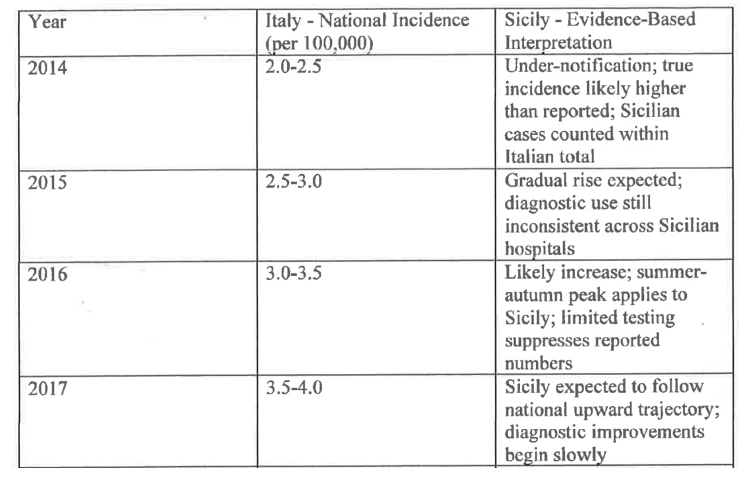
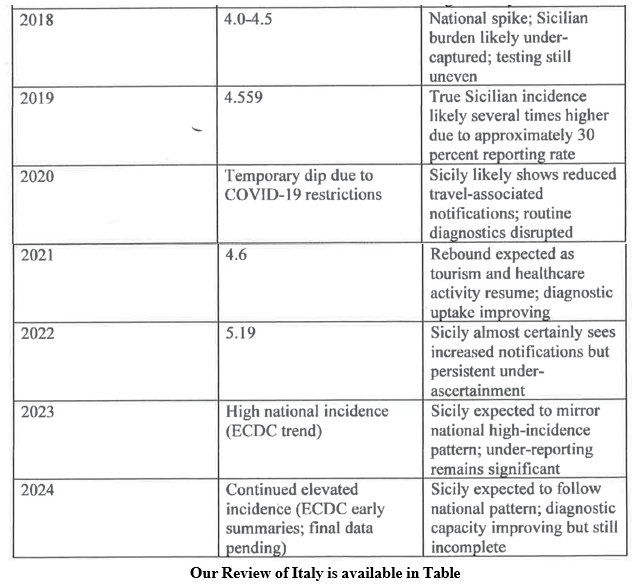
A key methodological point, we see, is that Sicily’s statistics are embedded within Italy’s national totals. In ISS and ECDC publications, Sicilian notifications are counted within the Italian aggregate. Region-specific table exist in technical reports, but they are not routinely published in a way that allows for a complete, year-by-year reconstruction for Sicily alone, generating disappointment for our Maltese Legionella Project.
Therefore, precise Sicily-only incidence values for 2014-2024 are not available in open sources for comparison, for example with Malta, and any good attempt to produce exact numbers would be speculative. The most academically defensible approach for us is to use comparable national incidence data as an anchor and interpret Sicily’s situation by considering the lingering documented regional under-reporting.
The national incidence for Italy roses from 1.05 per 100,000 in 2004 to 4.56 per 100,000 in 2019 (ISS, National Epidemiological Review 2004-2019). The ECDC surveillance reports place Italy at approximately 4.6 cases per 100,000 in 2021 and about 5.19 per 100,000 in 2022 – among the highest in Europe. Sicily almost certainly follows this upward trajectory but with lower reported numbers due to the under notification documented by ISS.
Recent improvements in diagnostic testing capacity - including a wider availability of urinary antigen tests, increased clinician awareness, and more standardized hospital protocols – have contributed to a gradual rise in detected cases. This explains why national incidence has been increasing steadily and why Sicily’s reported numbers, although still incomplete, show a slow an upward trend that mirrors national patterns. Sicily’s climate supports the same summer-to- early autumn seasonal peak observed nationally for Italy. The island’s tourism sector also has a meaningful share of travel associated cases, although these are not broken out by region in public datasets. Many travel-associated cases linked to Sicily are diagnosed in the visitor’s home country, meaning the exposure is Sicilian but the notification is foreign. These cases do not appear in Sicily’s regional totals, further obscuring the island’s true Legionella burden.
Our Interpretation: Evidence-Based Analysis
Across the last decade, Sicily’s reported numbers remain low, but this, we do believe, is a surveillance artifact, not a reflection of low disease burden. ISS explicitly documents that southern regions, including Sicily, notify only a fraction of expected cases, and that most Italian notifications come from a small group of northern regions. Because Sicilian cases of Legionnaires’ Disease are statistically merged with the rest of Italy in national totals, Sicily’s contribution is real, but not easily separable in public datasets.
When national incidence reaches 4 to 5 cases per 100,000, Sicily’s true incidence is likely in a similar range, but is only partially captured by notifications. The most academically defensible conclusion, we believe for our research, is that Sicily follows the national trend with Legionnaires’ Disease, but its surveillance system captures a minority of true cases –and much goes undocumented, weakening preparedness and readiness.
Improvements in diagnostic practices are gradually increasing detection, but the island’s true Legionella burden remains underestimated.
Legionella Bacteria: Cyprus Experience
Cyprus participates in EU-wide Legionnaires’ Disease surveillance through the European Surveillance System (TESSy), coordinated by European Centre for Disease Prevention and Control (ECDC). Unlike larger EU countries, Cyprus reports as a singular national unit, and no sub-national incidence tables for Cyprus are publicly released. The ECDC Annual Epidemiological Reports confirm that Cyprus consistently notifies and submits a small number of cases each year, but this must be interpreted cautiously because small-population countries show high year-to year variability and are strongly affected by weak diagnostic practices.
ECDC surveillance also shows that Cyprus regularly appears as an exposure location for travel-associated Legionnaires’ disease, meaning that some infections linked to Cyprus are diagnosed abroad and therefore do not appear in Cyprus’ national totals. This pattern is visible in ELDSNet travel-associated cluster listings, where accommodation sites in EU/EEA countries are monitored for potential Legionella exposure.
As with many Mediterranean countries, Cyprus has environmental conditions that support Legionella proliferation, including warm temperatures, seasonal tourism, and widespread use of cooling systems. However, publicly accessible Cyprus-specific incidence values for each year from 2014 to 2024 are not published in a consolidated national report, and the ECDC’s Surveillance Atlas requires manual extraction for each year.
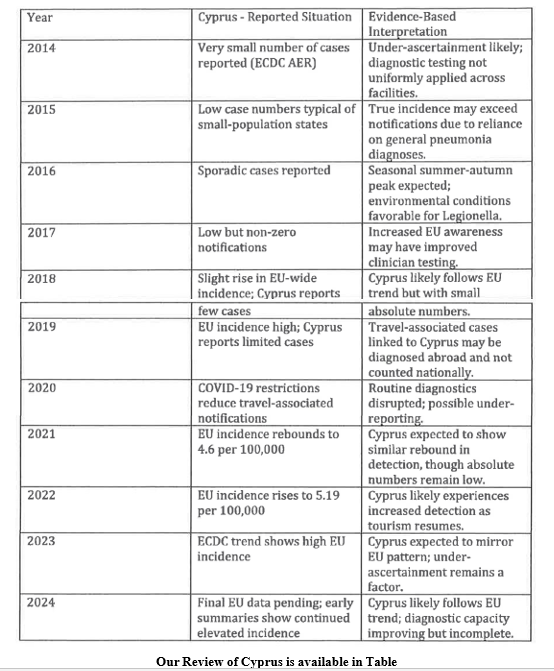
Therefore, the best academically defensible approach mirrors the Sicily methodology: use EU-level data as an anchor, integrate Cyprus’ reported case counts when available, and interpret trends in light of diagnostic capacity and travel-associated case patterns.
Our Interpretation: Evidence-Based Analysis
Across the last decade, Cyprus’ reported Legionnaires’ disease numbers remain low, but this reflects population size and diagnostic limitations, not necessarily a low true burden. ECDC data show that Mediterranean countries with strong tourism sectors often have travel-associated Legionella cases diagnosed abroad, which reduces their national notification totals.
Cyprus fits this pattern, as indicated by ELDSNet monitoring of accommodation-linked clusters. When EU incidence reaches 4 to 5 cases per 100,000, Cyprus’ true incidence is likely in a comparable range, but only partially captured by national surveillance.
Improvements in diagnostic practices, including a wider use of urinary antigen tests and PCR, are gradually increasing detection, but the true burden of Legionella Diseases, we believe, remains underestimated for Cyprus.
Disclosures
Acknowledgement
We recognize and thank Professors Neville Calleja, Charmaine Gauci and Pierre Mallia at the University of Malta for their untiring encouragement and guidance with our project – and the unlimited assistance of Krystle Attard. Lee Gary thanks the US Fulbright Foreign Scholarship Board for a Fulbright Teaching and Research Scholar Award at the University of Malta for 2025-2026.
Declaration of Conflicting Interest
Authors declare no competing issues nor Conflict of Interest with this project or any other conflict with the content of the manuscript. All agree to journal submission when proper.
Funding Statement
Authors volunteer that their work was independent and not supported by funding from any private organizations or public agencies. Office expenses for production of the manuscript were covered by SMS- USA, owned by Lee P. Gary Jr., Corresponding Author.
Data Availability
All data for our research study is presented within this article and is readily available from the Lead and/or Corresponding Author with a written or electronic request from any interested individual or organization.
Ethical Approval & Informed Consent Statement
Authors understand that no authorization from an Institutional Review Board or agency was required according to the nature and focus (plants) of our research project.
References
- Istituto Superiore di Sanita (ISS). Legionellosi in Italia - Rapporti Annuali.
- Istituto Superiore di Sanita (ISS). Legionellosi in Italia:Trend Epidemiologico 2004-2019.
- European Centre for Disease Prevention and Control (ECDC). Legionnaires’ Disease Annual Epidemiological Reports (2021, 2022, 2023).
- ECDC Surveillance Atlas of Infectious Diseases.
- European Centre for Disease Prevention and Control (ECDC). Annual Epidemiological Reports for Legionnaires’ Disease (2014-2024).
- ECDC Surveillance Atlas of Infectious Diseases (TESSy data extraction).
- ECDC ELDSNet Travel-Associated Legionnaires’ Disease Accommodation Site Listings