

Advances in Bioengineering and Biomedical Science Research(ABBSR)
ISSN: 2640-4133 | DOI: 10.33140/ABBSR

Impact Factor: 1.7

Short Communication - (2019) Volume 2, Issue 4
Absolute Stability of Control System with Electro Magneto Elastic Actuator for Nanobioengineering and Nanobiomedical Science Research
Received Date: Sep 12, 2019 / Accepted Date: Sep 22, 2019 / Published Date: Sep 25, 2019
Copyright: ©Copyright: ©2019 Afonin SM. This is an open-access article distributed under the terms of the Creative Commons Attribution License, which permits unrestricted use, distribution, and reproduction in any medium, provided the original author and source are credited.
Abstract
The stationary set of the control system of the hysteresis deformation of the electro magneto elastic actuator is the segment of the straight line. The aim of this work is to determine the condition of the absolute stability on the derivative for control system of the deformation of the electro magneto elastic actuator for nanobioengineering and nanobiomedical science research. The frequency methods for Lyapunov stable control system are used to calculate the absolute stability of the control system with electro magneto elastic actuator. In result we obtained the condition of the absolute stability on the derivative for the control system with the electro magneto elastic actuator for nanobioengineering and nanobiomedical science research.
Keywords
Condition absolute stability, Control system, Electro magneto elastic actuator, Piezoactuator, Deformation, Hysteresis loop, Butterfly characteristic, Stationary set, Transfer functionIntroduction
The control systems with electro magneto elastic actuator on piezoelectric, electrostrictive and magnetostrictive effects solves problems of the precise matching in the nanotechnology, the compensation of the temperature and gravitational deformations, the atmospheric turbulence by the wave front correction, the adjustment of the adaptive optic systems [1 − 14].
The piezo actuator for nanobioengineering and nanobiomedical science research is used in the scanning tunneling microscope, the scanning force microscope, the atomic force microscope, in the gene manipulator [15-29].
The condition of the absolute stability on the derivative for control system of the deformation of the electro magneto elastic actuator is calculated. The problems of using criteria absolute stability of the control system with electro magneto elastic actuator for nanobioengineering and nanobiomedical science research are discussed. The stationary set of the control system of the deformation of the electro magneto elastic actuator is determined.
Aim
The aim of this work is to calculate the condition of the absolute stability on the derivative for control system of the deformation of the electro magneto elastic actuator for nanobioengineering and nanobiomedical science research.Method
The frequency methods for Lyapunov stable control system are used to determine the condition of the absolute stability of control system with electro magneto elastic actuator for nanobioengineering and nanobiomedical science research.
Result
We determined the expression for the sufficient absolute stability condition of the control system with the hysteresis nonlinearity of the electro magneto elastic actuator using the Yakubovich absolute stability criterion with the condition on the derivative, which is the development of the Popov absolute stability criterion [2].
For the Lyapunov stable control system and the Yalubovich absolute stability criterion for the systems with the single hysteresis nonlinearity provides the simplest and pictorial representation of results of the investigation of the stability of the strain control system with the electro magneto elastic actuator for nanobioengineering and nanobiomedical science research.
We use the transfer function of the linear part of the system Wij (p) and the hysteresis function of the relative deformation Sj of the electro magneto elastic actuator for description of the system [16].
We have the description of the hysteresis nonlinearity of the actuator in the form

where Sj is the relative displacement of the cross section of the actuator along j axis, Ψi is the control parameter of the actuator along i axis. The hysteresis function Sj at each time instant t depends on the behavior of the function Ψi=Ei or Ψi =Hi, where Ei and Hi are the electric field strength and the magnetic field strength on the interval [0,t], the value of t, the initial value Sj(0) , and the sign of the rate Ψ′i of the field strength variation.
We consider the alternating sign hysteresis characteristics deformation of the piezoactuator on Figure 1. The set L[Ei (0)] is thevertical segment [S0 - S0 ] bounded by the points of intersection of j J the ordinate axis with the hysteresis loop at the maximum admissible field strength in the piezoactuator.
We receive the stationary set for the deformation of the piezoactuator on Figure 1 for the stable linear part of the control system. Therefore, we draw the straight line L with the equation
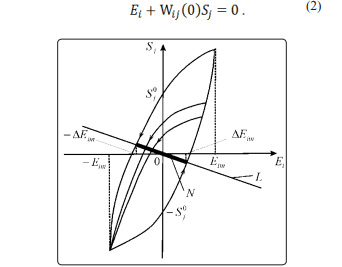
Figure 1: Hysteresis type characteristic deformation of piezoactuator
We have the value of the transfer function Wij (0) of the linear part of the control system for the deformation of the piezoactuator in static regime. The set of points N for intersection of this straight line L with the hysteresis characteristic represents the segment of the straight line marked on Figure 1. At Ei0 = Ei (0) and Sj0 = Sj (0) we have the stationary solution to the control system.
For stationary set we have

The stationary set N of the system is the marked segment of straight line L in Figure 1 with the set of pairs (Ei0 , Sj0). Each point of intersection of the hysteresis nonlinearity with the partial loops and the straight line L corresponds to one equilibrium position with the coordinates(Ei0 , Sj0).
Let us consider butterfly type characteristic of the deformation of the electro magneto elastic actuator for nanobioengineering and nanobiomedical science research. For the actuator with the electrostrictive effect the deformation characteristic on butterfly wings is observed for unipolar change of the electric field strength on Figure 2. The particular cycle is the hysteresis loop. For butterfly type characteristic deformation of actuator in the control system the coordinate origin is moved to new zero with top dash on Figure 2. For hysteresis loop on butterfly type characteristic we have stationary set N of the system marked segment of straight line L in Figure 2. For the magnetostrictive actuator the deformation characteristic has the butterfly type.
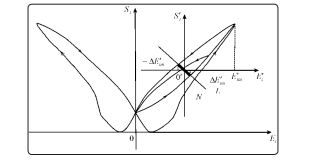
Figure 2: Butterfly type characteristic deformation of actuator with electrostrictive effect
The function Sj (Ei) of the hysteresis loop of the piezoactuator is continuous. Therefore, we have quantities

where the quantities v1ij and v2ij are calculated using the hysteresis characteristic on Figure 1 for the maximum admissible electric field strength in the piezoactuator. The quantities v1ij =0 and v2ij = vij are the minimum and the maximum values of the tangent of the inclination angle of the tangent line to the hysteresis nonlinearity of the piezoactuator. Thus, we obtain

where the ratios of the tangents of the inclination angle of the tangent line to the hysteresis nonlinearity of the piezoactuator for longitudinal, transverse and shift Piezo effects are proportional to the ratios of the Piezo modules.
We have the expression for the sufficient absolute stability condition of the system with the hysteresis nonlinearity of the electro magneto elastic actuator using the Yakubovich absolute stability criterion with the condition on the derivative. The Yalubovich criterion is the development of the Popov absolute stability criterion [2].
For the Lyapunov stabile control system the Yalubovich absolute stability criterion for the system with the single hysteresis nonlinearity provides the simplest and pictorial representation of results of the investigation of the stability control system. Therefore, the sufficient absolute stability condition of the control system of the deformation of the electro magneto elastic actuator has the form

where in brackets j is the imaginary unity and is the frequency.
The amplitude-phase characteristic of the open-loop system on Figure 3 should be situated to the right of the straight line

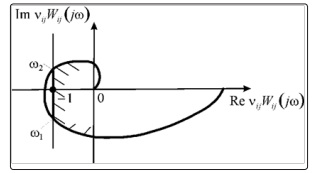
Figure 3: Absolute stability criterion for control system with electro magneto elastic actuator, shaded corrected characteristic
For the absolute stability criterion for the system with electro magneto elastic actuator on the plane of the logarithmic amplitude frequency characteristic and the phase frequency characteristic we have

The corrected logarithmic amplitude frequency characteristic is below the boundary curve in the form

For the piezoactuator from PZT the value of the maximum tangent of the inclination angle of the tangent line to hysteresis nonlinearity is about 1 nm/V for longitudinal piezo effect and about 0.6 nm/V for transverse piezo effect.
Summary
We used the frequency methods for Lyapunov stable control system to calculate the condition the absolute stability of the control system with electro magneto elastic actuator for nanobioengineering and nanobiomedical science research.Conclusions
We received the stationary set of the control system of the deformation of the electro magneto elastic actuator. We determined condition of the absolute stability on the derivative for the control system with the electro magneto elastic actuator for nanobioengineering and nanobiomedical science research.References
- Schultz J, Ueda J, Asada H (2017) Cellular actuators. Oxford: Butterworth-Heinemann Publisher 5: 382.
- Yakubovich VA (2002) Popov’s method and its subsequent development. European Journal of Control 8: 200-208.
- Zhou S, Yao Z (2014) Design and optimization of a modal-independent linear ultrasonic motor. IEEE Transaction on Ultrasonic, Ferroelectrics and Frequency Control 61: 535-546.
- Przybylski J (2015) Static and dynamic analysis of a flex tensional transducer with an axial piezoelectric actuation. Engineering Structures 84: 140-151.
- Ueda J, Secord T, Asada HH (2010) large effective-strain piezoelectric actuators using nested cellular architecture with exponential strain amplification mechanisms. IEEE/ASME Transactions on Mechatronics 15: 770-782.
- Karpelson M, Wei G-Y, Wood RJ (2012) Driving high voltage piezoelectric actuators in micro robotic applications. Sensors and Actuators A: Physical 176: 78-89.
- Afonin SM (2015) Block diagrams of a multilayer piezoelectric motor for Nano- and micro displacements based on the transverse Piezo effect. Journal of Computer and Systems Sciences International 54: 424-439.
- Afonin SM (2008) Structural parametric model of a piezoelectric Nano displacement transducer. Doklady Physics 53: 137-143.
- Afonin SM (2006) Solution of the wave equation for the control of an elecromagnetoelastic transducer. Doklady Mathematics 73: 307-313.
- Cady WG. (1946) Piezoelectricity: An introduction to the theory and applications of electromechanically phenomena in crystals. New York, London: McGraw-Hill Book Company 806.
- Mason W (1964) Physical acoustics: Principles and methods. Vol.1. Part A. Methods and devices. New York: Academic Press 515.
- Zwillinger D (1989) Handbook of differential equations. Boston: Academic Press 673.
- Afonin SM (2015) Structural-parametric model and transfer functions of electro elastic actuator for Nano- and micro displacement. Chapter 9 in Piezo electrics and nanomaterial’s: Fundamentals, developments and applications. Parinov IA 225-242.
- Afonin SM (2017) A structural-parametric model of electro elastic actuator for Nano- and micro displacement of mechatronic system. Chapter 8 in Advances in nanotechnology 19: 259-284.
- Afonin SM (2012) Nano- and micro-scale piezomotors. Russian Engineering Research 32: 519-522.
- Afonin SM (2007) Elastic compliances and mechanical and adjusting characteristics of composite piezoelectric transducers. Mechanics of Solids 42: 43-49.
- Afonin SM (2017) Structural-parametric model elecromagnetoelastic actuator Nano displacement for mechatronics. International Journal of Physics 5: 9-15.
- Afonin SM (2017) Structural-parametric model of piezoactuator Nano- and micro displacement for Nano science. AASCIT Journal of Nano science 3: 12-18.
- Afonin SM (2016) Solution wave equation and parametric structural schematic diagrams of elecromagnetoelastic actuators Nano- and micro displacement. International Journal of Mathematical Analysis and Applications 3: 31-38.
- Afonin SM (2018) Structural-parametric model of elecromagnetoelastic actuator for Nano mechanics. Actuators 7: 1-9.
- Afonin SM (2016) Structural-parametric models and transfer functions of elecromagnetoelastic actuators Nano- and micro displacement for mechatronic systems. International Journal of Theoretical and Applied Mathematics 2: 52-59.
- Afonin SM (2017) parametric block diagrams of a multi-layer piezoelectric transducer of Nano- and micro displacements under transverse piezoelectric effect. Mechanics of Solids 52: 81-94.
- Afonin SM (2018) Structural-parametric model of electro elastic actuator for nanotechnology and biotechnology. Journal of Pharmacy and Pharmaceutics 5: 8-12.
- Afonin SM (2019) A structural-parametric model of a multilayer electro elastic actuator for mechatronics and nanotechnology. Chapter 7 in Advances in nanotechnology. Volume 22: 169-186.
- Afonin SM (2019) Structural-parametric model and diagram of a multilayer elecromagnetoelastic actuator for Nano mechanics. Actuators 8: 1-14.
- Afonin SM (2018) Elecromagnetoelastic actuator for Nano mechanics. Global Journal of Research in Engineering: A Mechanicaland Mechanics Engineering 18: 19-23.
- Afonin SM (2019) Structural-parametric model multilayerelecromagnetoelastic actuator Nano displacement for Nano mechatronics. International Journal of Physics 7: 50-57.
- Afonin SM (2019) Actuator for Nano biomedical research. Biomedical Journal of Scientific and Technical Research 19: 14300-14302.
- Bhushan B (2004) Springer Handbook of Nanotechnology.Berlin, New York: Springer 1222.