

Annals of Civil Engineering and Management(ACEM)
ISSN: 3065-9779 | DOI: 10.33140/ACEM



Review Article - (2026) Volume 3, Issue 3
A Unified Energy Framework for Structural Material Strength: An AT Mathematics Interpretation of Electromagnetic Bonding in Steel, Concrete, Wood, and Masonry

Received Date: Jul 13, 2026 / Accepted Date: Sep 14, 2026 / Published Date: Sep 23, 2026
Copyright: ©2026 Paul T E Cusack. This is an open-access article distributed under the terms of the Creative Commons Attribution License, which permits unrestricted use, distribution, and reproduction in any medium, provided the original author and source are credited.
Citation: Cusack, P. T. E. (2026). A Unified Energy Framework for Structural Material Strength: An AT Mathematics Interpretation of Electromagnetic Bonding in Steel, Concrete, Wood, and Masonry. Ann Civ Eng Manag, 3(3), 01-10.
Abstract
Modern structural engineering relies on experimentally calibrated design equations to predict the strength of concrete, steel, wood, and masonry structures. Limit States Design (LSD) methodologies have achieved remarkable success; however, the fundamental origin of the measured material strengths used in these equations remains primarily empirical. Parameters such as steel yield strength, concrete compressive strength, wood bending strength, and masonry compressive strength are determined through testing rather than derived from a universal physical principle. This paper proposes a theoretical interpretation in which the strength of structural materials is considered a macroscopic expression of electromagnetic interactions occurring at the atomic and molecular level. Since chemical bonding is fundamentally electromagnetic in origin, the mechanical resistance of engineering materials can be viewed as arising from stored electromagnetic energy within their atomic structures. An AT Mathematics framework is introduced through the fundamental relationships [ t^2-t-1=E, ] [ E=\frac{1}{t}, ] [ M=\ln t, ] and [ \frac{dM}{dt}=\frac{1}{t}=E. ] These relationships are proposed as a universal energy relationship connecting mass, energy, and structural resistance. A generalized strength expression is developed in which the measured strength of a material is interpreted as a material- dependent transformation of a universal energy parameter. The objective is not to replace established structural design standards but to propose a possible theoretical foundation linking materials engineering, electromagnetic physics, and AT Mathematics.
Keywords
Structural Engineering, Limit States Design, Electromagnetic Bonding, Material Strength, Steel, Concrete, Wood, Masonry, AT Mathematics, Energy Density
Introduction
The design of modern infrastructure depends upon a detailed understanding of material behavior. Bridges, buildings, tunnels, dams, and transportation systems are designed using experimentally verified relationships that describe the resistance of structural members under load. The principal materials used in construction steel, concrete, wood, and masonry appear very different at the engineering scale. Steel is ductile and capable of large deformation before failure. Concrete is strong in compression but weak in tension. Wood has highly directional strength due to its cellular structure. Masonry combines manufactured units and mortar into a composite material. Despite their differences, all structural materials share a common origin: their atoms and molecules are held together by electromagnetic forces.
The fundamental question addressed in this paper is:
Can the strength parameters used in structural engineering be interpreted as manifestations of a deeper electromagnetic energy principle?
Current engineering practice begins with measured properties:

f′m and incorporates them into design equations. This approach is highly effective but does not directly explain why these strengths exist or why different materials possess different levels of resistance.
A theoretical framework based on energy provides a possible connection between atomic physics and structural mechanics.
2. Electromagnetic Foundation of Material Strength
2.1. Fundamental Interactions All physical materials are governed by the fundamental forces of nature:
• Gravitational force
• Electromagnetic force
• Strong nuclear force
• Weak nuclear force At the scale of engineering materials, the electromagnetic interaction dominates. Chemical bonding occurs because electrons and atomic nuclei interact through electromagnetic attraction and quantum mechanical principles. The resulting bonds determine the stiffness, strength, and deformation characteristics of matter.
Bonding Mechanisms in Engineering Materials
• Steel: Steel derives its strength from metallic bonding. In a metal lattice, positively charged atomic nuclei are surrounded by delocalized electrons. This electron structure allows atoms to rearrange through dislocation movement, giving steel its characteristic combination of strength and ductility.
• Concrete: Concrete strength originates primarily from ionic and covalent bonding within cement hydration products. Calcium-silicate-hydrate phases provide the microscopic structure responsible for compressive resistance.
• Wood: Wood consists mainly of cellulose, lignin, and water. Covalent bonds within polymer chains provide molecular strength, while hydrogen bonding and cellular structure influence macroscopic behavior.
• Masonry: Brick, stone, and mortar involve ionic and covalent bonds within ceramic and mineral structures. Their strength depends on both atomic bonding and the mechanical interaction between units and mortar. Although these materials behave differently, their ultimate resistance to deformation arises from electromagnetic interactions.
From Atomic Bonding to Engineering Strength
A structural member resists applied loads by developing internal stresses.
Stress is defined as

where:
F = applied
force A =
resisting area
Elastic deformation follows Hooke's law:

where:
Es = elastic modulus
ε = strain
The energy stored during elastic deformation is:

This energy density represents the work required to deform the material.
At the atomic level, this energy is associated with changes in electromagnetic bonding configurations. As deformation increases, atoms are displaced from equilibrium positions and internal electromagnetic forces resist this displacement. Failure occurs when the available bonding energy can no longer maintain equilibrium. Therefore, the macroscopic failure stress can be interpreted as the point at which a critical internal energy condition is reached.
The Need for a Unified Strength Theory
Current structural engineering formulas are extremely successful but remain largely empirical. For example, steel design uses:

The common feature is that each equation requires a measured strength parameter. The question is whether these different strength parameters can be related through a common physical quantity. This paper proposes that AT Mathematics provides a possible framework for such a relationship.
Part II: AT Mathematics Foundation and Energy-based Strength Formulation
Foundations of AT Mathematics
The proposed AT Mathematics framework begins with a fundamental relationship between a universal parameter (t), energy (E), and mass (M).
The primary equation is defined as:
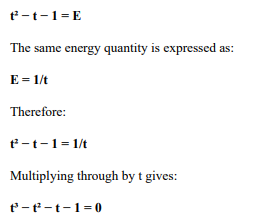

which establishes a relationship between the mathematical structure of (t) and the energy parameter (E). The parameter (t) represents the underlying variable from which energy and mass relationships are developed. Multiplying through by (t),
This defines a characteristic value of (t) for which the two energy expressions are equal.
Mass-Energy Relationship in AT Mathematics
Mass is defined in the AT Mathematics framework as:

This provides a central relationship:
Energy = change in mass/change in t
Within this interpretation, energy is not treated as an isolated quantity but as a rate of transformation associated with the fundamental variable t.
Energy Density as the Basis of Structural Resistance
Structural materials resist deformation by storing energy. For an elastic material:
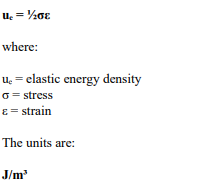
Therefore, the mechanical resistance of a material can be described as an energy density.
At the atomic scale, this stored energy corresponds to the displacement of atoms from their equilibrium positions within electromagnetic bonding fields.
Electromagnetic Origin of Bond Energy
The strength of a material depends upon the energy required to alter its atomic structure. For a simple atomic bond, the restoring force arises from electromagnetic interaction between charged particles. When an external force is applied:
• Atoms are displaced.
• Electromagnetic forces resist displacement.
• Energy is stored in the material.
• Continued deformation eventually causes irreversible changes.
In metals, this occurs through dislocation motion. In ceramics and concrete, failure occurs through crack propagation. In wood, failure involves rupture of polymer chains and cellular structures.
In all cases, electromagnetic interactions provide the fundamental resistance mechanism.
Proposed AT Energy Criterion
The central hypothesis of this paper is that material failure occurs when the available structural energy reaches a critical value. The critical energy density is proposed as:

This provides a theoretical relationship between mechanical deformation and the AT energy parameter.
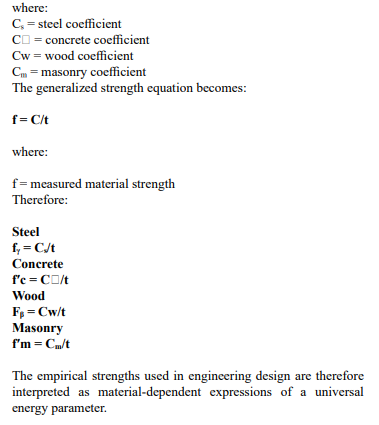
Material-Specific Strength Constants
Engineering materials do not all possess identical strength because their structures convert atomic bonding energy into macroscopic resistance differently.
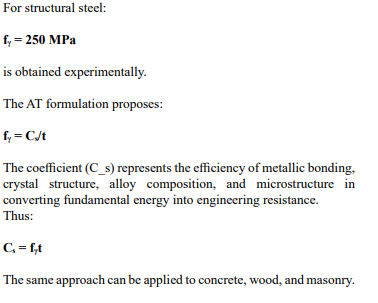
Therefore, introduce a material coefficient:
Connection to Limit States Design Limit States Design
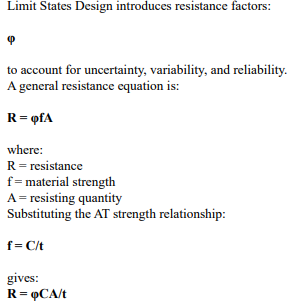
This provides a theoretical interpretation of the existing LSD formulation.
The resistance factor (\phi) remains an engineering reliability parameter, while the strength term is interpreted as a manifestation of the underlying energy relationship.
Example: Steel Yield Strength
Significance of the Framework
The proposed framework does not eliminate experimental testing.
Material testing remains essential because real materials contain:
• Defects
• Voids
• Impurities
• Grain Boundaries
• Moisture Effects
• Construction Variability
However, it provides a possible theoretical explanation for why empirical strength parameters exist. The hypothesis is that engineering strength is not an arbitrary measured property, but a macroscopic expression of deeper energy relationships.
References
- Ashby, M. F. Materials Selection in Mechanical Design.Butterworth-Heinemann.
- Callister, W. D., and Rethwisch, D. G. Materials Science and Engineering: An Introduction. Wiley.
- Gere, J. M., and Goodno, B. J. Mechanics of Materials.Cengage Learning.
- Hibbeler, R. C. Structural Analysis. Pearson.
- DeWolf, J. T., Mazurek, D. F., P Beer, F., & Johnston JR, E. R. (2021). Mecânica dos Materiais-8. McGraw Hill Brasil.
- CSA Group. CSA A23.3: Design of Concrete Structures.
- CSA Group. CSA S16: Design of Steel Structures.
- CSA Group. CSA O86: Engineering Design in Wood.
- CSA Group. CSA S304: Design of Masonry Structures.
- Maxwell, J. C. A Treatise on Electricity and Magnetism.Oxford University Press.
- Griffith, A. A. "The Phenomena of Rupture and Flow in Solids." Philosophical Transactions of the Royal Society A, 1921.
- Landau, L. D., and Lifshitz, E. M. Electrodynamics of Continuous Media. Pergamon Press.
- Paul T. E. Cusack. Selected works on AT Mathematics, Astrotheology, energy relationships, and unified field concepts.