

Journal of Mathematical Techniques and Computational Mathematics(JMTCM)
ISSN: 2834-7706 | DOI: 10.33140/JMTCM

Impact Factor: 1.3


Research Article - (2025) Volume 4, Issue 5
A Systematic Literature Review on the Integration of Business Process Management and Information Entropy
2Department of Archival, Library & Information Studies (ALIS), University of West Attica, Greece
Received Date: Apr 09, 2025 / Accepted Date: May 05, 2025 / Published Date: May 14, 2025
Copyright: ©©2025 Apostolos Mouzakitis. This is an open-access article distributed under the terms of the Creative Commons Attribution License, which permits unrestricted use, distribution, and reproduction in any medium, provided the original author and source are credited.
Citation: Mouzakitis, A., Liapakis, A. (2025). A Systematic Literature Review on the Integration of Business Process Management and Information Entropy. J Math Techniques Comput Math, 4(5), 01-24
Abstract
This systematic literature review introduces managerial info physics, a novel interdisciplinary metaparadigm that integrates Business Process Management (BPM), information entropy, econophysics, and informatics to address organizational complexity and uncertainty. Anchored in the PRISMA 2020 methodology, the review analyzes 191 peer-reviewed sources published between 2018 and 2024 across 21 academic databases. Findings indicate that entropy-based metrics—originally developed in thermodynamics and information theory—can quantify process variability and execution uncertainty, extending traditional key performance indicators (KPIs). The review highlights entropy’s practical utility in enhancing workload distribution, resource allocation, and dynamic system modeling, particularly in high-variability sectors such as healthcare, finance, and manufacturing. Moreover, it identifies foundational gaps in entropy’s integration within BPM, emphasizing conceptual ambiguities and methodological inconsistencies. By applying analogical induction, the study formalizes managerial info physics as a framework for entropy-informed BPM, bridging theory and application. While empirical validation remains limited, the framework offers a unified approach to managing unpredictability, supporting adaptive modeling and strategic decision-making in data-intensive environments. Future research directions are proposed for refining entropy-based tools and operationalizing this metaparadigm in real-time, smart system contexts.
Keywords
Business Process Management (Bpm), Information Entropy, Entropy-Based Metrics, Process Modeling, Organizational Uncertainty, Complexity Management, Econophysics, Systematic Literature Review, Prisma Methodology, Interdisciplinary Frameworks
Introduction
Business Process Management (BPM) frameworks are instrumental in optimizing organizational workflows, reducing inefficiencies, and managing operational complexity in contemporary business environments [1-15]. However, as organizations increasingly encounter dynamic and unpredictable conditions, conventional BPM approaches may fall short in addressing variability and uncertainty. This has led to a growing interest in incorporating insights from information theory, particularly entropy, to improve decision-making processes across domains such as finance, social sciences, and managerial science [9,16-33].
This study introduces an interdisciplinary framework—managerial info physics—which integrates BPM principles with entropy- based metrics to enhance the management of uncertainty. By systematically evaluating emerging modeling techniques, the framework seeks to bridge theoretical knowledge and industry application, thereby strengthening the practical effectiveness of BPM strategies [1,4, 6, 10,11,34,35].
Entropy-based metrics represent a paradigm shift from traditional key performance indicators (KPIs), offering avenues for refined resource allocation and improved modeling precision, especially within sectors characterized by high complexity [3,6,16,29,36- 38]. Despite this potential, BPM literature lacks a coherent model that incorporates entropy-driven insights for managing inherent process variability [3,6,11,32,33,36,39,40]. This review identifies this gap and emphasizes the value of combining BPM’s structured methodologies with entropy’s capacity for capturing complexity and unpredictability.
Entropy has demonstrated wide applicability across disciplines— from financial markets to healthcare systems [9,21,26,40– 42]. Shannon entropy, in particular, offers robust tools for quantifying uncertainty and enhancing process optimization [9,17,20,21,26,29,36,43]. In the BPM context, entropy can support the detection of inefficiencies, guide predictive modeling, and refine operational planning [4,9,17, 20,26,29,36, 43,44].
Nevertheless, integrating entropy into BPM presents notable challenges. BPM emphasizes stability and process efficiency, while concepts like volatility and variability introduce analytical complexities. Volatility—commonly used in financial contexts— refers to rapid fluctuations, whereas variability captures broader process deviations [2,3,6,9,17,26,29,43,45]. Entropy-based models can address both: Shannon entropy is suitable for general uncertainty, while Tsallis and Rényi entropy better capture non- linear and heavy-tailed phenomena typical of volatile systems [27,36]. Real-world implementation, however, requires empirical validation to ensure that these models are both effective and practical [3,9,11,17,20,26,29,45,46].
Econophysics offers examples of entropy's utility in resource optimization, strategic planning, and adaptability—all valuable contributions to BPM methodologies [9,16,20,23,29,36,44,47– 50].
The objective of this paper is to formulate and validate the managerial info physics framework through a systematic literature review, guided by the PRISMA methodology [51]. Covering research published between 2018 and 2024, this study explores the convergence of BPM, information entropy, and econophysics to build a unified foundation for managing organizational complexity. Results are expected to highlight entropy’s utility in augmenting BPM models and in supporting decision-making in uncertain operational environments [3,6,9,32,33,44,49].
The central hypothesis is that entropy-integrated BPM creates a cohesive managerial paradigm capable of improving organizational performance by balancing efficiency and informational complexity. This is supported through inductive synthesis drawn from literature, presenting managerial info physics not only as a theoretical proposition but also as an observable and practicable framework. An interpretive lemma capturing the main conceptual finding is discussed in later sections.
Falsifiability is addressed by identifying conditions under which the hypothesis would not hold—specifically if the literature fails to reveal convergence between entropy and BPM or if entropy-based tools do not enhance BPM outcomes. Conversely, successful applications and empirical validations would substantiate the framework’s relevance and adaptability across industries.
In summary, integrating information entropy into BPM introduces a promising avenue for enhancing organizational management. The proposed managerial info physics framework emphasizes uncertainty quantification and process adaptability, aiming to extend the robustness of BPM in dynamic, information-rich environments.
Methodology
Research Design, Prisma Framework, and Search Strategy
Systematic reviews play a crucial role in synthesizing existing knowledge, prioritizing future research, identifying primary research issues, and evaluating theories [52]. Given the interdisciplinary nature of this study—bridging BPM, Econophysics, and Information Theory—a structured and transparent review methodology was necessary. The PRISMA framework was selected for its ability to provide a rigorous, replicable process for synthesizing literature across these domains ensuring that relevant studies on entropy-based BPM models, statistical physics applications, and com-plex system optimization were systematically evaluated[53].
While PRISMA 2020 was originally developed for health sciences, its structured approach has been widely adopted across disciplines, including complex systems, computational modeling, and business process optimization [51]. In this review, PRISMA was tailored to identify and evaluate studies incorporating entropy-based metrics (e.g., Shannon entropy, Tsallis entropy) in BPM frameworks. This ensures that findings from statistical physics, econophysics, and information theory are systematically synthesized to assess their impact on BPM efficiency and decision-making processes. Based on observational research, the utilization of the statement results in improved reporting [27,54]. Since the previous iteration, systematic review practices have changed considerably. The statement’s evolution was made possible and necessary by certain technological advancements. For instance, deep machine learning and natural language processing rendered it less difficult to identify and evaluate research systematically [55]. Certain approaches have been devised to facilitate the synthesis and presentation of findings in situations where conducting a meta-analysis is problematic [56,57]. In addition, the understanding of bias sources has improved systematic review assessment methodologies [58]. Recent modifications in review systems have changed the emphasis from high quality evidence to reliable evidence [59].
The statement’s latest version is termed PRISMA 2020 [60]. The primary emphasis of PRISMA 2020 is on conducting systematic reviews of health practices. However, other fields may also utilize and benefit from its checklist. The most recent version of the statement is encompassing of meta-analyses and other synthesis methodologies, irrespective of the subject of study. This methodology can be utilized in mixed-methods reviews, although the presentation and analysis of qualitative data may need to adhere to supplementary criteria [51]. It is noteworthy to mention, however, that the statement is not necessary to serve as a guide for conducting systematic reviews, when such a task can be accomplished with the assistance of extensive, peer reviewed re-sources [61]. Fig. 1 represents the general schematic of the PRISMA flow diagram which has been used as the basic literary tool for conducting this review.

Figure 1: PRISMA 2020 Flow Diagram for Systematic Reviews.
Even though its fundamental structure should remain unchanged, it can be altered in accordance with the pertinent details of the research at hand. However, the authors mention the following considerations:
1. If possible, the number of records found in each database or registration searched should be reported rather than the total.
2. The number of excluded records (either manually or automatically) should be indicated.
This systematic review follows the PRISMA framework to ensure a transparent and replicable review process. The study, conducted from 2018 to 2024, involved three research cycles, each focusing on distinct, overarching thematic units:
1. BPM: Focusing on optimization through modeling, quality standards, and data-driven decision-making.
2. Econophysics and Financial Networks: Integrating complex systems theory and machine learning within economic and ethical contexts.
3. Thermodynamics, Entropy, and Information Theory: Their applications in industrial settings, complex systems, and interdisciplinary scientific advancements.
Each research cycle was designed to assess whether a convergence of ideas could be identified across the literature, spanning multiple disciplines. To ensure thorough coverage of relevant literature, this review employed primary queries and sub-queries, with the primary queries targeting broad research themes and sub-queries allowing for a deeper investigation within those themes.
A total of 21 databases were selected, each specializing in peer- reviewed content relevant to the thematic areas under investigation. The following key databases were utilized: ACS Publications: 2 times, AIP: 1 time, APS: 2 times, Annual Reviews: 1 time, Cambridge Core: 1 time, Emerald: 8 times, ICI: 1 time, IDEAS: 2 times, IEEE Xplore: 10 times, IOPscience: 2 times, JSTOR: 1 time, MDPI: 47 times, NIH: 9 times, Nature: 1 time, PLOS ONE: 1 time, PhilPapers: 1 time, Royal Society Publishing: 1 time, SAGE: 1 time, Science Direct: 47 times, Springer: 26 times, arXiv: 14 times.
The identification process began with the formulation of 179 primary queries and 62 sub-queries, resulting in 241 total queries across the three research cycles. These queries targeted a wide range of identification terms, 435 in total, which can be further categorized in the following segments. Table 1 displays a detailed thematic categorization of the identification terms used in this study.
|
Category |
Terms |
|
Business and Management Concepts |
Business analytics, Actionable guidelines, Adoption of change, Agent-based models (ABM), Automated planning, Balanced Scorecard, BPM (Business Process Management), BPMN (Business Process Modeling Notation), Business excellence models, Business process modeling, Business process performance, Business process re-engineering, Capability maturity model integration, Change adoption, Change agents, Efficient business processes, Future business process management capabilities, Integrating process management, Process- aware information systems, Process models, Quality awards, Quality measurement, Quality requirements, Re- engineering, Reversibility, SIPOC, Systematic literature review, Unified BPM methodologies, Use cases, Value chain processes, Value network. |
|
Corporate Excellence and Strategies |
ASQ, Baldrige criteria, Corporate communication, Competitive advantage, Firm performance, Kaplan, Key performance indicators (KPIs), Management, Management theory, Market efficiency, Performance excellence, Porter models, Porter's value chain framework, Quality standards, Scientific management, TQM literature review. |
|
Artificial Intelligence, Machine Learning, and Informatics |
Artificial Intelligence (AI), Machine learning (ML), Deep learning, Convolutional Neural Networks (CNN), Long Short-Term Memory (LSTM), Recurrent Neural Networks (RNN), Neural networks, Simulation algorithms, Simulation-based estimations. |
|
Informatics and Data |
Bioinformatics, Medical informatics, Nursing informatics, Neuroinformatics, Urban informatics, Data analysis, Data science, Data uncertainty, Information systems, Future ERP, Software engineering language selection, Industrial Internet of Things (IIoT). |
|
Entropy, Thermodynamics, and Physics |
Aleatoric, Barrow entropy, Basic concepts of classical thermodynamics, Bayesian inference, Boltzmann, Boltzmann entropy, Boltzmann equation, Carnot cycle, Clausius, Diffusion entropy, Disorder, Entanglement entropy, Entropic uncertainty relation, Entropy, Entropy economics, Entropy growth, Entropy maximization, Entropy measures, Entropy research, Equilibrium for a low-density gas, First law of thermodynamics, Finite- time thermodynamic process, Gibbs and Boltzmann entropy, Gibbs free energy, H-theorem, Irreversible entropy production, Landauer’s principle, Maximum entropy, Modified cosmology, Renyi entropy, Residual entropy, Second law of thermodynamics, Shannon entropy, Statistical entropy, Statistical mechanics, Thermodynamic entropy, Third law of thermodynamics, Transfer entropy, Von Neumann entropy. |
|
Classical and Modern Physics |
A mathematical theory of communication, Alan Turing legacy, Brillouin, Classical mechanics, Claude Shannon, Coalescence processes, Confined quantum systems, Conservation of information, Contributions of Shewhart and Deming, Crystallization, Diffusion rate, Einstein, Heisenberg, Hilbert space, Irreversibility, Ising model, Jaynes, Josiah Willard, Joule, Mayer, Quantum cosmology, Quantum mechanics, Rudolf Clausius, Symmetry, Thomson. |
|
Statistical and Mathematical Modeling |
Abductive theory, Algorithmic complexity, Bayesian inference, Complex methods, Complex networks, Complex systems, Complexity economics, Comparative research, Comparative study, Continuous stochastic volatility models, Decision models, Determinism, Dynamic controllability, Dynamical stability, Fat-tailed distributions, Fractional cumulative residual entropy, Geometry, Geostatistical models, Granger causality, Macroscopic behavior, Mathematical modeling, Multivariate probability density, Network analysis, Network structure, Probabilities, Probability, Stochastic processes, Temporal process modeling. |
|
Information Theory and Entropy |
Information dynamics, Information entropy system model, Information gain, Information governance, Information theory, Entropy measures, Shannon entropy, Negentropy. |
|
Econophysics and Financial Systems |
Economic complexity, Econophysics, Financial economics, Financial inclusion, Financial networks, Financial system networks, Physics of financial networks, Risk, Portfolio allocation. |
|
Decision-Making and Management |
Decision models, Decision support systems, DebtRank, Delphi study, MCDM (Multi-Criteria Decision Making), TOPSIS, PDCA. |
|
Technological Innovations |
Industry 3.5, 4.0, 5.0, Industrial revolution, Lean Philosophy, Circular value chain, Renewable energy resources, Digital transformation. |
|
Category |
Terms |
|
Process and System Improvements |
BPMN (Business Process Modeling Notation), Event processing, Process-oriented systems, Re-engineering, iBPM (Intelligent BPM), Integration, Techniques. |
|
Communication Models and Theories |
A mathematical theory of communication, Communication, Interactive communication, Message transmission, Corporate communication. |
|
Information and Knowledge |
A priori knowledge, Application research, Application scenarios, Bibliometric analysis, Information theory, Information systems, Knowledge-based systems. |
|
Philosophical and Ethical Concepts |
Ethical challenges, Ethical concerns, Ethical interventions, Ethics in technology, Philosophical frameworks, Philosophy of economics, Philosophy of physics, Scientific pluralism, Scientific revolution, Scientific method, Scientific transformations. |
|
Historical and Legacy Contributions |
Alan Turing legacy, Contributions of Shewhart and Deming, Historical evolution, Historical interpretation, History of management, History of thermodynamics, Michael Porter, Robert Batterman, Rudolf Clausius, Eugene Stanley, Jaynes, Rosario Nunzio Mantegna, Taylorism. |
|
Health Systems and Models |
COVID-19 pandemic, Epidemiological models, Healthcare informatics, Biosystems, Biocomplexity. |
|
Miscellaneous Concepts and Theories |
Chapman–Jouguet condition, Constantino Tsallis, Field theories, Glasses, Historical overview, Micro-founded approach, Operating organized systems, Social influence dynamics, Sociophysics, Synchronization. |
Table 1: Thematic Categorization of Identification Terms for PRISMA-Based Research
Inclusion, Exclusion, Screening, and Eligibility Criteria
At the identification stage, a total of 16,101 records were retrieved from the selected databases. To ensure that this systematic review focused on entropy-based BPM applications, studies were included if they met at least one of the following criteria:
Inclusion Criteria: Records were considered if they were peer- reviewed articles, review papers, or studies that directly addressed the research themes, such as the deployment of entropy metrics in BPM optimization, the application of statistical physics methodologies and entropy in complex systems such as economic networks, proposed a novel interdisciplinary framework linking entropy with BPM modeling. Furthermore, literature that was purely descriptive, lacking any synthesized theoretical contribution with potential implementation in BPM, was deprioritized to ensure that the review provided a combined and critical perspective on research trends, rather than simply summarizing existing studies.
Exclusion Criteria: Records were excluded if they did not contain relevant keywords, were non-English, were not suitable peer- reviewed types (e.g., conference abstracts or non-academic publications), were irrelevant to the core themes of the study, or were duplicates. Specifically, 1,221 records were excluded for missing relevant keywords when a narrowing down of the scope was necessary, 72 non-English records were removed to focus on English-language publications, 10,172 records were excluded for being inappropriate peer-reviewed types, and 3,708 records were excluded for irrelevance to the study’s main themes. Additionally, 34 duplicate records were removed manually.
In total, 15,207 records were excluded before the screening stage, substantially reducing the initial pool of potential sources. Details on the exclusion and inclusion criteria can be found in Table 2. During the screening phase, a total of 894 records were assessed for relevance based on their alignment with the predefined thematic units and their contribution to the overarching research objectives. Two levels of exclusion criteria were applied. First, 251 records were removed for thematic irrelevance. Second, 417 records were excluded due to redundant or overlapping content already captured in other sources. As a result, 668 records were excluded at this stage, refining the pool to studies that met both thematic and methodological relevance thresholds. A key procedural nuance in this phase involved the deliberate classification of citations, particularly regarding their formal inclusion under the PRISMA framework. Specifically, twelve sources were excluded from the core dataset due to non-conformity with inclusion criteria. However, these works were retained as contextual references due to their conceptual value in framing foundational perspectives and supporting the theoretical constructs within the thematic analysis [32,33,40,62-70].
Additionally, to enhance transparency in the development of thematic insights, a cross-referencing mechanism was applied. For example, the concept introduced in [71]. is discussed in more depth on page 13 of [72]. offering readers a traceable trajectory of the idea’s evolution. This cross-referencing approach reinforced the analytical continuity of the review while preserving methodological rigor. During the eligibility phase, a closer examination was conducted on 226 records that had passed the initial screening.
|
Criteria Details |
Auxiliary Information |
|
Missing Keywords |
H-Theorem, ASQ, Alan Turing, BPM life cycle, Baldrige, Bibliometric analysis, Biocomplexity, Boltzmann entropy, Coalescence processes, Continuum informatics, DMAIC, Deming, Deming cycle, Deming prize, EFQM, Eco-informatics, Embedding, Empirical study, Enterprise applications, Financial, Financial networks, Granger, Group transfer entropy, Guidelines, ISO, Industrial revolutions, Informatics, Information dynamics, Japan, Juran, M. Porter, Nursing informatics, Ohno, PDCA, Philosophical, Process, Review, Shannon, Shingo, Survey, Systematic literature review, Ten principles of good BPM, Understandable BPMN, Use cases, Automated planning, Business analytics, Dynamic controllability, Modeling. |
|
Appropriate Publication Type |
Articles, Articles Compiled into Handbooks or Book Chapters, Entry, Journal Articles, Journals, Research Articles, Review Articles. |
|
Relevant Scope |
Applied Software Computing, Artificial Intelligence, Author: Schinckus, Big Data, Business, Chemistry and Earth Sciences, Computer Science, Cosmology, Decision Sciences, Earth Sciences, Econometrics and Finance, Economics, Engineering, History and Philosophical Foundations of Physics, Information Technology, Management, Managerial Accounting, Mathematics, Networks, Philosophy, Philosophy of Science, Physics, Physics and Astronomy, Quantitative Finance, Research and Analysis Methods, Software Engineering, Statistical physics and dynamical systems, Statistics, Statistics for Engineering, Thermodynamics |
Table 2: Inclusion and Exclusion Criteria Details
However, 11 records could not be retrieved due to issues with their Digital Object Identifiers (DOIs). Further exclusions were made based on specific criteria: 6 records were excluded due to retractions, 5 were excluded because of errata published after their initial release, and 13 were excluded for relying on small datasets that limited the generalizability of their conclusions. In total, 24 records were excluded, leaving 191 records eligible for the systematic review.
Data Extraction, Query Formulation, and Synthesis Framework
Following the eligibility stage, data extraction was conducted on the remaining 191 records. Key information, including the relevant database, query and sub-query numbers, identification terms, total records found, database hits that aligned with the inclusion criteria or lacked exclusion criteria, and the number of records selected for screening, was extracted, and categorized according to the three primary thematic units mentioned before.
To systematically incorporate entropy-based research, studies were categorized by their application in BPM, econophysics, and information theory. Shannon entropy was examined for quantifying uncertainty in BPM, Tsallis entropy for modeling non-extensive systems in econophysics, and Rényi entropy for complexity analysis in business decision-making. This classification helped identify patterns in entropy applications, ensuring both theoretical insights and empirical implementations were systematically analyzed.
These records were deemed to be the most relevant and reliable, meeting all eligibility criteria established in the earlier stages. The PRISMA process ensured that the systematic review was grounded in a robust methodological approach, meticulously filtering records through various layers of scrutiny to achieve the highest standards of research quality.
The search strategy used can be described as a segmentation strategy. The emphasis was on the use of well-defined identification terms and exclusion criteria to narrow down the search results, ensuring only relevant records are selected for further screening. This approach focuses on refining the search in two stages: (1) Pre-Screening: removing records not meeting all of the inclusion criteria, and (2) Detailed Screening: Removing records for meeting all the exclusion criteria for in-depth review.
Structured Boolean operators (AND, OR) were used in stages 1 and 2 for each query to ensure a thorough retrieval of relevant studies. For instance, query 2, which may be retrieved at the repository website indicated in “Data Availability and Ethical Considerations”, was conducted on Science Direct to explore use cases and process management in technology-assisted applications. The search string included the terms: industrial internet of things, IoT, integrating process management, system, architecture, event processing, use cases, integration, application scenarios, and BPM, yielding 20 records. By filtering for research papers, 4 were excluded, leaving 16. Since research papers were needed for their in-depth, peer-reviewed analyses, theoretical frameworks, and case studies—critical for understanding complex technical fields—the initial 16 publications were skimmed on a surface level. However, to focus more precisely on use cases and process management, a sub-query (2b) was performed, filtering for the term “use cases,” which reduced the results to 1. Thus, query number 2 becomes 2a and the sub-query becomes 2b (1 primary query and 1 sub-query totaling to 2 queries). This remaining result passed the PRISMA process and was eventually included in the systematic review as the relevant citation [15].
The process starts with defining relevant the relevant identification terms (ID Terms) and running the query in a database. Even though the queries presented at the repository are in chronological order, searches on other databases for the same ID Terms which did not yield any useful results were not included in this table to avoid extensive tables which would confuse the reader. This process, overall, ensured that only highly relevant information would be presented in this review. Essentially, this review’s segmentation strategy involves breaking down search results by specific publication inclusion criteria such as filtering for relevance to certain academic disciplines (e.g., business, management, and accounting). This approach allowed for both extremely broad searches and specific, nuanced searches that captured detailed aspects of each theme. Furthermore, synonyms and variants were included throughout this process to ensure completeness (e.g., Artificial Intelligence vs. Machine Intelligence, AI). To construct the PRISMA flowchart, it was essential to summarize the data in a clear and concise manner, as presented in Table 3.
|
PRISMA Data Summary |
||
|
Identification |
Databases searched |
21 |
|
Records found in databases |
16.101 |
|
|
Records excluded due to missing keywords |
1.221 |
|
|
Non-English records excluded |
72 |
|
|
Records excluded (inappropriate publication type) |
10.172 |
|
|
Records excluded (irrelevant scope) |
3.708 |
|
|
Duplicates (removed manually) |
34 |
|
|
Total records removed before screening |
15.207 |
|
|
Screening |
Records screened |
894 |
|
Records excluded (irrelevant information) |
251 |
|
|
Records excluded (duplicate information) |
417 |
|
|
Total records excluded in screening |
668 |
|
|
Eligibility |
Records sought for retrieval |
226 |
|
Records not retrieved (DOI issues) |
11 |
|
|
Records assessed for eligibility |
215 |
|
|
Records excluded (retracted articles) |
6 |
|
|
Records excluded (errata published) |
5 |
|
|
Records excluded (small datasets) |
13 |
|
|
Total records excluded in eligibility |
24 |
|
|
Included |
Records included in review |
191 |
Table 3: Prisma Data Summary
Beyond its role in ensuring systematic screening, the PRISMA framework also facilitates identifying major research gaps in the interdisciplinary use of entropy-based models in BPM. By categorizing exclusions and inclusions, the flowchart highlights areas where entropy-driven BPM applications are underexplored, suggesting potential future research directions in manage-rial science, business analytics, and decision theory. For clarity, the “records found in databases” refers to the total number of records retrieved after applying the exclusion criteria, encompassing all records that were not excluded as well as those that met the inclusion criteria.

Figure 2: PRISMA 2020 Flow Diagram
Additionally, the categorization of records by database is detailed in Fig. 2, which depicts the PRISMA flowchart used in this systematic review. Detailed information on the frequency of each database's usage and the number of records retrieved for publications included in the review is provided in Table 4.
|
Details |
Auxiliary Information |
|
Databases and Searches per Database |
ACS Publications: 2 times, AIP: 1 time, APS: 2 times, Annual Reviews: 1 time, Cambridge Core: 1 time, Emerald: 8 times, ICI: 1 time, IDEAS: 2 times, IEEE Xplore: 10 times, IOPscience: 2 times, JSTOR: 1 time, MDPI: 47 times, NIH: 9 times, Nature: 1 time, PLOS ONE: 1 time, PhilPapers: 1-time, Royal Society Publishing: 1 time, SAGE: 1 time, Science Direct: 47 times, Springer: 26 times, arXiv: 14 times. |
|
Databases and Records per Database |
ACS Publications: 2 records, AIP: 1 record, APS: 167 records, Annual Reviews: 14 records, Cambridge Core: 837 records, Emerald: 89 records, ICI: 33 records, IDEAS: 9 records, IEEE Xplore: 1124 records, IOPscience: 16 records, JSTOR: 313 records, MDPI: 208 records, NIH: 49 records, Nature: 7 records, PLOS ONE: 30 records, PhilPapers: 15 records, Royal Society Publishing: 1 record, SAGE: 2 records, Science Direct: 10405 records, Springer: 2743 records, arXiv: 36 records |
Table 4: Data Extraction and Synthesis Process
Data Availability, Ethical Considerations, and Synthesis Approach
All data associated with this systematic review, including the raw search queries, and data extraction forms have been depos- ited in a publicly available repository [https://www.dropbox. com/scl/fi/66entykq9s1oas6ypsbmb/Prisma-QueryTables.xlsx- ?rlkey=3n8e2md3xzf1euf5i3t38esb0&st=d7jbzh1t&dl=0]. The accession numbers for the data will be available upon request to ensure full transparency and reproducibility of the review’s find- ings. It should be noted that up until the publication of this review certain query results in the databases will yield more results since new papers are published daily. Lastly, this review did not involve any intervention ARY studies involving humans or animals; thus, ethical approval was not required.
Given the nature of this systematic literature review, the analysis primarily focused on qualitative synthesis. Studies were grouped based on thematic units, including BPM, Econophysics, Theory of Complex Systems and Entropy and Information Theory. The goal was to identify recurring patterns, themes, gaps in the literature, and a potential convergence of diverse scientific fields pertinent to the scope of this review.
Ameta-analysis was not conducted due to the diverse methodologies and out-comes across the selected studies. However, a structured narrative synthesis was used to summarize the key findings. No formal bibliometric or citation analysis was per-formed, as the scope of this review was to assess the content and findings of the included studies rather than their citation impact or publication trends.
By using a structured approach, the PRISMA framework enabled the systematic review to narrow down a vast amount of literature from various databases, arriving at a final body of research that was both comprehensive and relevant to the subject areas under investigation. The process, from identification through inclusion, ensured that the data supporting this review was carefully curated and highly reliable, contributing to a well-founded analysis of the selected topics.
Review Findings
Systemic Foundations Of Business Process Management: Toward An Info physical Perspective
BPM encompasses coordinated activities within an organization aimed at defining, implementing, measuring, and improving processes to achieve specific goals [1]. It functions as a structured framework for transforming organizational processes [73]. Through the SIPOC model (Supplier, Input, Process, Output, Customer), processes are understood as procedures converting inputs into deliverables [2]. Standardized BPM frameworks are particularly vital for organizations adhering to quality benchmarks like EFQM or ISO standards [74]. A comprehensive BPM system enhances clarity and uniformity in operations, fostering consistency and long-term customer loyalty [75].
The BPM life cycle typically includes (re)design, implementation/ configuration, operation, and control phases [3]. These stages align with cybernetic principles, incorporating feedback loops and iterative modeling. During the (re)design phase, a process model is created, followed by system integration during implementation/ configuration. Design flaws tend to cause non-recurring issues, requiring structural changes, while recurring issues often stem from execution errors [4]. Execution errors can lead to extreme operational variations, especially where end-to-end processes are absent, as seen in product development and customer engagement contexts [34]. BPM interventions are reviewed using the PDCA (Plan, Do, Check, Act) model. Well-aligned processes contribute significantly to customer satisfaction and sustainability [5].
With digital transformation, BPM increasingly incorporates structured information flows [6]. This review adopts two classification systems to map execution diversity. The first, based on classical BPM theory, categorizes processes by the availability of execution information: static, structured with ad hoc exceptions, semi-structured, unstructured with fragments, and fully unstructured [76]. Static processes are fully optimized pre-execution; others vary in flexibility and definition, with unstructured processes often lacking explicit sequential articulation.
The second classification, drawn from Process-Aware Information Systems (PAIS), defines three process types: peer to peer, person to application, and application to application [71,72]. Peer-to-peer processes involve high human interaction, as seen in platforms like Meta and X. Person-to-application processes integrate users with software, aiming for seamless functionality. Application- to-application processes operate autonomously. However, clear boundaries rarely exist—real-world workflows often span these categories.
Complex process management involves strategic decision-making shaped by systems dynamics and entropy concepts [77,19]. Though an established set of ten BPM principles exists [7], for this review, they are distilled into four interconnected domains:
1. Value Creation: Processes across areas such as HR and finance aim to create stakeholder value [8].
2. Process Optimization: Effective design and maturity assessment are critical, with IT integration enhancing stability [78,9].
3. Process Standardization: Consistent practices improve efficiency and reduce costs [74].
Effective Management: Managing processes requires managing procedures. BPM overlaps with governance and project management disciplines [2,79]. Mere design or standards are insufficient—execution management is essential for continuous improvement [80].
Evolutionary Paradigms In Business Process Management: From Quality To Epistemics and Technology
BPM has evolved through diverse methodologies and conceptual frameworks aimed at improving process execution, oversight, and evaluation [81]. While pinpointing definitive historical milestones is difficult due to the density and complexity of past developments—especially around events like World War II— scholars broadly identify three major paradigms in BPM: quality control, epistemic management, and information technology.
The quality control paradigm originates in the early 20th century with F. W. Taylor’s scientific management theory, inspired by A. Smith's advocacy for task specialization [82]. W. A. Shewhart and W. E. Deming further advanced the field by introducing statistical methods for process control [83-87]. After WWII, the American Society for Quality (ASQ) was founded to consolidate wartime improvements [10], with J. M. Juran becoming a central figure [88]. Japanese manufacturers, influenced by Deming, adopted quality-focused practices, giving rise to lean methodologies through leaders like S. Shingo and T. Ohno [89]. The dominance of Total Quality Management (TQM) in the 1970s eventually gave way to Six Sigma, notably adopted by Motorola in the late 1980s [89]. Lean Six Sigma was institutionalized by ASQ in the early 2000s and is now standard in companies like Walmart, Amazon, and Costco [90]. This evolution also encompassed innovations like the Capability Maturity Model (CMM), targeting software quality [91].
The epistemic management paradigm, building on Taylor's foundation was further shaped by Juran’s analysis of postwar production inefficiencies and his conceptualization of quality costs [89]. In the 1980s, M. Porter introduced the concept of value chains, repositioning internal processes as sources of strategic differentiation [92]. His theories remain highly influential particularly in light of global competitive pressures and declining profit margins [93,94]. A major shift occurred in the early 1990s with Kaplan and Norton’s introduction of the Balanced Scorecard (BSC), aligning operational measures with strategic objectives [95]. The BSC framework remains relevant today, with growing scholarly interest [95].
The information technology paradigm gained momentum with the development of Business Process Re-engineering (BPR) by M. Hammer and J. Champy [11,96]. BPR challenged the dominance of TQM in the 1990s by advocating for technology- driven transformation, although its high failure rate tempered its early promise [97]. Today, BPM platforms and enterprise resource planning (ERP) systems aim to mitigate complexity by enabling process-based architectures that enhance business performance [98]. Contemporary BPM practices, now integrated within traditional information systems [6], are increasingly influenced by emerging technologies such as blockchain, artificial intelligence, and big data which offer both disruption and opportunity for inter- organizational process evolution [84–87].
By tracing these three paradigms—quality control, epistemic management, and information technology—this review presents a historical and conceptual map of BPM's evolution, highlighting how intellectual streams and technological shifts have shaped contemporary practices.
Business Process Modeling And Metrics: Methods, Lan- guages, And Entropic Evaluation
Business Process Modeling (BPMo) refers both to the frameworks aligning process systems with institutional quality standards such as EFQM and to the methodologies—like Business Process Model and Notation (BPMN)—used to visually depict processes more clearly than text-based descriptions [12,98,99]. BPMo facilitates system-level assessments across multiple dimensions, such as process efficiency and efficacy in academic and applied settings temporal constraints run-time limitations and links between business and financial performance [13, 100-102].
Modeling, in this context, structures process systems for downstream integration. Since the early days of computing, process modeling languages (BPMLs) have supported BPM. The earliest modeling attempt using generic notation is attributed to A. Turing in 1949 [14]. Use cases further demonstrate how modeling tools simulate real-world processes via event-driven diagnostics and execution assessments [15]
Two widely used BPMLs—Event-driven Process Chains (EPC)[103] and BPMN—integrate well with Petri nets, ERP platforms and broader enterprise modeling systems [1,3,12,101]. EPC remains foundational in platforms like ARIS and SAP, with hundreds of embedded models focusing on data, functions, and organizational logic [103]. BPMN, standardized by the Object Management Group, has evolved into BPMN 2.0, which includes an extension mechanism to accommodate diverse modeling goals [104]. Recent studies introduced BEBoP, the first open-source tool able to verify 34 of 50 BPMN 2.0 modeling guidelines. BPMN 2.0 currently supports over 80% of features prioritized by BPM decision-makers, underscoring its dominance in both academia and industry [105,106].
Nonetheless, selecting the right BPML often defaults to user familiarity rather than alignment with process goals [106]. Successful BPM initiatives depend heavily on the rationale behind their implementation [107]. Without well-defined objectives tied to the BPM life cycle and principles organizations risk misaligned models that fail to improve measurable performance [3]. Fragmentation of tools across teams further complicates strategic alignment [107].
To evaluate process outcomes, metrics such as time, cost, and quality are essential [16]. Time-based KPIs include lead time and synchronization, while costing frameworks like Activity- Based Costing (ABC) and Resource Consumption Accounting (RCA) are now integrable into BPMN 2.0 [39]. Quality metrics differ for knowledge-intensive processes and must be tailored accordingly [108]. Yet, selecting meaningful KPIs is a complex task with improvements dependent on the proper interpretation of performance gaps[109]. Strategic modeling increasingly involves AI integration and real-time, process-oriented analytics.
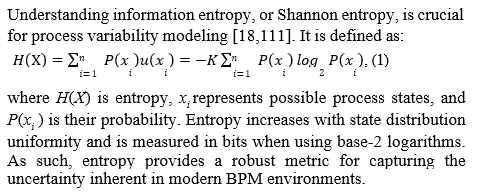
Recent advancements in computational resources enable the use of entropy-based metrics to capture uncertainty and complexity in business processes. Shannon entropy [17,18,20,21,26,27,31,36,45,50] quantifies execution variability, while Tsallis entropy allows for the modeling of non-extensive and non-linear systems. These models link with econophysics, where entropy describes business inefficiencies and systemic fluctuations [20,21,31,36,50].
Entropy increases as execution scenarios approach uniform distribution, and logical complexity corresponds to structural gateway diversity [110]. Shannon entropy measures uncertainty in discrete process execution [18,20,31,45], while Tsallis entropy captures non-extensive variability [21,26–27,36,50]. These augment traditional KPIs by adding dynamic indicators of variability. For instance, links high process entropy to increased unpredictability and planning difficulty, whereas demonstrates that lowering entropy enhances efficiency [33]. Similarly, shows how entropy improves performance monitoring and can be adapted for BPM optimization [42].
Interdisciplinary Infusions Into Econophysics: From Big Data To Epistemic Convergence
To develop a cohesive theoretical model, it is necessary to syn-thesize diverse epistemological and methodological approaches by identifying how insights from one domain address limitations in another [19]. Interdisciplinary integration—especially between physics, information science, and social sciences—has shown to enhance innovation and problem-solving [112].
The convergence of managerial and physical sciences mirrors pat- terns observed in financial economics and social systems. Four key dimensions—big data statistics, norm-challenging frameworks, academic momentum, and epistemological convergence—reveal how interdisciplinary pathways evolve.
A. Mandelbrot’s work on market irregularities influenced E. F. Fama, who applied probability theory and martingales to mod- el efficient markets [113]. Financial data exhibit non-Gaussian properties and power-law behaviors prompting adoption of entro- py-based models like Tsallis entropy to better address volatility and systemic risk [20,26,31,45,114],. High-frequency trading and big data analytics now uncover patterns previously undetectable, reshaping financial modeling [115].
B. Stylized facts in economics—macro-regularities unexplained by micro-level theory—can be interpreted using the multiple real- izability argument, which acknowledges heterogeneity at the agent level [116]. This resonates with nature’s layered complexity across different observation scales [117]. Adaptive simulations offer mi- cro-foundations for macro-patterns and deep learning holds poten- tial to refine these behavioral models further [118].
Econophysics has matured into a well-established academic field, extending from finance to energy and environmental economics [47]. Growth in academic programs, peer-reviewed publications, and research output has fostered interdisciplinary education [119]. A bibliometric analysis of econophysics from 2000 to 2019 identi- fied clusters of collaboration and highlighted foundational studies on time series, market crashes, and global network dynamics [48]. Self-citations were prominent early but declined, with physics as the dominant contributor, followed by economics. Network sci- ence and sociophysics are also gaining traction in curricula, though connecting theoretical models to social complexities remains a key challenge [120].
Recent work integrates statistical physics with economics, social systems, and network analysis [121-124], yet struggles persist in modeling long-range dependencies in markets and information flows. Entropy-based models may offer a more generalizable framework. The use of phase transition theory and renormalization group techniques to explain market scaling marked a turning point in the field’s development [125].
Statistical mechanics, long applied to thermodynamic systems, now serves as a tool to understand macro-level patterns emerging from micro-level heterogeneity [20]. Since the early 2000s, apply- ing these principles to social systems has been both promising and contentious [126,127]. Thermodynamics has influenced neoclassi- cal economic theory for over 150 years and today, the explosion of social data opens new opportunities for entropy-based modeling in sociology, economics, and organizational behavior [20,128].
Interdisciplinary Info Physics and The Foundations of En- tropic Bpm
Econophysics, as defined by Mantegna and Stanley, is the applica- tion of physical science methodologies to economic problems [47]. Its origins trace back to Mandelbrot’s pioneering work on fractal geometry, revealing self-similarity in complex systems across dis- ciplines including physics, biology, and finance [49,129]. Built on analogical reasoning, econophysics applies statistical mechanics and thermodynamics to economic data, enhancing our understand- ing of market dynamics with research collaborations marking its growth as a high-impact, interdisciplinary science [48,130].
Econophysical insights are increasingly embedded in practical domains. Physicists contribute to trading and financial analytics, applying modeling expertise to volatility and risk management [131,132]. Markets exhibit statistical properties like non-Gaussian distributions and scale invariance [20,31,36,50]. In this context, Tsallis entropy has become a core methodological tool, modeling non-extensive dynamics and systemic irregularities in financial systems [26,27,36,50].
Sociophysics, a conceptual sibling of econophysics, uses statistical physics principles to analyze group behavior, opinion dynamics, and knowledge diffusion [120,133,134]. It focuses on social inter- actions and decision-making using models derived from empirical and network-based data. While econophysics relies on quantitative financial data, sociophysics extends this to broader societal behav- iors. Integration of these fields—alongside leadership and behav- ioral theories—offers new opportunities for holistic socio-eco- nomic modeling [125].
Network science, another integral pillar, studies complexity using mathematical and computational models [135]. Statistical physics has significantly contributed to this field by enabling geometric deep learning and quantum-informed structures for communica- tion systems [136]. Proximity-based networks in econophysics facilitate modeling of interactions such as loans and ownerships and network studies now encompass tasks like clustering, link pre- diction, and information flow analysis [137].
Quantized information systems treat network operators as statis- tical ensembles, allowing density matrix construction for measur- ing complexity via von Neumann entropy [138]. In bio-networks, Rényi and Tsallis entropy help assess robustness and self-organi- zation phenomena, including social and financial networks [139]. Granger causality and association networks are crucial in mac- roeconomic modeling, often requiring exhaustive testing due to the exponential growth in node combinations [140,141]. Filtering techniques, such as minimum spanning trees, enhance interpret- ability and efficiency of financial networks with empirical roots in interdisciplinary studies led by physicists [36,142,143, [144].
Informatics serves as a critical foundation for “infophysical” thinking. In fields like medical informatics, data governance and AI-enhanced diagnostics address diagnostic variance [145–147]. Similarly, bioinformatics leverages data-intensive computation to detect nuanced patterns in biological data [148,149]. Informatics also reshapes social disciplines—urban informatics being a prime example—through participatory and ethically grounded smart systems [150,151]. In managerial contexts, informatics supports continuum thinking in complex data governance environments [46,152].
Info physics emerges at the intersection of BPM, statistical phys- ics, and information theory. While the term is not yet standard- ized, this systematic review proposes info physics as a conceptual framework for entropy-driven optimization of business processes. Grounded in information entropy, data compression, thermody- namics, and statistical mechanics [18,67,111]. it seeks to model the efficiency and flow of information across structured systems. This lens offers a novel view of process complexity, enabling im- provements in BPM systems through entropy-based metrics and physical modeling techniques.
Entropy generalization further supports this integration. Organi- zational systems can be viewed thermodynamically as open sys- tems subject to stochastic variability [9,44]. Metrics like Kull- back-Leibler, transfer entropy, and Rényi entropy enable signal filtering, dynamic structure detection, and systemic risk analysis in financial markets [20]. These approaches extract meaning from noisy environments by isolating high-influence interactions.
Moreover, Granger causality—originally developed for econo- metrics—has been generalized in physics and shown to align with transfer entropy in Gaussian conditions, underscoring its interdis- ciplinary applicability [153–155]. Georgescu-Roegen’s thermo- dynamic view of economics connects energy irreversibility with resource constraints and challenges to sustainable growth [50]. This entropic interpretation frames economics as a non-reversible system in constant degradation, reinforcing entropy’s central role in long-term planning.
Recent applications of entropy include cryptocurrency market dynamics stock prediction and pandemic-induced fluctuations contributing to an expanded scope for econophysics [21-24,156]. While power-law distributions reveal enduring volatility, tradi- tional Lévy models fail to fully explain these effects [25]. A deeper microscopic-to-macroscopic analysis—bridging fluctuations with emergent patterns—remains essential.
Ultimately, info physics proposes a cross-disciplinary framework for modeling information-rich, entropy-sensitive environments such as BPM systems. By uniting managerial science with phys- ics, it supports innovations in predictability, resource allocation, and systemic resilience—foundational goals for 21st-century busi- ness process design.
The Involutional Nexus Of Entropy: From Physical Roots To Informational Systems
The concept of entropy emerged during the Industrial Revolution through studies of heat-work conversion and energy dissipation. While energy conservation was firmly established R. Clausius redefined heat flow in cyclic processes, introducing entropy to explain irreversible transformations [157,158]. Pioneers like Watt and Carnot refined heat engines, while Joule and Mayer advanced mechanical energy theory under significant skepticism [159–162]. These developments shaped the foundation of modern thermodynamics and statistical mechanics.
Entropy quantifies the energy in a system that is unavailable for useful work [26]. Thermodynamically, it reflects disorder and the number of possible microscopic configurations of particles in isolated, closed, or open systems with nonequilibrium definitions presenting ongoing challenges [163,164]. Clausius described entropy as a measure of energy degradation, later expanded to chemical reactions and molecular energy distributions [165–168]. Modern literature frames entropy across three interpretations: as a physical property, a measure of information generation, and a statistical inference tool [169].
Clausius’s foundational laws of thermodynamics encapsulated entropy’s role in natural progression: “The energy of the world is constant; the entropy of the world tends toward a maximum” [68]. His reinterpretation of Carnot’s reversible cycle laid the groundwork for entropy’s broader application extending from equilibrium thermodynamics to real-world irreversible processes [43], [37,43,170171]. Today, entropy underpins analyses in cosmology life sciences geophysics chemistry and social science domains including economics linguistics, and organizational management [9,23,26,28,38,41, 172–179].
Yet, entropy’s application across disciplines introduces conceptual fragmentation—particularly between thermodynamic, statistical, and informational definitions [26]. A unified view is needed, especially for integrating entropy into systems like BPM where complexity, uncertainty, and variability intersect.
Entropy’s universality lies in its foundational invariance. Boltzmann and Gibbs formalized this with statistical mechanics, introducing core relations such as:

where S is entropy, kB is Boltzmann’s constant, and W the number of microstates [167,180]. Entropy is grounded in universal principles that apply across disciplines, independent of the specific statistical framework or physical composition of matter [167]. It emerges from the probabilistic structure of natural processes and reflects the system's uncertainty and disorder. Its validity, regardless of methodology, depends on consistency with foundational theoretical constructs [181–183].
Boltzmann, expanding on Maxwell's molecular dynamics, provided a statistical basis for thermodynamics by linking
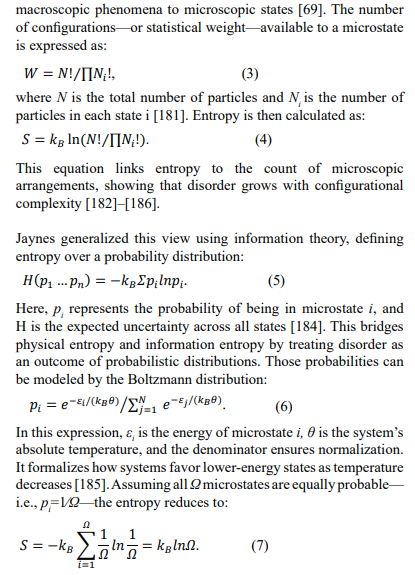
This is the well-known Boltzmann entropy formula, derived from the principle of equal a priori probabilities and showing that entropy increases with the logarithm of the number of accessible microstates [186–189].
Ultimately, Boltzmann and Gibbs demonstrated that entropy reflects the statistical nature of macroscopic phenomena. Their work established entropy as a unifying concept across physics and information theory, explaining why systems evolve toward states of maximum disorder—the most statistically probable configurations [190].
Entropy, Information, And Uncertainty: Toward A Unified Framework For Complex Systems
Recent research confirms that information entropy plays a foundational role in modeling complexity, structure, and uncertainty across disciplines. In colloidal systems, entropy alone can drive self-organization without energetic input [191]. In biomolecular environments, it governs non-equilibrium dynamics while in risk management, it enables quantitative approaches to uncertainty [30]. These examples reinforce entropy’s function as a cross-cutting analytical tool—but also expose divergent assumptions in its interpretation.
Shannon's communication theory reframed entropy as a probabilistic measure of uncertainty, echoing thermodynamic formulations [192]. By quantifying limits in signal transmission and modeling noise, Shannon established upper bounds for reliable communication [193,194]. His use of Maxwell's demon metaphor illustrated how knowledge modifies system behavior. Yet, the parallel between Shannon's and Boltzmann's equations'though mathematically elegan'rests on a conceptual ambiguity: are these entropies truly interchangeable, or merely analogous? [31].
Boltzmann's entropy, which quantifies microstate multiplicity is often equated to information entropy, yet this equivalence is not straightforward. Brillouin's negentropy argument that information is negative entropy attempted to resolve Maxwell's demon paradox but introduced a problematic inversion: thermal entropy cannot be negative, and transmitted information must remain physically realizable [195,196]. This unresolved contradiction underscores deeper issues with equating physical and semantic domains.
Landauer's principle addressed this by grounding information in thermodynamic irreversibility: erasing one bit produces heat,quantified by:

computation and physical entropy, reinforcing the materiality of information. Jaynes extended this logic, interpreting entropy as missing microstate information and linking macroscopic thermodynamic laws with probabilistic models [199]. Though not equivalent, thermodynamic and informational entropy can be expressed in the same units, such as bits [45].
Critically, this unification remains epistemological, not ontological. Layers argued that total system information includes both known values and entropy as uncertainty suggesting a complementary relationship. Knowledge acquisition reduces entropyâ??but only within a bounded interpretive frame [200,201]. Finally, if entropy and information are indeed entangled, they must obey reciprocal laws not just within a system, but across its interface with the environment. The conservation of total entropy- information has been proposed at a cosmological scale but this remains more metaphysical than empirica-highlighting the need for rigorous frameworks like info physics to operationalize these analogies[202,203].
Shannon's foundational contribution to information theory introduced entropy as a probabilistic measure of information content and uncertainty [67]. The total information I transmitted from a finite source with M possible messages is given by:

For binary systems, such as N relay circuits with two states each, the information capacity becomes:

This binary abstraction laid the groundwork for digital encoding and system-level quantification.
Shannon entropy is defined as the average uncertainty per symbol, formalized in parallel to Boltzmann's entropy:

where pi denotes the probability of observing symbol i [26, 27,204,205]. Building on this, Cumulative Residual Entropy (CRE) has emerged as a refinement for non-parametric datasets, particularly in finance and risk [206]. Unlike Shannon entropy, CRE is concave, nonlinear, and sensitive to historical dependencies- ideal for modeling fractional-order and heavy-tailed data distributions. This connects to residual entropy in physical systems, such as imperfect crystals at near-zero temperature, where disorder persists despite minimized energy [207,208].
The degradation of a binary message- where parts of the sequence are lost or altered-serves as a useful analogy for rising entropy. Just as corrupted information increases uncertainty, residual entropy describes persistent disorder in physical systems like imperfect crystals, even at low energy states [207,208].
This analogy supports the broader categorization of entropy into three major forms: thermal, residual, and informational. As Popovic and others explain these categories differ in context and units-joules per kelvin in material sciences, bits in information theory-but share a probabilistic foundation [209,210]. Each form expresses how uncertainty or disorder evolves within different types of systems.
Rather than focusing on formal equations, what matters is the conceptual bridge: entropy consistently reflects the limits of structure and predictability. Whether modeling energy dispersion, structural imperfection, or communication loss, entropy highlights the dynamics of systems moving toward less ordered states.
This trifold view creates a common ground for interdisciplinary integration. It also builds the theoretical foundation for applying entropy to BPM, where managing variability, unpredictability, and informational degradation is increasingly critical.
Empirical Foundations And Analogical Extensions Of In- formation Entropy In Bpm
The systematic review conducted through the PRISMA framework reveals that the concept of process information entropy emerged well before 2018, with its foundational application in BPM environments presented by Jung in 2008 [32]. This early study assessed task execution uncertainty by quantifying entropy in control-flow constructs, thereby offering a mathematical lens for improving workflow scheduling and resource assignment.
Subsequent advancements formalized entropy's use in capturing process variability and control-flow uncertainty, providing metrics tailored to dynamic environments [33]. These studies marked a shift from conceptual application to performance-oriented BPM design.
Entropy-based clustering and resource optimization, as implemented in real-world healthcare settings pushed this further.By leveraging process mining to predict task preferences and optimize allocation, the Multi-Criteria Resource Recommendation (MCRR) method outperformed heuristic and learning-based approaches. This confirmed entropy's utility in balancing workloads and enhancing process efficiency.
Beyond BPM-specific models, broader empirical research has demonstrated entropy's relevance in organizational processes. A bibliometric analysis spanning 980 articles linked entropy not only to accounting and decision-making structures but also to organizational communication and cultural flow'suggesting entropy operates beyond formal process frameworks [9].
A notable example from educational systems during the COVID-19 crisis illustrates entropy's practical influence. In a study on real-time online courses across Greater China entropy was used to describe uncertainty stemming from fragmented digital delivery[211]. By reducing this entropy-through improved integration across platforms'educational outcomes and resource allocation improved. While not BPM in name, the process-oriented nature of this entropy reduction is structurally analogous.
Likewise, an entropy-weighted model for real-time mobile device performance used a combination of time series data and the TOPSIS method to improve user experience and responsiveness [42]. Entropy enabled more accurate signal weighting and dynamic adaptation, demonstrating its role in optimizing responsiveness under variability.
These cases support a broader inference through analogical induction: if entropy-based methodologies have succeeded in systems characterized by dynamic flows and resource constraints, then their application in BPM is not only plausible but theoretically justified [212,213]. Though this reasoning is not deductively certain, it presents a robust framework for exploring entropy's translational potential.
Foundational studies and align entropy with BPM's core tenets' uncertainty reduction, resource optimization, and execution clarity. Other studies reinforce entropy's adaptability in real- time environments[9,32,33,40,42,211]. Together, they establish a coherent bridge between empirical implementations and BPM- specific design logic.
This review thus situates information entropy not just as a borrowed metaphor, but as a measurable, operational construct with tested utility. It lays the groundwork for further inquiry into how entropy can help manage risk, variability, and optimization in increasingly complex business processes.
Discussion
Systemic Foundations Of Bpm: Toward an Info physical Perspective
This review synthesizes BPM with complexity theory, information entropy, and foundational principles from physics to propose a structured and adaptive process management model. Standardized BPM frameworks are shown to improve consistency and efficiency, while emerging technologies such as blockchain, AI, and big data further extend BPM's relevance in addressing complex organizational challenges [1,2,5, 85–87].
Shannon’s information entropy offers a quantitative lens for evaluating process variability, enriching traditional KPI systems by capturing dynamic behaviors [17,32,40,110]. Its practical applications in healthcare settings demonstrate that entropy metrics can support optimal workload distribution and resource management [40]. Furthermore, Popovic’s tripartite classification—thermal, residual, and informational entropy— offers a conceptual basis for understanding process variability in BPM [70].
Interdisciplinary perspectives from econophysics and statistical mechanics contribute models that sharpen BPM's applicability in complex social and economic systems [20,47,49,121]. Collectively, these findings support a framework that leverages entropy to improve operational predictability and efficiency in sectors marked by high variability, such as healthcare [17,32,33,40].
Evaluation Of The Working Hypothesis
Hypothesis: The central hypothesis of this review suggests that integrating BPM with entropy-based metrics forms a cohesive managerial framework that enhances process efficiency by embedding structured, physics-informed methodologies. This was examined through a PRISMA-guided systematic review [51], drawing from both theoretical and empirical sources. The evidence confirms a synergistic potential between BPM and entropy models for optimizing processes and enhancing decision-making.
Validation and Falsification Criteria: Information entropy introduces quantifiable means for addressing process uncertainty in structured business environments [74,107]. Its ability to measure variability allows decision-makers to assess and reduce unpredictability in scheduling and resource distribution [17,32,110]. Empirical data further shows that lower entropy levels correlate with improved operational efficiency, as seen in mobile device performance models and healthcare BPM scenarios [33,48]. The evidence affirms the hypothesis: entropy-enhanced BPM constitutes a viable, scalable framework for managing uncertainty and complexity across domains. Insights from econophysics and statistical mechanics further reinforce its theoretical robustness and cross-domain applicability [20,28,126,178].
LEMMA 1. This lemma synthesizes the findings and conceptu- ally anchors the proposed framework.
Literary evidence across BPM and information entropy reveals a converging pattern. When interpreted through inductive reasoning, this pattern supports the integration of both fields under the metaparadigm of managerial infophysics.
This lemma synthesizes the empirical and theoretical convergence, indicating that managerial infophysics—defined as a unified framework that bridges entropy metrics with BPM—offers both conceptual and applied utility [214].
Emergent Research Questions and Expected Outcomes: Au- tomated BPM can significantly enhance process alignment and resource optimization, paving the way for more agile business architectures [15]. Likewise, econophysical modeling in finance provides novel tools for evaluating risk, improving systemic resil- ience [215,216].
In tandem, advanced statistical methodologies enhance entropy- based frameworks, particularly in analyzing uncertainty-prone environments and social dynamics [144]. From these intersections, three research questions and their corresponding outcomes are proposed:
• ERQ1: How can industry-specific BPM frameworks enhance synchronization and reduce organizational fragmentation?
• EEO1: Such frameworks are expected to improve consistency and efficiency across verticals by aligning fragmented operations.
• ERQ2: In what ways can automation in BPM reduce manual interventions and improve process accuracy?
• EEO2: Automation leads to optimal resource use, increased accuracy, and a more responsive BPM infrastructure.
• ERQ3: How can econophysical risk models and statistical analysis of intraday data deepen our understanding of organizational behavior?
• EEO3: These models can yield improved financial resilience and more granular insights into social systems, benefiting both strategic and operational planning.
Mplications And Future Outlook Of Entropy-Integrated Bpm
Using the PRISMA framework, this review outlines BPM’s evolution across disciplines and its integration with entropy- driven approaches. Core principles—value creation, optimization, standardization, and effective management—emerged alongside paradigms like quality control, epistemic management, and IT innovations, including TQM, Six Sigma, and ERP systems [217–219]. Languages like BPMN and historical-data-based probabilistic models support managing structural complexity and predicting process uncertainty [217–219].
Transdisciplinary integration, particularly through entropy, strengthens BPM by applying universal laws of energy and uncertainty to structured operations [33,215,220–222]. Yet, entropy remains underutilized strategically [223]. Foundational obstacles and limited conceptual clarity hinder its organizational integration. Structural inefficiencies caused by organizational entropy reinforce BPM’s relevance in managing variability [17,18,32,33,40,107,110].
Challenges include fragmented modeling tools, OR-join ambiguities, and limited human-centered frameworks [224-230]. Real-time data processing via Digital Process Twins (DPTs) shows promise for performance monitoring but raises issues of computational cost and scalability [15,216,231]. Methodological inconsistencies and definitional fragmentation remain barriers in knowledge-intensive sectors while entropy-based KPIs introduce complexity bottlenecks [109, 231–234, 235,236].
Emerging fields like econophysics and sociophysics offer predictive modeling tools to assess market dynamics, risk, and urban behavior [47,237–240]. Post-2008 critiques of conventional economics prompted cross-disciplinary interest in agent-based macro-dynamics though challenges in modeling intention limit physics-style coarse-graining in social systems [49,144,241–243].
To future-proof BPM within the managerial info physics paradigm, this review proposes the following postulations:
Context-Specific Adaptation: BPM should reflect industry- specific and organizational cultures.
Competency Development: Establish governance structures and performance metrics.
Stakeholder-Centric Design: Foster adoption through active participant engagement.
Technological Compatibility: Balance system customization and integration cost-effectively.
Continuous Evolution: Embed feedback mechanisms for adaptability and resilience.
These postulations support the transition of BPM into a dynamic, entropy-informed framework that is equipped to manage uncertainty, foster innovation, and optimize resource allocation across complex systems.
Future Research Trajectories And Limitations In Entropy- Informed Bpm
The intersection of BPM and information entropy reveals considerable opportunities for advancing predictive modeling and adaptive process design. Notably, entropy-driven frameworks can enhance dynamic decision-making and evaluate organizational change preemptively through models that incorporate analytics, machine learning, and complexity theory [244-246]. These adaptive models, grounded in interdisciplinary synthesis, can quantify process predictability, optimize resource allocation, and manage complexity using entropy-based computational tools [247, 248].
Modern BPM systems must support explorative capabilities alongside operational stability. Explorative BPM—emphasizing external trend detection and innovation—aligns naturally with managerial info physics by broadening traditional BPM scopes [216,228]. Methodologies integrating IIoT-driven data and Complex Event Processing (CEP) may improve real-time execution, automation, and decision-making [15]. However, practical frameworks for Explorative BPM remain underdeveloped [216,249].
Entropy-informed BPM also invites the development of performance metrics rooted in probabilistic reasoning, which can reduce inefficiencies through blockchain-based information resilience [250-255]. Research should address known tool limitations and embed human-system interaction into standardized BPM frameworks [230]. This includes balancing innovation with process reliability and developing fractal or complexity- driven models for social systems particularly relevant to smart manufacturing [256–261].
Although the conceptual underpinnings of managerial info physics are strong, practical implementation remains nascent. Future efforts should focus on real-time entropy modeling tools and refining methods for empirical testing [258].
The scalability and generalizability of entropy-integrated BPM face several challenges. While conceptually robust, entropy’s practical deployment across sectors demands deeper empirical support [9,262]. BPM tools often lack adaptability for high- variability environments and struggle to model uncertainty, particularly in industries with dynamic, human-influenced processes [17,32,33,71,72,74, 81,107,110].
The internal focus of traditional BPM constrains innovation and limits responsiveness to external environmental shifts [216]. As PAIS and hyper-automation evolve, scalability pressures mount, particularly as manual tasks increase system complexity and cognitive load [263]. Rigid legacy frameworks frequently fail to align with modern manufacturing and digital transformation demands [264].
Moreover, entropy’s value as a measure of process unpredictability remains under-leveraged, partly due to methodological inconsistencies and measurement complexities [33,206,265]. Traditional BPM systems also tend to prioritize individual components over systemic coherence, hampering holistic cross- organizational process governance.
Finally, data scarcity and abstract modeling constraints present methodological limitations. The empirical quantification of organizational entropy remains difficult while static BPM approaches overlook emergent uncertainty dimensions [266,267]. Adapting to digital transformation requires real-time responsiveness and robust metric standardization [255]. Without durable implementation frameworks, tools become obsolete, and hyper-automation may increase systemic fragility unless BPM evolves toward more adaptive, entropy-sensitive models [231,266].
Conclusion
This systematic review initially aimed to explore the convergence of econophysics and managerial science. However, during the research process, it became evident that the integration of information entropy necessitated a broader theoretical scope, prompting the inclusion of informatics as a bridging discipline between physics and information science. Following early dissemination of preliminary results at the 33rd European Conference on Operational Research the study’s scope and title were refined to better reflect its interdisciplinary breadth [268].
Anchored in the PRISMA methodology, this review evaluated both in-scope and select out-of-scope works for contextual significance. Drawing a parallel with physical systems—where homogeneous states in equilibrium and heterogeneous systems in quasi-stationary states are both of interest—BPM is proposed here as a framework for examining open, dynamic, and complex systems through the analytical lens of information entropy.
Using analogical induction as a methodological guide, this work proposes interdisciplinary connections grounded in precedent. This approach, while lacking deductive certainty, supports hypothesis formation by applying established theories in novel contexts, exemplified historically through the transfer of thermodynamic and biological models into economics and [269].
A core contribution of this review is the substantiation of entropy- based metrics in BPM. Originally used to quantify uncertainty in thermodynamics and information theory, entropy now shows promise in quantifying execution uncertainty and variability within business workflows [270]. Developing a formal tool to empirically measure execution entropy would provide a unified and scalable method to identify inefficiencies and enhance predictability in high-variability sectors.
However, conceptual misapplications of entropy remain common. Clarifying the distinctions between thermodynamic, residual, and informational entropy is essential [177]. Among these, information entropy—while rooted in communication theory—emerges as the most versatile, with applications spanning biomolecular systems, risk analysis, and process.
The review also identifies entropy as a bridge between theoretical modeling and strategic decision-making, applicable in evaluating system complexity, density, and cohesiveness in BPM [204]. Moreover, the emergence of cognitive weight models and resource-alignment strategies based on entropy further underlines its practical potential [6,270].
Econophysics continues to contribute theoretical tools for understanding systemic dynamics, though its integration into BPM remains underdeveloped [125]. Meanwhile, advances in simulation and process mining present opportunities to improve training and execution models by connecting event data with entropy-based metrics [163,269].
Importantly, entropy also influences organizational culture and responsiveness. By quantifying systemic variability, it offers a framework for aligning resource flexibility with customer- centric strategies, enabling firms to respond more effectively to volatile environments [38,41,132]. Managerial infophysics, as proposed, unifies these insights into a metaparadigm that interprets processes as interrelated systems, emphasizing outputs, dialectical interactions, and the role of managerial cognition in shaping organizational evolution.
While Shannon entropy remains the prevailing model in BPM literature, recent developments in econophysics and financial modeling suggest that q-Tsallis entropy—used in modeling non- Gaussian distributions and long-range dependencies—could extend the theoretical and practical reach of BPM [20,271–274]. Though underrepresented in BPM-specific studies, its demonstrated applicability in risk assessment and volatility modeling presents a compelling direction for future research.
Ultimately, managerial info physics is proposed as a metaparadigm that conceptualizes business processes through the lens of systemic interconnectivity and informational dynamics. While its empirical validation remains limited, this framework provides a novel epistemological foundation for advancing BPM as both a theoretical construct and an adaptive management tool in complex, data-driven environments.
Acknowledgement
This research was partially funded by New York College, Athens, Greece.
References
- Nousias, N., Tsakalidis, G., & Vergidis, K. (2024). Not yet an- other BPM lifecycle: A synthesis of existing approaches using BPMN. Information and Software Technology, 171, 107471.
- Nandakumar, N., Saleeshya, P. G., & Harikumar, P. (2020). Bottleneck identification and process improvement by lean six sigma DMAIC methodology. Materials Today: Proceed- ings, 24, 1217-1224.
- Ayech, H. B. H., Ghannouchi, S. A., & Amor, E. A. E. H. (2021). Extension of the BPM lifecycle to promote the main- tainability of BPMN models. Procedia Computer Science, 181, 852-860.
- Tomaskova, H., Tirkolaee, E. B., & Raut, R. D. (2023). Busi- ness process optimization for trauma planning. Journal of Business Research, 164, 113959.
- Arredondo-Soto, K. C., Blanco-Fernández, J., Miranda-Ack- erman, M. A., Solís-Quinteros, M. M., Realyvasquez-Vargas, A., & García-Alcaraz, J. L. (2021). A plan-do-check-act based process improvement intervention for quality improvement. IEEE Access, 9, 132779-132790.
- Kerpedzhiev, G. D., König, U. M., Röglinger, M., & Rose- mann, M. (2021). An exploration into future business process management capabilities in view of digitalization: results from a Delphi study. Business & Information Systems Engi- neering, 63(2), 83-96.
- Badakhshan, P., Scholta, H., Schmiedel, T., & vom Brocke, J. (2023). A measurement instrument for the “ten principles of good BPM”. Business Process Management Journal, 29(6), 1762-1790.
- Brinch, M., Gunasekaran, A., & Wamba, S. F. (2021). Firm-level capabilities towards big data value creation. Jour- nal of Business Research, 131, 539-548.
- Abad-Segura, E., González-Zamar, M. D., & Squillante, M. (2021). Examining the research on business information-en- tropy correlation in the accounting process of organizations. Entropy, 23(11), 1493.
- Ibidapo, T. A. (2022). From Industry 4.0 to Quality 4.0. Man- agement for Professionals.
- Grisold, T., Groß, S., Stelzl, K., vom Brocke, J., Mendling, J., Röglinger, M., & Rosemann, M. (2022). The five diamond method for explorative business process management. Busi- ness & Information Systems Engineering, 64(2), 149-166.
- Pufahl, L., Zerbato, F., Weber, B., & Weber, I. (2022). BPMN in healthcare: Challenges and best practices. Information Sys- tems, 107, 102013.
- Aydiner, A. S., Tatoglu, E., Bayraktar, E., Zaim, S., & Del- en, D. (2019). Business analytics and firm performance: The mediating role of business process performance. Journal of business research, 96, 228-237.
- Bowen, J. P. (2018). The impact of Alan Turing: Formal meth- ods and beyond. In International Summer School on Engi- neering Trustworthy Software Systems (pp. 202-235). Cham: Springer International Publishing.
- Seiger, R., Malburg, L., Weber, B., & Bergmann, R. (2022). Integrating process management and event processing in smart factories: A systems architecture and use cases. Journal of Manufacturing systems, 63, 575-592.
- Domínguez, E., Pérez, B., Rubio, A. L., & Zapata, M. A. (2019). A taxonomy for key performance indicators manage- ment. Computer Standards & Interfaces, 64, 24-40.
- Abdar, M., Pourpanah, F., Hussain, S., Rezazadegan, D., Liu, L., Ghavamzadeh, M., ... & Nahavandi, S. (2021). A review of uncertainty quantification in deep learning: Techniques, appli- cations and challenges. Information fusion, 76, 243-297.
- Zenil, H., Hernández-Orozco, S., Kiani, N. A., Soler-Toscano, F., Rueda-Toicen, A., & Tegnér, J. (2018). A decomposition method for global evaluation of Shannon entropy and local estimations of algorithmic complexity. Entropy, 20(8), 605.
- Roux, T. (2019). Interdisciplinary synergies in comparative research on constitutional judicial decision-making. Ver- fassung und Recht in Übersee/Law and Politics in Africa, Asia and Latin America, 52(4), 413-438.
- Jakimowicz, A. (2020). The role of entropy in the develop- ment of economics. Entropy, 22(4), 452.
- Dimpfl, T., & Peter, F. J. (2019). Group transfer entropy with an application to cryptocurrencies. Physica A: Statistical Me- chanics and its Applications, 516, 543-551.
- Grilli, L., & Santoro, D. (2022). Forecasting financial time se- ries with Boltzmann entropy through neural networks. Com- putational Management Science, 19(4), 665-681.
- Kim, S., Ku, S., Chang, W., & Song, J. W. (2020). Predicting the direction of US stock prices using effective transfer entro- py and machine learning techniques. IEEE Access, 8, 111660- 111682.
- Qiu, L., & Yang, H. (2020). Transfer entropy calculation for short time sequences with application to stock markets. Physi- ca A: Statistical Mechanics and Its Applications, 559, 125121.
- Li, A. W., & Bastos, G. S. (2020). Stock market forecasting using deep learning and technical analysis: a systematic re- view. IEEE access, 8, 185232-185242.
- Natal, J., Ávila, I., Tsukahara, V. B., Pinheiro, M., & Maciel,C. D. (2021). Entropy: From thermodynamics to information processing. Entropy, 23(10), 1340.
- Tsallis, C. (2022). Entropy. Encyclopedia, 2(1), 264-300.
- Filina, E., & Shindina, T. (2024, April). Organization of Sup- port and Education for Adults in the Context of Transition to the Concept of Information Society. In 2024 7th International Conference on Information Technologies in Engineering Edu- cation (Inforino) (pp. 1-4). IEEE.
- Yazdani, M., Torkayesh, A. E., Santibanez-Gonzalez, E. D., & Otaghsara, S. K. (2020). Evaluation of renewable energy resources using integrated Shannon Entropy—EDAS model. Sustainable Operations and Computers, 1, 35-42.
- Mishra, S., & Ayyub, B. M. (2019). Shannon entropy for quantifying uncertainty and risk in economic disparity. Risk Analysis, 39(10), 2160-2181.
- Corral, Á., & García del Muro, M. (2020). From Boltzmann to Zipf through Shannon and Jaynes. Entropy, 22(2), 179.
- Jung, J. Y. (2008, June). Measuring entropy in business pro- cess models. In 2008 3rd International Conference on Innova- tive Computing Information and Control (pp. 246-246). IEEE.
- Jung, J. Y., Chin, C. H., & Cardoso, J. (2011). An entro- py-based uncertainty measure of process models. Information Processing Letters, 111(3), 135-141.
- Mehmood, E., & Anees, T. (2020). Challenges and solutions for processing real-time big data stream: a systematic litera- ture review. IEEE Access, 8, 119123-119143.
- Guimarães, M. H., Pohl, C., Bina, O., & Varanda, M. (2019). Who is doing inter-and transdisciplinary research, and why? An empirical study of motivations, attitudes, skills, and be- haviours. Futures, 112, 102441.
- Smolyak, A., & Havlin, S. (2022). Three decades in econo- physics—From microscopic modelling to macroscopic com- plexity and back. Entropy, 24(2), 271.
- Finn, K., Karamitsos, S., & Pilaftsis, A. (2018). Eisenhart liftfor field theories. Physical Review D, 98(1), 016015.
- Hansen, T. M. (2021). Entropy and information content of geostatistical models. Mathematical Geosciences, 53(1), 163184.
- Kissa, B., Gounopoulos, E., Kamariotou, M., & Kitsios, F. (2023). Business process management analysis with cost in- formation in public organizations: A case study at an academ- ic library. Modelling, 4(2), 251-263.
- Zhao, W., Liu, H., Dai, W., & Ma, J. (2016). An entropy-based clustering ensemble method to support resource allocation in business process management. Knowledge and Information Systems, 48, 305-330.
- Dinga, E., TÃÂ??nÃÂ??sescu, C. R., & Ionescu, G. M. (2020). Socialentropy and normative network. Entropy, 22(9), 1051.
- Wang, Z., Wang, Z., Wu, J., Xiao, W., Chen, Y., Feng, Z., ... & Fu, J. (2024). Application Research On Real-Time Per- ception Of Device Performance Status. arXiv preprint arX- iv:2409.03218.
- Landi, G. T., & Paternostro, M. (2021). Irreversible entropy production: From classical to quantum. Reviews of Modern Physics, 93(3), 035008.
- Liu, Y., Ma, H., Jiang, Y., & Li, Z. (2021). Learning to recom- mend via random walk with profile of loan and lender in P2P lending. Expert Systems with Applications, 174, 114763.
- Çengel, Y. A. (2021). On entropy, information, and conserva- tion of information. Entropy, 23(6), 779.
- Arhami, M., Desiani, A., & Hayati, R. (2018). Eco-informat- ics: The Encouragement of Ecological Data Management. In Proceedings of MICoMS 2017 (Vol. 1, pp. 555-561). Emerald Publishing Limited.
- Ferreira, P., Pereira, É. J., & Pereira, H. B. (2020). From Big Data to Econophysics and its use to explain complex phenom- ena. Journal of Risk and Financial Management, 13(7), 153.
- Sharma, K., & Khurana, P. (2021). Growth and dynamics of Econophysics: a bibliometric and network analysis. Sciento- metrics, 126(5), 4417-4436.
- Jovanovic, F., Mantegna, R. N., & Schinckus, C. (2019). When financial economics influences physics: The role of Econophysics. International review of financial analysis, 65, 101378.
- Udriste, C., Ferrara, M., Tevy, I., Zugravescu, D., & Muntea- nu, F. (2019). Entropy of Reissner–Nordström 3D Black Hole in Roegenian Economics. Entropy, 21(5), 509.
- Page, M. J., McKenzie, J. E., Bossuyt, P. M., Boutron, I.,Hoffmann, T. C., Mulrow, C. D., ... & Moher, D. (2021). The PRISMA 2020 statement: an updated guideline for reporting systematic reviews. bmj, 372.
- Gough, D., Thomas, J., & Oliver, S. (2019). Clarifying differ- ences between reviews within evidence ecosystems. System- atic reviews, 8, 1-15.
- Moher, D. (2018). Reporting guidelines: doing better for read- ers. BMC medicine, 16(1), 233.
- Leclercq, V., Beaudart, C., Ajamieh, S., Rabenda, V., Tirelli, E., & Bruyere, O. (2019). Meta-analyses indexed in PsycIN- FO had a better completeness of reporting when they mention PRISMA. Journal of Clinical Epidemiology, 115, 46-54.
- Marshall, I. J., & Wallace, B. C. (2019). Toward systematic re- view automation: a practical guide to using machine learning tools in research synthesis. Systematic reviews, 8, 1-10.
- McKenzie, J. E., & Brennan, S. E. (2019). Synthesizing and presenting findings using other methods. Cochrane handbook for systematic reviews of interventions, 321-347.
- Higgins, J. P., López-López, J. A., Becker, B. J., Davies, S. R.,Dawson, S., Grimshaw, J. M., ... & Caldwell, D. M. (2019). Synthesising quantitative evidence in systematic reviews of complex health interventions. BMJ global health, 4(Suppl 1), e000858.
- Shea, B. J., Reeves, B. C., Wells, G., Thuku, M., Hamel, C., Moran, J., ... & Henry, D. A. (2017). AMSTAR 2: a critical ap- praisal tool for systematic reviews that include randomised or non-randomised studies of healthcare interventions, or both. bmj, 358.
- Hultcrantz, M., Rind, D., Akl, E. A., Treweek, S., Mustafa, R. A., Iorio, A., ... & Guyatt, G. (2017). The GRADE Working Group clarifies the construct of certainty of evidence. Journalof clinical epidemiology, 87, 4-13.
- Asar, S. H., Jalalpour, S. H., Ayoubi, F., Rahmani, M. R., & Rezaeian, M. (2016). PRISMA; preferred reporting items for systematic reviews and meta-analyses. Journal of Rafsanjan University of Medical Sciences, 15(1), 68-80.
- Dekkers, O. M., Vandenbroucke, J. P., Cevallos, M., Rene- han, A. G., Altman, D. G., & Egger, M. (2019). COSMOS-E:guidance on conducting systematic reviews and meta-analy- ses of observational studies of etiology. PLoS medicine, 16(2), e1002742.
- EFQM. (2023). “About EFQM,” [Online]. Available: https:// efqm.org/about/.
- ISO. (2023). “About Us,” [Online]. Available: https://www. iso.org/about-us.html.
- ARIS. (2024). “ARIS Platform by Software AG,” [Online]. Available: https://www.softwareag.com/en_corporate/plat- form/aris.html.
- SAP. (2024). “SAP Community,” [Online]. Available: https:// community.sap.com/.
- Object Management Group. (2024). “About OMG,” [On- line]. Available: https://www.omg.org/about.
- Shannon, C. E. (1948). A mathematical theory of communica- tion. The Bell system technical journal, 27(3), 379-423.
- Clausius, R. (1865). On various forms of the principal equa- tions of mechanical theory. Ann. Phys, 201, 353-400.
- L, Boltzmann. (1872). “Further Studies on the Thermal Equi- librium among Gas Molecules,” Proceedings of the Academic Scientific Sessions, part II, vol. 66, pp. 275-370, 1872; re- printed in Scientific Papers, vol. I, Leipzig, Germany: J. A. Barth, 1909, pp. 316-402
- Popovic, M. (2017). Researchers in an entropy wonder- land: A review of the entropy concept. arXiv preprint arX- iv:1711.07326.
- Dumas, M., Van der Aalst, W. M., & Ter Hofstede, A. H. (2005). Process-aware information systems: bridging people and software through process technology. John Wiley & Sons.
- Schwerz, A. L., Liberato, R., Pu, C., & Ferreira, J. E. (2018). Robust and reliable process-aware information systems. IEEE Transactions on Services Computing, 14(3), 820-833.
- Borkowski, M., Fdhila, W., Nardelli, M., Rinderle-Ma, S., & Schulte, S. (2019). Event-based failure prediction in distrib- uted business processes. Information Systems, 81, 220-235.
- Rodríguez-Mantilla, J. M., Martínez-Zarzuelo, A., & Fernán- dez-Cruz, F. J. (2020). Do ISO: 9001 standards and EFQM model differ in their impact on the external relations and communication system at schools?. Evaluation and Program Planning, 80, 101816.
- Niknejad, N., Ismail, W., Ghani, I., Nazari, B., Bahari, M., & Hussin, A. R. B. C. (2020). Understanding Service-Ori- ented Architecture (SOA): A systematic literature review and directions for further investigation. Information Systems, 91, 101491.
- SzelÃÂ??gowski, M. (2021). Practical assessment of the nature of business processes. Information Systems and e-Business Man- agement, 19, 541-566.
- HasiÃÂ??, F., De Smedt, J., & Vanthienen, J. (2018). Augmenting processes with decision intelligence: Principles for integrated modelling. Decision Support Systems, 107, 1-12.
- Corallo, A., Crespino, A. M., Del, Vecchio. V., Gervasi, M., Lazoi, M., et al. (2023). Evaluating maturity level of big data management and analytics in industrial companies. Technol. Forecast. Soc, 196, 122826.
- Shivakumar, S. K. (2015). Project Management for Enter- prise Applications. In Architecting High Performing, Scalable and Available Enterprise Web Applications, 2nd ed.; Shiva- kumar, S.K., Ed.; Morgan Kaufmann: San Francisco, USA, 3, 199-219.
- Froger, M., Benaben, F., Truptil, S., & Boissel-Dallier, N. (2019). A non-linear business process management maturi- ty framework to apprehend future challenges. International Journal of Information Management, 49, 290-300.
- Ubaid, A. M., & Dweiri, F. T. (2020). Business process man- agement (BPM): terminologies and methodologies unified. International Journal of System Assurance Engineering and Management, 11(6), 1046-1064.
- Kanger, L., & Sillak, S. (2020). Emergence, consolidation and dominance of meta-regimes: Exploring the historical evolu- tion of mass production (1765–1972) from the Deep Transi- tions perspective. Technology in society, 63, 101393.
- Endalamaw, A., Khatri, R. B., Mengistu, T. S., Erku, D., Wol- ka, E., Zewdie, A., & Assefa, Y. (2024). A scoping review of continuous quality improvement in healthcare system: con- ceptualization, models and tools, barriers and facilitators, and impact. BMC health services research, 24(1), 487.
- Goni, J. I. C., & Van Looy, A. (2023, September). Towards a Measurement Instrument for Assessing Capabilities When Innovating Less-Structured Business Processes. In Interna- tional Conference on Business Process Management (pp. 229- 240). Cham: Springer Nature Switzerland.
- Nawari, O. N., Ravindran, S. (2019). Blockchain and the built environment: Potentials and limitations. J. Build. Eng, 25, 100832.
- Romero, M., Guédria, W., Panetto, H., & Barafort, B. (2022). A hybrid deep learning and ontology-driven approach to per- form business process capability assessment. Journal of In- dustrial Information Integration, 30, 100409.
- Surbakti, F. P. S., Wang, W., Indulska, M., & Sadiq, S. (2020). Factors influencing effective use of big data: A research frame- work. Information & Management, 57(1), 103146.
- Aggarwal, A., Aeran, H., & Rathee, M. (2019). Quality man- agement in healthcare: The pivotal desideratum. Journal of oral biology and craniofacial research, 9(2), 180-182.
- Pakdil, F. (2020). Overview of quality and six sigma. In Six Sigma for Students: A Problem-Solving Methodology (pp. 3-40). Cham: Springer International Publishing.
- Janoski, T., Lepadatu, D. (2021). Mass Merchandizing and Lean Production at Walmart, Costco, and Amazon. In: The Cambridge International Handbook of Lean Production: Di- verging Theories and New Industries around the World, 2nd ed.; Janoski, T., Lepadatu, D., Eds.; Cambridge University Press: Cambridge, United Kingdom, 350-374.
- Hidayati, A., Purwandari, B., Budiardjo, E. K., Solichah, I.(2018). Global Software Development and Capability Matu- rity Model Integration: A Systematic Literature Review. In Proc. 3rd Int. Conf. Informatics Comput. (ICIC), Palembang, Indonesia.
- Westney, E. (2020). Reflecting on Japan’s contributions tomanagement theory. Asian Business & Management, 19, 8-24.
- Ricciotti, F. (2020). From value chain to value network: a systematic literature review. Management Review Quarterly, 70(2), 191-212.
- Eisenreich, A., Füller, J., Stuchtey, M., & Gimenez-Jimenez,D. (2022). Toward a circular value chain: Impact of the circu- lar economy on a company's value chain processes. Journal of Cleaner Production, 378, 134375.
- Suárez-Gargallo, C., & Zaragoza-Sáez, P. (2023). A compre- hensive bibliometric study of the balanced scorecard. Evalua- tion and Program Planning, 97, 102256.
- Röglinger, M., Plattfaut, R., Borghoff, V., Kerpedzhiev, G., Becker, J., Beverungen, D., ... & Trkman, P. (2022). Exog- enous shocks and business process management: a scholars’ perspective on challenges and opportunities. Business & In- formation Systems Engineering, 64(5), 669-687.
- Fetais, A., Abdella, G. M., Al-Khalifa, K. N., & Hamouda,A. M. (2022). Business process re-engineering: a literature review-based analysis of implementation measures. Informa- tion, 13(4), 185.
- Szelgowski, M., Berniak-Wozny, J., & Lupeikiene, A. (2022, September). The Future Development of ERP: Towards Pro- cess ERP Systems?. In International Conference on Business Process Management (pp. 326-341). Cham: Springer Interna- tional Publishing.
- Din, A. M., Asif, M., Awan, M. U., & Thomas, G. (2020).What makes excellence models excellent: a comparison of the American, European and Japanese models. The TQM Journal, 33(6), 1143-1162.
- Heinrich, B., Krause, F., & Schiller, A. (2019). Automated planning of process models: The construction of parallel splits and synchronizations. Decision support systems, 125, 113096.
- Ocampo-Pineda, M., Posenato, R., & Zerbato, F. (2022). TimeAwareBPMN-js: An editor and temporal verification tool for Time-Aware BPMN processes. SoftwareX, 17, 100939.
- Eder, J., Franceschetti, M., & Lubas, J. (2022). Dynamic con- trollability of processes without surprises. Applied Sciences, 12(3), 1461.
- Amjad, A., Azam, F., Anwar, M. W., Butt, W. H., & Rashid,M. (2018). Event-driven process chain for modeling and ver- ification of business requirements–a systematic literature re- view. Ieee Access, 6, 9027-9048.
- Polancic, G., & Orban, B. (2023). An experimental investi- gation of BPMN-based corporate communications modeling. Business Process Management Journal, 29(8), 1-24.
- Corradini, F., Ferrari, A., Fornari, F., Gnesi, S., Polini, A., Re, B., & Spagnolo, G. O. (2018). A guidelines framework for understandable BPMN models. Data & Knowledge Engineer- ing, 113, 129-154.
- Farshidi, S., Kwantes, I. B., & Jansen, S. (2024). Business process modeling language selection for research modelers.Software and Systems Modeling, 23(1), 137-162.
- Malinova, M., & Mendling, J. (2018). Identifying do’s and don’ts using the integrated business process management framework. Business Process Management Journal, 24(4), 882-899.
- Guilherme, C., Soares, I., de Souza, D. (2021). Quality Mea- surement in Agile and Rapid Software Development. J. Syst. Softw, 111041.
- Krhac Andrašec, E., Kern, T., & Urh, B. (2023). An Innova- tive Approach to Organizational Changes for Sustainable Pro- cesses: A Case Study on Waste Minimization. Sustainability, 15(22), 15706.
- Elkhovskaya, L. O., Kshenin, A. D., Balakhontceva, M. A., Ionov, M. V., & Kovalchuk, S. V. (2023). Extending process discovery with model complexity optimization and cyclic states identification: Application to healthcare processes. Al- gorithms, 16(1), 57.
- Cincotta, P. M., Giordano, C. M., Silva, R. A., & Beaugé, C. (2021). The Shannon entropy: An efficient indicator of dy- namical stability. Physica D: Nonlinear Phenomena, 417, 132816.
- Pluchino, A., Burgio, G., Rapisarda, A., Biondo, A. E., Pul- virenti, A., Ferro, A., & Giorgino, T. (2019). Exploring the role of interdisciplinarity in physics: Success, talent and luck. PloS one, 14(6), e0218793.
- Di Nunno, G., Kubilius, K., Mishura, Y., & Yurchenko-Tyta- renko, A. (2023). From constant to rough: A survey of contin- uous volatility modeling. Mathematics, 11(19), 4201.
- Kamal, M., Aldallal, R., Nassr, S. G., Al Mutairi, A., Yusuf, M., Mustafa, M. S., ... & Almetwally, E. M. (2023). A new im- proved form of the Lomax model: Its bivariate extension and an application in the financial sector. Alexandria Engineering Journal, 75, 127-138.
- Subrahmanyam, A. (2019). Big data in finance: Evidence and challenges. Borsa Istanbul Review, 19(4), 283-287.
- Woodward, J. (2024). Some reflections on Robert Batterman's a middle way. Studies in History and Philosophy of Science, 106, 21-30.
- Del Santo, F., & Gisin, N. (2019). Physics without determin- ism: Alternative interpretations of classical physics. Physical Review A, 100(6), 062107.
- Schinckus, C. (2019). Agent-based modelling and economic complexity: a diversified perspective. Journal of Asian Busi- ness and Economic Studies, 26(2), 170-188.
- Parthey, H. (2022). Institutionalisation, interdisciplinarity, and ambivalence in research situations. The responsibility of science, 141-161.
- Tsintsaris, D., Tsompanoglou, M., & Ioannidis, E. (2024). Dy- namics of social influence and knowledge in networks: Socio- physics models and applications in social trading, behavioral finance and business. Mathematics, 12(8), 1141.
- Hong, W. T., & Hwang, E. (2022). Exponentially Weighted Multivariate HAR Model with Applications in the Stock Mar- ket. Entropy, 24(7), 937.
- Vilela, A. L., Wang, C., Nelson, K. P., & Stanley, H. E. (2019).Majority-vote model for financial markets. Physica A: Statis-tical Mechanics and its Applications, 515, 762-770.
- Mishra, D., Kandpal, V., Agarwal, N., & Srivastava, B. (2024). Financial inclusion and its ripple effects on socio-economic development: a comprehensive review. Journal of Risk and Financial Management, 17(3), 105.
- Ioannidis, E., Varsakelis, N., & Antoniou, I. (2019). Change agents and internal communications in organizational net- works. Physica A: Statistical Mechanics and its Applications, 528, 121385.
- Kutner, R., Ausloos, M., Grech, D., Di Matteo, T., Schinckus, C., & Stanley, H. E. (2019). Econophysics and sociophysics: Their milestones & challenges. Physica A: Statistical Me- chanics and its Applications, 516, 240-253.
- Robledo, A., & Velarde, C. (2022). How, why and when Tsal- lis statistical mechanics provides precise descriptions of natu- ral phenomena. Entropy, 24(12), 1761.
- Vazquez, F. (2022). Modeling and analysis of social phenom- ena: challenges and possible research directions. Entropy, 24(4), 491.
- Weinhardt, M. (2021). Big data: Some ethical concerns for the social sciences. Social Sciences, 10(2), 36.
- Hargittai, I. (2024). Remembering Benoit Mandelbrot on his centennial–His fractal geometry changed our view of nature. Structural Chemistry, 35(5), 1657-1661.
- Schinckus, C. (2018). Ising model, econophysics and analo- gies. Physica A , 508, 95-103.
- Jiang, Z. Q., Xie, W. J., Zhou, W. X., & Sornette, D. (2019). Multifractal analysis of financial markets: A review. Reports on Progress in Physics, 82(12), 125901.
- Bardoscia, M., Barucca, P., Battiston, S., Caccioli, F., Cimini, G., et al. (2021). The Physics of Financial Networks. Nat. Rev. Phys, 3, 490-507.
- De Domenico, F., Livan, G., Montagna, G., & Nicrosini, O. (2023). Modeling and simulation of financial returns under non-Gaussian distributions. Physica A: Statistical Mechanics and Its Applications, 622, 128886.
- Sobkowicz, P. (2023). Social Depolarization and Diversity of Opinions—Unified ABM Framework. Entropy, 25, 568.
- KesiÃÂ??, S. (2024). Complexity and biocomplexity: Overview of some historical aspects and philosophical basis. Ecological Complexity, 57, 101072.
- Ghavasieh, A. (2022). De Domenico, M. The physics of com- plex networks. J. Phys. Complex. 3, 011001.
- Hou, M., Ren, J., Zhang, D., Kong, X., Zhang, D. et al. (2020). Network embedding: Taxonomies, frameworks and applica- tions. Comput. Sci. Rev, 38, 100296.
- Ghavasieh, A., Nicolini, C., De Domenico, M. (2020). Statis- tical physics of complex information dynamics. Phys. Rev. E, 102, 052304.
- Ghavasieh, A. (2024). De Domenico, M. Maximum entropy network states for coalescence processes. Physica A, 643, 129752.
- Gao, X., Huang, S., Sun, X., Hao, X., & An, F. (2018). Mod-elling cointegration and Granger causality network to detect long-term equilibrium and diffusion paths in the financial sys- tem. Royal Society open science, 5(3), 172092.
- Galeano, P., & Peña, D. (2019). Data science, big data and statistics. Test, 28(2), 289-329.
- Sezer, O. B., Gudelek, M. U., & Ozbayoglu, A. M. (2020). Financial time series forecasting with deep learning: A sys- tematic literature review: 2005–2019. Applied soft computing, 90, 106181.
- Batrancea, L. M., Balci, M. A., Akgüller, Ö., & Gaban, L. (2022). What drives economic growth across European coun- tries? A multimodal approach. Mathematics, 10(19), 3660.
- Jackson, M. O., & Pernoud, A. (2021). Systemic risk in finan- cial networks: A survey. Annual Review of Economics, 13(1), 171-202.
- Liu, J., Xie, W., & Liu, S. (2024). Understanding Nursing In- formatics: A Survey of Nurses’ Perception. In Innovation in Applied Nursing Informatics (pp. 627-628). IOS Press.
- Panayides, A. S., Amini, A., Filipovic, N. D., Sharma, A., Tsaftaris, S. A., Young, A., ... & Pattichis, C. S. (2020). AI in medical imaging informatics: current challenges and future directions. IEEE journal of biomedical and health informat- ics, 24(7), 1837-1857.
- Sohn, S., Moon, S., Prokop, L. J., Montori, V. M., & Fan, J.W. (2022). A scoping review of medical practice variation re- search within the informatics literature. International journal of medical informatics, 165, 104833.
- López-López, E., Bajorath, J., & Medina-Franco, J. L. (2020). Informatics for chemistry, biology, and biomedical sciences. Journal of chemical information and modeling, 61(1), 26-35.
- Bieliska-WÃz, D., WÃz P., Bzaczkowska, A., Mandrysz, J., Lass, A., GÃzadysz, P., & Karamon, J. (2024). Mathematical modeling in bioinformatics: Application of an alignment-free method combined with principal component analysis. Symme- try, 16(8), 967.
- Foth, M. (2018). Participatory urban informatics: towards cit- izen-ability. Smart and sustainable built environment, 7(1), 4-19.
- Das, K., Pattanaik, M., Basantia, S., Mishra, R., Das, D., Sa- hoo, K., & Paital, B. (2023). Informatics on a social view and need of ethical interventions for wellbeing via interference of artificial intelligence. Telematics and Informatics Reports, 11, 100065.
- Upward, F. (2019). The monistic diversity of continuum infor- matics: A method for analysing the relationships between re- cordkeeping informatics, ethics and information governance. Records Management Journal, 29(1/2), 258-271.
- Colomer, C., Dhamala, M., Ganesh, G., & Lagarde, J. (2023). Granger Geweke Causality reveals information exchange during physical interaction is modulated by task difficulty. Human Movement Science, 92, 103139.,
- Shojaie, A., & Fox, E. B. (2022). Granger causality: A review and recent advances. Annual Review of Statistics and Its Ap- plication, 9(1), 289-319.
- Lam, W. S., Lam, W. H., Jaaman, S. H., & Lee, P. F. (2023).Bibliometric analysis of granger causality studies. Entropy, 25(4), 632.
- Maghyereh, A., Abdoh, H., & Awartani, B. (2022). Have re-turns and volatilities for financial assets responded to implied volatility during the COVID-19 pandemic?. Journal of Com- modity Markets, 26, 100194.
- Saslow, W. M. (2020). A history of thermodynamics: The missing manual. Entropy, 22(1), 77.
- Xue, T. W., & Guo, Z. Y. (2019). What is the real Clausius statement of the second law of thermodynamics?. Entropy, 21(10), 926.
- PGroumpos, P. P. (2021). A critical historical and scientific overview of all industrial revolutions. IFAC-PapersOnLine, 54(13), 464-471.
- Kelly, M., & Gráda, C. Ó. (2022). Connecting the scientific and Industrial Revolutions: The role of practical mathematics. The Journal of Economic History, 82(3), 841-873..
- Lopes Coelho, R. (2021). On the energy concept problem: Ex- periments and interpretations. Foundations of Science, 26(3), 607-624.
- Bhat, R. M., Silllalee, A., & Kandasamy, L. S. (2023). Con- cepts and contexts: The interplay of philosophy and history in understanding human society. East Asian Journal of Multidis- ciplinary Research, 2(6), 2581-2590..
- Gedde, U. W., & Gedde, U. W. (2020). An Introduction to Thermodynamics and the First Law. Essential Classical Ther- modynamics, 1-12.
- Lucia, U., & Grisolia, G. (2021). Nonequilibrium tempera- ture: an approach from irreversibility. Materials, 14(8), 2004.
- Namdari, A., & Li, Z. (2019). A review of entropy measures for uncertainty quantification of stochastic processes. Advanc- es in Mechanical Engineering, 11(6), 1687814019857350.,.
- Sciortino, F. (2019). Entropy in self-assembly. La Rivista del Nuovo Cimento, 42(11), 511-548.
- Ribeiro, M., Henriques, T., Castro, L., Souto, A., Antunes, L., Costa-Santos, C., & Teixeira, A. (2021). The entropy uni- verse. Entropy, 23(2), 222.
- Schmelzer, J. W., & Tropin, T. V. (2018). Glass transition, crystallization of glass-forming melts, and entropy. Entropy, 20(2), 103.
- Li, W., Zhao, Y., Wang, Q., & Zhou, J. (2019). Twenty years of entropy research: A bibliometric overview. Entropy, 21(7), 694.
- Sands, D. (2021). The carnot cycle, reversibility and entropy.Entropy, 23(7), 810.
- Tsallis, C. (2019). Black hole entropy: A closer look. Entropy, 22(1), 17.
- Sheykhi, A. (2023). Modified cosmology through Barrow en- tropy. Physical Review D, 107(2), 023505.,
- Aristov, V. V., Buchelnikov, A. S., & Nechipurenko, Y. D. (2022). The use of the statistical entropy in some new ap- proaches for the description of biosystems. Entropy, 24(2), 172.
- Li, B., Liu, B., Guo, K., Li, C., & Wang, B. (2019). Applica- tion of a maximum entropy model for mineral prospectivity maps. Minerals, 9(9), 556.
- Kennedy, I. R., & Hodzic, M. (2021). Partitioning entropy with action mechanics: predicting chemical reaction rates and gaseous equilibria of reactions of hydrogen from molecular properties. Entropy, 23(8), 1056.
- Sabirov, D. S., & Shepelevich, I. S. (2021). Information entro- py in chemistry: An overview. Entropy, 23(10), 1240.
- Aghelpour, P., Mohammadi, B., Biazar, S. M., Kisi, O., & Sourmirinezhad, Z. (2020). A theoretical approach for fore- casting different types of drought simultaneously, using entro- py theory and machine-learning methods. ISPRS Internation- al Journal of Geo-Information, 9(12), 701.
- Yu, Z., Ren, Y., Wang, N., Liu, F., & Zhou, Z. (2023, De-cember). Research on the Comprehensive Evaluation Method of Power Grid Production Cost-Effectiveness Based on the Multisource Data. In 2023 IEEE 11th Joint International In- formation Technology and Artificial Intelligence Conference (ITAIC) (Vol. 11, pp. 1307-1311). IEEE.
- Han, Q., & Yang, D. (2018). Hierarchical information entropy system model for TWfMS. Entropy, 20(10), 732.
- Girolami, G. S. (2019). A brief history of thermodynamics, as illustrated by books and people. Journal of Chemical & Engineering Data, 65(2), 298-311.
- Lazarovici, D. (2023). Typicality reasoning in probability, physics, and metaphysics. Cham, Switzerland: Palgrave Mac- millan.
- Gaj, N. (2023). Epidemiological Models and Epistemic Per- spectives: How Scientific Pluralism may be Misconstrued. Foundations of Science, 1-21.
- Fisher, G., Gelfert, A., & Steinle, F. (2021). Exploratory mod- els and exploratory modeling in science: Introduction. Per- spectives on Science, 29(4), 355-358.
- Goldstein, S., Lebowitz, J. L., Tumulka, R., & Zanghì, N. (2020). Gibbs and Boltzmann entropy in classical and quan- tum mechanics. In Statistical mechanics and scientific expla- nation: Determinism, indeterminism and laws of nature (pp. 519-581).
- Heusler, S., Dür, W., Ubben, M. S., & Hartmann, A. (2022). Aspects of entropy in classical and in quantum physics. Jour- nal of Physics A: Mathematical and Theoretical, 55(40), 404006.
- Matsoukas, T. (2020). Statistical mechanics of discrete multi- component fragmentation. Condensed Matter, 5(4), 64.
- Al-Nasser, A. D. (2019). The Journey from Entropy to Gen- eralized Maximum Entropy. Journal of Quantitative Methods, 3(1), 1-7.
- Caticha, A. (2021). Entropy, information, and the updating of probabilities. Entropy, 23(7), 895.
- JBeck, J. L. (2018). Contrasting implications of the frequentist and Bayesian interpretations of probability when applied to quantum mechanics theory. arXiv preprint arXiv:1804.02106.
- Lebowitz, J. L. (2021). Microscopic Origins of Macroscopic Behavior. arXiv preprint arXiv:2105.03470.
- Nascimento, W. S., & Prudente, F. V. (2018). Shannon en- tropy: A study of confined hydrogenic-like atoms. Chemical Physics Letters, 691, 401-407.
- Rioul, O. (2021). This is IT: A primer on Shannon’s entropy and information. In Information Theory: Poincaré Seminar 2018 (pp. 49-86). Springer International Publishing.
- Dani, V., Hayes, T. P., Movahedi, M., Saia, J., & Young, M. (2018). Interactive communication with unknown noise rate.Information and computation, 261, 464-486.
- Lu, Z., & Jarzynski, C. (2019). A programmable mechanical maxwell’s demon. Entropy, 21(1), 65.
- Martinelli, M. (2018). Entropy, carnot cycle, and information theory. Entropy, 21(1), 3.
- Brouty, X., & Garcin, M. (2022, December). Maxwell’s de- mon and information theory in market efficiency: A Brillou- in’s perspective. In Physical Sciences Forum (Vol. 5, No. 1, p. 23). MDPI.
- Bormashenko, E. (2019). Entropy, information, and symme- try: Ordered is symmetrical. Entropy, 22(1), 11.
- Frank, M. P. (2018, August). Physical foundations of Landau- er’s principle. In International conference on reversible com- putation (pp. 3-33). Cham: Springer International Publishing.
- Shenker, O. (2020). Information vs. entropy vs. probability.European Journal for Philosophy of Science, 10(1), 5.
- 200. Crevecoeur, G. U. (2019). Entropy growth and infor- mation gain in operating organized systems. AIP Advances, 9(12).
- Caetanoâ?ÂÂAnollés, G. (2023). Agency in evolution of biomo- lecular communication. Annals of the New York Academy of Sciences, 1525(1), 88-103.
- Brizuela, D., & de Cesare, M. (2023). Generalized bound- ary conditions in closed cosmologies. Physical Review D, 107(10), 104054.
- Ijjas, A., & Steinhardt, P. J. (2018). Bouncing Cosmolo- gy made simple. Classical and Quantum Gravity, 35(13), 135004.
- She, R., Liu, S., & Fan, P. (2019). Information Measure Simi- larity Theory: Message Importance Measure via Shannon En- tropy. arXiv preprint arXiv:1901.01137..
- Tsallis, C. (2019). Beyond Boltzmann–Gibbs–Shannon inphysics and elsewhere. Entropy, 21(7), 696.
- Xiong, H., Shang, P., & Zhang, Y. (2019). Fractional cumula- tive residual entropy. Communications in Nonlinear Science and Numerical Simulation, 78, 104879.
- Shirai, K. (2022). Residual Entropy of Glasses and the Third Law Expression. arXiv preprint arXiv:2207.11421.
- GJohari, G. P. (2021). Entropy, enthalpy and volume of per- fect crystals at limiting high pressure and the third law of ther- modynamics. Thermochimica Acta, 698, 178891.,
- Popovic, M. (2018). Wanted Dead or Alive Extraterrestrial Life Forms (Thermodynamic criterion for life is a growing open system that performs self-assembly processes). arXiv preprint arXiv:1810.10389.
- Ben-Gal, I., & Kagan, E. (2021). Information theory: deep ideas, wide perspectives, and various applications. Entropy, 23(2), 232.
- eng, K. L., Lin, P. M., Xu, J., & Wang, X. (2022). Realtime online courses mutated amid the COVID-19 pandemic: Em- pirical study in hospitality program. Journal of Hospitality, Leisure, Sport & Tourism Education, 30, 100379.
- Hayes, B. K., & Heit, E. (2018). Inductive reasoning 2.0. Wi- ley Interdisciplinary Reviews: Cognitive Science, 9(3), e1459.
- Haig, B. D., & Haig, B. D. (2018). An abductive theory ofscientific method. Method matters in psychology: Essays inapplied philosophy of science, 35-64.
- Beauchaine, T. P. (2024). Developmental psychopathology as a meta-paradigm: From zero-sum science to epistemological pluralism in theory and research. Development and Psychopathology, 36(5), 2114-2126.
- Stokols, D. (2006). Toward a science of transdisciplinary action research. American journal of community psychology, 38, 63-77.
- Grisold, T., Gross, S., Röglinger, M., Stelzl, K., & vom Brocke, J. (2019). Exploring explorative BPM-setting the ground for future research. In Business Process Management: 17th International Conference, BPM 2019, Vienna, Austria, September 1–6, 2019, Proceedings 17 (pp. 23-31). Springer International Publishing.
- Cardoso, J. (2005, July). Evaluating the process control-flow complexity measure. In IEEE International Conference on Web Services (ICWS'05). IEEE.
- Gruhn, V., & Laue, R. (2007). Approaches for business process model complexity metrics. In Technologies for business information systems (pp. 13-24). Dordrecht: Springer Netherlands.
- Mendling, J., Reijers, H. A., & Cardoso, J. (2007). What makes process models understandable?. In Business Process Management: 5th International Conference, BPM 2007, Brisbane, Australia, September 24-28, 2007. Proceedings 5 (pp. 48-63). Springer Berlin Heidelberg.
- Palagin, O. V. (2014). Transdisciplinarity, informatics and development of modern civilization.
- Jia, H., & Wang, L. (2024). Introducing Entropy into Organizational Psychology: An Entropy-Based Proactive Control Model. Behavioral Sciences, 14(1), 54.
- CEUR Workshop Proceedings. [Online]. Available: https:// ceur-ws.org/Vol-2565/paper20.pdf (accessed Oct. 4, 2024).
- Alla, B., Sergiy, B., Svitlana, O., & Tanaka, H. (2020, February). Entropy paradigm of project-oriented organizations management. In CEUR workshop proceedings (Vol. 2565, pp. 233-243).
- Istudor, N., Ursacescu, M., Sendroiu, C., & Radu, I. (2016). Theoretical framework of organizational intelligence: a managerial approach to promote renewable energy in rural economies. Energies, 9(8), 639.
- Carroll, T. L. (2020). Do reservoir computers work best at the edge of chaos?. Chaos: An Interdisciplinary Journal of Nonlinear Science, 30(12).
- Rane, S. B., & Narvel, Y. A. M. (2021). Re-designing the business organization using disruptive innovations based on blockchain-IoT integrated architecture for improving agility in future Industry 4.0. Benchmarking: An International Journal, 28(5), 1883-1908.
- Bushuyev, S., Murzabekova, A., Murzabekova, S., & Khusainova, M. (2017, September). Develop breakthrough competence of project managers based on entrepreneurship energy. In 2017 12th International Scientific and Technical Conference on Computer Sciences and Information Technologies (CSIT) (Vol. 2, pp. 11-16). IEEE.
- Bondar, A., Glovatska, S., Onyshchenko, S., Vishnevska, O., Vishnevskyi, D., & Zelenskyi, A. (2020). Constructing and investigating a model of the energy entropy dynamics of organizations.
- Siokis, F. M. (2024). Exploring the Dynamic Behavior of Crude Oil Prices in Times of Crisis: Quantifying the Aftershock Sequence of the COVID-19 Pandemic. Mathematics, 12(17), 2743.
- 230. Ubaid, A. M., & Dweiri, F. T. (2020). Business process management (BPM): terminologies and methodologies unified. International Journal of System Assurance Engineering and Management, 11(6), 1046-1064.
- Beerepoot, I., Di Ciccio, C., Reijers, H. A., Rinderle-Ma, S., Bandara, W., Burattin, A., ... & Zerbato, F. (2023). The biggest business process management problems to solve before we die. Computers in Industry, 146, 103837.
- Baiyere, A., Salmela, H., & Tapanainen, T. (2020). Digital transformation and the new logics of business process management. European journal of information systems, 29(3), 238-259.
- Suša Vugec, D., Tomicic-Pupek, K., & Vukšic, V. B. (2018). Social business process management in practice: Overcoming the limitations of the traditional business process management. International Journal of Engineering Business Management, 10, 1847979017750927.
- Groombridge, D. (2022). Gartner top 10 strategic technology trends for 2023. https://www. gartner. com/en/articles/gartner- top-10-strategic-technology-trends-for-2023.
- Okwir, S., Nudurupati, S. S., Ginieis, M., & Angelis, J. (2018). Performance measurement and management systems: a perspective from complexity theory. International Journal of Management Reviews, 20(3), 731-754.
- Kasim, T., Haracic, M., & Haracic, M. (2018). The improvement of business efficiency through business process management. Economic Review: Journal of Economics and Business, 16(1), 31-43.
- Galam, S. (2008). Sociophysics: A review of Galam models.International Journal of Modern Physics C, 19(03), 409-440.
- Galam, S. (2011). Sociophysics: an overview of emblematic founding models. Sociophysics: A Physicist's Modeling of Psycho-political Phenomena, 93-100.
- Barthelemy, M. (2019). The statistical physics of cities.Nature Reviews Physics, 1(6), 406-415.
- V. Kishore, A. R. Sonawane, and M. S. Santhanam, "Title of article," Phys. Rev. E, vol. 88, art. no. 014801, 2013,
- Meeusen, W. (2011). Whither the microeconomic foundations of macroeconomic theory. Brussels Economic Review, 54(1), 51-80.
- Shang, R., Zhang, Y., Shi, W., Wang, X., & Zhang, Y. (2014). Fresh look and understanding on Carnot cycle. Energy Procedia, 61, 2898-2901.
- Thakor, A. V. (2015). The financial crisis of 2007–2009: Why did it happen and what did we learn?. The Review of Corpo- rate Finance Studies, 4(2), 155-205.
- Vom Brocke, J., Schmiedel, T., Recker, J., Trkman, P., Mer-tens, W., & Viaene, S. (2014). Ten principles of good business process management. Business process management journal, 20(4), 530-548.
- Zhu, Y., & Augenbroe, G. (2006). A conceptual model for supporting the integration of inter-organizational information processes of AEC projects. Automation in construction, 15(2), 200-211.
- Mergel, I., Kleibrink, A., & Sörvik, J. (2018). Open data out- comes: US cities between product and process innovation. Government Information Quarterly, 35(4), 622-632.
- Blanc, P., Vieillard, P., Gailhanou, H., Gaboreau, S., Gaucher, E., Fialips, C. I., ... & Giffaut, E. (2015). A generalized model for predicting the thermodynamic properties of clay minerals. American journal of science, 315(8), 734-780.
- Sharma, B. G., Agrawal, S., Sharma, M., Bisen, D. P., & Sharma, R. (2011). Econophysics: A brief review of historical development, present status and future trends. arXiv preprint arXiv:1108.0977.
- van der Aalst, W. M. (2010, June). Business process simula- tion revisited. In Workshop on enterprise and organization- al modeling and simulation (pp. 1-14). Berlin, Heidelberg: Springer Berlin Heidelberg.
- Tunç, T. Project and Process Realms: Analysis of Two Stra- tegic Management Means in the Context of Competitive Ad- vantage. 19 Mayzs Sosyal Bilimler Dergisi, 3(1), 58-74.
- Bauer, I., Ziolkowski, R., Hacker, J., & Schwabe, G. (2023). Why Blockchain: A socio-technical perspective on the mo- tives of business consortia members to engage with Block- chain technology. Distributed Ledger Technologies: Research and Practice, 2(2), 1-27.
- Akpinar, H., & Ozer Caylan, D. (2023). Modeling organiza- tional resilience in maritime business: an ISM and MICMAC approach. Business Process Management Journal, 29(3), 597- 629.
- Lee, J. (2021). Generalized Bernoulli process with long-range dependence and fractional binomial distribution. Dependence Modeling, 9(1), 1-12.
- Gowda, N., & Chakravorty, C. (2021). Comparative study on cryptocurrency transaction and banking transaction. Global Transitions Proceedings, 2(2), 530-534.
- Aloini, D., Benevento, E., Stefanini, A., & Zerbino, P. (2023). Transforming healthcare ecosystems through blockchain: Op- portunities and capabilities for business process innovation. Technovation, 119, 102557.
- Blackledge, J., & Lamphiere, M. (2021). A review of the frac- tal market hypothesis for trading and market price prediction. Mathematics, 10(1), 117.
- Chakraborty, T. (2018). Role of interdisciplinarity in comput- er sciences: quantification, impact and life trajectory. Sciento- metrics, 114, 1011-1029
- .Wang, Y., & Chiew, V. (2010). On the cognitive process of human problem solving. Cognitive systems research, 11(1),81-92.
- Seiger, R., Malburg, L., Weber, B., & Bergmann, R. (2022). Integrating process management and event processing in smart factories: A systems architecture and use cases. Journal of Manufacturing systems, 63, 575-592.
- Ahmad, T., & Van Looy, A. (2020). Business process manage- ment and digital innovations: A systematic literature review. Sustainability, 12(17), 6827.
- Helbin, T., & Van Looy, A. (2021). Is business process man- agement (BPM) ready for ambidexterity? Conceptualization, implementation guidelines and research agenda. Sustainabil- ity, 13(4), 1906.
- Bernetti, M., Bertazzo, M., & Masetti, M. (2020). Data-driven molecular dynamics: a multifaceted challenge. Pharmaceuti- cals, 13(9), 253.
- Gartner, "Gartner identifies the top strategic technology trendsfor 2021."
- Butt, J. (2020). A conceptual framework to support digital transformation in manufacturing using an integrated business process management approach. Designs, 4(3), 17.
- Zhang, L., Gao, Q., & Li, T. (2021). Dynamic adaptation method of business process based on hierarchical feature model. Information, 12(9), 362.
- Yolles, M. (2021). Metacybernetics: towards a general theory of higher order cybernetics. Systems, 9(2), 34.
- Witt, U. (1997). Self-organization and economics—what is new?. Structural change and economic dynamics, 8(4), 489- 507.
- A. Mouzakitis and A. Liapakis, "Managerial econophysics un- veiled: A comprehensive literature review on the amalgama- tion of business process management (BPM) and information entropy analysis," in Proc. 33rd Eur. Conf. Oper. Res. (EURO XXXIII), Copenhagen, Denmark, Jun. 30–Jul. 3, 2024.
- Cooper, R., Chenail, R. J., & Fleming, S. (2012). A grounded theory of inductive qualitative research education: results of a meta-data-analysis. Qualitative Report, 17, 8.
- Goonetillake, J. F., Ren, G., & Li, H. (2023). An integration of business processes and information management for im- proving the efficiency and reliability of infrastructure. Applied Sciences, 13(24), 12974.
- Pavlos, G. P., Iliopoulos, A. C., Karakatsanis, L. P., Xenakis, M., & Pavlos, E. (2015). Complexity of Economical Systems. Journal of Engineering Science & Technology Review, 8(1).
- Wang, Z., & Shang, P. (2021). Generalized entropy plane based on multiscale weighted multivariate dispersion entro- py for financial time series. Chaos, Solitons & Fractals, 142, 110473.
- Prenga, D., Kovaçi, S., & Kushta, E. (2020). An econo-phys- ics view on the historical dynamics of the Albanian currency vs. Euro exchange rates. Acta Universitatis Danubius. Œco- nomica, 16(1).
- Soloviev, V. N., Bielinskyi, A., & Solovieva, V. (2019). Entro- py Analysis of Crisis Phenomena for DJIA Index. In ICTERI Workshops (pp. 434-449).