

Advances in Bioengineering and Biomedical Science Research(ABBSR)
ISSN: 2640-4133 | DOI: 10.33140/ABBSR
Impact Factor: 1.7

Research Article - (2022) Volume 5, Issue 3
A Study on the Association between Subclinical Hypothyroidism and Polycystic Ovary Syndrome
2Gansu Maternal and Child Health Hospital, Lanzhou, Gansu, 730050, China
Received Date: May 20, 2022 / Accepted Date: May 25, 2022 / Published Date: Jul 25, 2022
Copyright: ©Copyright: ©2022 Fang Wang. This is an open-access article distributed under the terms of the Creative Commons Attribution License, which permits unrestricted use, distribution, and reproduction in any medium, provided the original author and source are credited.
Citation: Mei Wang, Xiaofeng Li, Nan Ding, Fang Wang. (2022). A Study on the Association between Subclinical Hypothyroidism and Polycystic Ovary Syndrome. Adv Bioeng Biomed Sci Res, 5(3), 172-179.
Abstract
Background: Polycystic ovary syndrome (PCOS) and hypothyroidism are endocrine and metabolic disorders. Hypothyroidism has been found to be related to changes in blood lipids and insulin insensitivity. However, the relationship between subclinical hypothyroidism (SCH) and endocrine disorders in PCOS patients remains unclear. The incidence of SCH in PCOS patients is increasing. Metabolomics methods have been used to investigate the differences in metabolites and metabolic pathways between normal body weight and overweight (not obese) PCOS patients with SCH. Understanding the association between PCOS and SCH can guide diagnosis and treatment.
Methods: We performed an untargeted serum metabolomics analysis in 62 PCOS patients. From 38 PCOS patients with SCH, 24 were selected and divided into the overweight (n = 13) and normal weight (n = 11) groups. Differential metabolites were identified using ultra-high-performance liquid chromatography–quadrupole time-of-flight mass spectrometry analysis. The significance of metabolites was evaluated by calculating the variable importance in projection score (> 1 and P < 0.01) from partial least squares discriminant analysis (PLS-DA) and orthogonal PLS-DA models. Kyoto Encyclopedia of Genes and Genomes pathway analysis was conducted to investigate the metabolomic pathways. P < 0.05 (Fisher’s exact test) was considered statistically significant.
Results: In PCOS patients with SCH, significant differences in body weight, right ovary volume, homeostasis model assessment for insulin resistance value, insulin level at 2 h after a meal, and triglyceride level were observed between the overweight and normal weight groups. Twenty-six different metabolites were identified, mainly fatty acids and phosphatidylcholines, to have significantly levels in overweight patients with SCH. Moreover, 18 enriched metabolic pathways were identified, mainly biosynthesis of fatty acids and unsaturated fatty acids, digestion and absorption of proteins, aminoacyl-tRNA biosynthesis, and ATP-binding cassette (ABC) transporters.
Conclusion: The interaction between body mass index and thyroid-stimulating hormone affects the metabolic status of PCOS patients. Overweight PCOS patients with SCH may have the worst metabolic status. The overweight and normal weight groups showed differences in glycerol phospholipid, sterol lipid, phosphatidylcholine, and androsterone sulphate levels. PCOS with SCH affects endocrine metabolism and ester metabolism through fatty acid biosynthesis, protein digestion and absorption, and ABC transporters.
Keywords
Polycystic Ovary Syndrome, Metabolomics, Subclinical Hypothyroidism
Introduction
Polycystic ovary syndrome (PCOS) is a complex disorder as-sociated with multiple metabolic disturbances. Recent studies have identified multiple factors that are involved in the patho-genesis of PCOS, including endocrine and genetic factors [1]. In the past, many studies have reported that hyperhomocysteinae-mia, obesity (vs. non-obesity), insulin resistance (vs. non-insulin resistance), hypothyroidism, and other clinical and endocrine characteristics affect the fertility, cardiovascular disease risk, oxidative stress state, and inflammatory state of PCOS patients. The relationship between insulin resistance and hypothyroidism has been studied for decades; however, the influence of subclinical hypothyroidism (SCH) on clinical and metabolic parame¬ters has not been sufficiently investigated in the setting of PCOS [2]. The prevalence of SCH has been reported to be 16.9% in PCOS patients and 6.2% in non-PCOS patients [3]. A systematic review sugges ted that the risk of SCH is significantly elevat¬ed in PCOS patients (odds ratio (OR), 2.87) relative to controls when the critical value is not uniform. When the critical value of thyroid-stimulating hormone (TSH) was 4 µIU/mL, the OR increased to 3.59 [4]. When a TSH level of 2.5 µIU/mL was used as the diagnostic cut-off point for SCH, the difference in endocrine and metabolic characteristics was more significant than when a TSH cut-off level of 4.2 µIU/mL was used in PCOS patients.
Genes, proteins, and small-molecule metabolites participate in various physiological processes, including the cell cycle, metabolism, and sustained growth. Furthermore, functional changes in genes and proteins, which are proteomic features, will eventually be reflected at the metabolomics level. Therefore, metabolomics is the transcriptomics and proteomics studies, providing information about the metabolic state of a cell or an organism and how that state changes in different environmental contexts for genomics studies, as well as providing more reliable infor¬mation than that found in proteomics databases, In recent years, the number of metabolomics studies of blood and follicular fluid has been gradually increasing [5-10].
We limited this study to PCOS combined with SCH under con¬ditions of increased TSH (but not hypothyroidism) and weight gain (but not obesity). We aimed to investigate the differences in metabolites and metabolic pathways between normal weight and overweight patients. We also explored the correlation between PCOS and SCH and the factors that promote the occurrence and development of the disease, to provide a theoretical basis for developing precise treatments.
Materials and Methods
Study Participants
A total of 62 PCOS patients from Lanzhou University Second Hospital between November 2018 and October 2019 were en-rolled. The average age of the patients was 26.02 years. PCOS was diagnosed based on the 2003 Rotterdam Criteria; that is, at least two of the following features must be present: oligo- or an-ovulation, clinical or biochemical hyperandrogenism, and poly¬cystic ovaries on ultrasound. Normal weight was defined as 18.5 kg/m2 ≤ body mass index (BMI)< 23 kg/m2, overweight was defined as 23 kg/m2 ≤ BMI > 30 kg/m2, and obesity was defined as BMI ≥ 30 kg/m2 according to the Asia-Pacific Perspective [11]. SCH was defined as a serum TSH level of ≥ 2.5 µIU/mL, and serum thyroxine and free thyroxine levels within the normal ranges, without symptoms of hypothyroidism. First, the sample of 62 PCOS patients was classified into two groups: PCOS pa¬tients with SCH (n = 38) and PCOS patients with normal thyroid function (n = 24). From the 38 PCOS patients with SCH, 24 patients were selected and divided into two groups: overweight (n = 13) and normal weight (n = 11) groups.
Sample Preparation
From each participant, approximately 4 mL blood sample was collected into a vacuum container. After blood collection and centrifugation, the samples were immediately stored at -80°C until further processing for ultra-high-performance liquid chro- matography–quadrupole time-of-flight mass spectrometry (UH-PLC-Q-TOF/MS) analysis. Before the analysis, the samples were thawed at4â??. Thereafter, 100 μL samples were transferred to Eppendorf tubes and mixed with 400 μL methanol/ace-tonitrile (1:1, v/v). The tubes were vortexed for 60 s, incubated for 1 h at -20°C, and centrifuged at 14,000 × g for 20 min at 4°C. The supernatants were collected and dried with nitrogen, and the lyophilised powder was stored at -80°C until the analysis. At the start of the experiment, serum samples from PCOS patients were dissolved slowly at 4°C, and 100 μL of each sample was trans¬ferred and mixed with 400 μL pre-cooled methanol/acetonitrile (1:1, v/v). The samples were vortexed for 1 min, incubated for 1 h at -20°C, and centrifuged at 14,000 × g for 20 min at 4°C. The supernatants were subjected to UHPLC-Q-TOF/MS analy¬sis. In parallel with the preparation of the test samples, pooled quality control (QC) samples were prepared by mixing equal amounts (30 μL) of each sample. The QC sample can be used to determine the stability of the instrument before the experiment. All samples to be tested were numbered, and all samples were continuously analysed in random order to reduce the impact of fluctuations in instrument detection signals on the results. QC samples were inserted at intervals among the test samples'.
UHPLC-Q-TOF/MS Analysis
Metabolic profiling of serum samples was performed on an Agilent 1290 Infinity LC system (Agilent Technologies, San-ta-Clara, CA, USA) coupled with an AB SCIEX Triple TOF 6600 system (AB SCIEX, Framingham, MA, USA). The col-umn temperature was set at 25°C. The mobile phase (A) was composed of ammonium acetate, ammonia water, and distilled water, whereas acetonitrile was used for the mobile phase (B). In the positive (negative) model, the elution gradient initially started with 95% B for 0.5 min; linearly decreased to 65% B at 7 min; further linearly decreased to 40% B at 8 min, which was maintained for 1 min; and returned to 95% B for approxi¬mately 0.1 min, which was maintained for 2.9 min. During the entire analysis, the samples were placed in an automatic injector at 4â????. The delivery flow rate was 300 μL/min, and a 2 μL ali¬quot of each sample was injected onto the column. TOF/MS was performed in both ionisation modes. The electrospray ionisation source conditions for triple TOF were set as follows: ion source gas 1, 40 psi; ion source gas 2, 60 psi; curtain gas, 30 psi; source temperature, 600°C; and ion spray voltage floating, +5500 V (+) and -5500 V (-). Information-dependent acquisition, an artificial intelligence-based product ion scan mode, was used to detect and identify MS/MS spectra. The parameters were set as follows: declustering potential, 60 V (+) and -60 V (-); collision energy, 50 V (+) and -20 V (-), excluding isotopes within 4 Da; and number of candidate ions to monitor per cycle, The analysis was performed with the assistance of Applied Protein Technolo-gy Co., Ltd. (Shanghai, China).
Data Analysis
The raw data generated by UHPLC-Q-TOF/MS were converted into mzXML format files using the Proteo Wizard MS converter tool and processed using XCMS software. The non-linear align-ment in the time domain, automatic integration, and extraction of the peak intensities were completed by XCMS software with default parameter settings. The data were subsequently pro-cessed using XCMS software for peak alignment and data fil-tering. MetaboAnalyst 4.0 was used for statistical analysis. The significance of the metabolites was evaluated by calculating the variable importance in projection (VIP) score (VIP > 1 and P < 0.01), and Student’s t test was used to determine the significance of the differences between the two groups.
We also performed Kyoto Encyclopedia of Genes and Genomes (KEGG) pathway analysis to investigate the metabolomic path¬ways. Briefly, the enrichment level of each metabolomic pathway was calculated using Fisher’s exact test, and P < 0.05 was considered statistically significant.
Ethics Statement
This study was performed in accordance with the recommen-dations of the Institutional Ethics Committee of Lanzhou Uni-versity Second Hospital. All patients provided written informed
Table 1: Clinical and biochemical indicators in normal weight and overweight patients withpolycystic ovary syndrome and subclinical hypothyroidism
|
Parameter |
Normal weight |
Overweight |
P |
|
|
(n = 11) |
(n=13) |
|
|
Waist circumference (cm) |
72.36 ± 6.57 |
92.57 ± 15.44 |
0.095 |
|
Height (cm) |
159.18 ± 3.34 |
161.85 ± 4.02 |
0.320 |
|
Weight (kg) |
49.00 ± 5.31 |
79.96 ± 25.79 |
0.001* |
|
Volume of the right ovary (cm3) |
17.96 ± 4.56 |
18.71 ± 8.69 |
0.027* |
|
LH (mIU/mL) |
9.02 ± 4.40 |
8.83 ± 6.15 |
0.921 |
|
FSH (mIU/mL) |
5.84 ± 1.45 |
5.97 ± 1.23 |
0.322 |
|
PRL (ng/mL) |
15.98 ± 9.37 |
12.30 ± 3.12 |
0.007* |
|
E2 (pg/mL) |
54.06 ± 17.62 |
43.05 ± 13.07 |
0.304 |
|
HOMA-IR |
1.39 ± 0.60 |
3.93 ± 2.25 |
0.038* |
|
Insulin level at 2 h after a meal (µU/L) |
30.48 ± 20.01 |
83.93 ± 61.31 |
0.013* |
|
Total cholesterol (mmol/L) |
4.00 ± 0.88 |
4.40 ± 0.85 |
0.479 |
|
Triglyceride (mmol/L) |
1.05 ± 0.57 |
1.60 ± 0.26 |
0.034* |
|
HDL (mmol/L) |
1.59 ± 0.14 |
1.23 ± 0.20 |
0.220 |
|
LDL (mmol/L) |
2.48 ± 0.84 |
3.05 ± 0.91 |
0.808 |
|
HCY (µmol/L) |
13.18 ± 2.36 |
12.00 ± 2.65 |
0.986 |
Values are mean ± standard deviation.*Significant (P < 0.05) LH, luteinizing hormone; FSH, follicle-stimulating hormone; PRL, prolactin; E2, oestradiol; HOMA-IR, homeostasis model assess-ment for insulin resistance; HDL, high-density lipoprotein; LDL, low-density lipoprotein; HCY, homocysteine.
QC of Untargeted Metabolomics Analysis
Before the analysis, the data were assessed for integrity and no missing values were detected. Principal component analysis (PCA) was performed using the molecular features of all groups in the study, including the QC samples. All QC injections were tightly clustered in the PCA space. The consistency of the re-peated QC injections and the reliable quality of data across all samples revealed the potency of the metabolic profiling method during the experiment. The total ion chromatogram of the QC sample demonstrated that the overlaps of the spectral peaks of the QC samples showed only slight changes, suggesting that the method has good reproducibility.
The supervised orthogonal partial least squares discriminant analysis score plots exhibited clear discrimination between over-weight (n = 13) and normal weight (n = 11) PCOS patients with SCH. An obvious separation trend was observed between over-weight and normal weight PCOS patients with SCH. Moreover, the metabolic profile clearly distinguished between the groups (Figure 1).
Figure 1: Orthogonal partial least squares discriminant analysis (OPLS-DA) score plots and permutation test. A. Negative mode (R2X = 0.308, R2Y = 0.951, Q2 = 0.318). B. Positive mode (R2X = 0.222, R2Y = 0.867, Q2 = 0.262). Green spots indicate overweight patients (n = 13) and blue spots indicate normal weight patients (n = 11) with polycystic ovary syndrome and subclinical hypothyroidism.
C and D. Serum samples from overweight and normal weight patients with polycystic ovary syndrome and subclinical hypothy-roidism were tested. C. Negative mode. D. Positive mode. The x-axis and y-axis represent the permutation degree and values of R2 and Q2, respectively.
Identification of Differential Serum Metabolites and Pathway Analysis
Significant differences in serum metabolites were observed be-tween overweight and normal weight PCOS patients with SCH. A total of 26 metabolites with the most significant differenc¬es were identified: L-alanine, alpha-N-phenylacetyl-L-gluta¬mine, oleic acid, (R)-2-hydroxycaprylic acid, dihydrothymine, L-glutamate, xanthine, stearic acid, formyl-anthranilic acid, L-proline, androsterone sulphate, 5,6,7,8-tetrahydro-2-naph-thoic acid, oxindole, 1-stearoyl-2-oleoyl-sn-glycerol 3-phos-phocholine,4-hydroxy-3-methoxycinnamaldehyde,1-myris-toyl-sn-glycero-3-phosphocholine,1-palmitoyl-sn-glyc- ero-3-phosphocholine,alpha-N-phenylacetyl-L-gluta-mine,7-oxocholesterol,1,2-dioleoyl-sn-glycero-3-phospha-tidylcholine,1-stearoyl-2-hydroxy-sn-glycero-3-phospho-choline,tetracosanoyl-4-sphingenyl-1-O-phosphorylcholine, sphingomyelin (d18:1/18:0), creatinine, 3-methylhistidine, and N-docosanoyl-4-sphingenyl-1-O-phosphorylcholine. The results of the correlation analysis of different metabolites in over-weight and normal weight PCOS patients with SCH. We per-formed Student’s t-test including metabolites with VIP > 1 to verify whether there were significant differences in serum me-tabolites between the overweight and normal weight groups of PCOS patients with SCH (Figures 2).
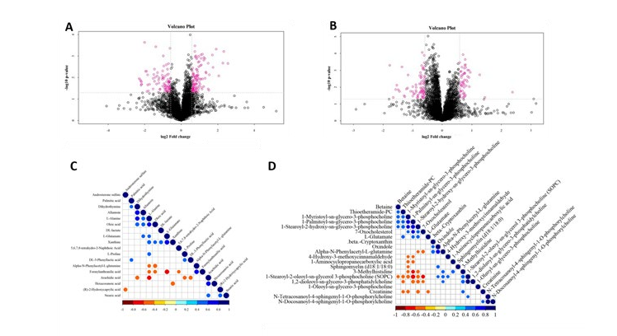
Figure 2:Volcano plots and correlation analysis of overweight and normal weight patients A. Volcano plots of negative mode. B. Volcano plots of positive mode. LogFc=0.585, adj.P value<0.05. Red and black dots indi-cate notable and non-notable differences. C. Correlation analysis of negative mode. D. Correlation analysis of positive mode.
Moreover, we performed a KEGG analysis to investigate the metabolomic pathways affected by BMI in PCOS patients with SCH. In the KEGG analysis, a total of 18 metabolic pathways related to the differential metabolites were detected: biosynthesis of unsaturated fatty acids; central carbon metabolism in cancer; protein digestion and absorption; aminoacyl-tRNA biosynthesis; fatty acid biosynthesis; retrograde endocannabinoid signalling; taurine and hypotaurine metabolism; ATP-binding cassette (ABC) transporters; arginine and proline metabolism; alanine, aspartate, and glutamate metabolism; mineral absorp¬tion; Huntington disease; FoxO signalling pathway; histidine metabolism; nicotine addiction; long-term potentiation; gluta-matergic synapse; and cocaine addiction (Figure 3).
Figure 3: Bubble chart of the Kyoto Encyclopedia of Genes and Genomes (KEGG) enrichment pathway. Each bubble represents a pathway. The darker the colour of the bubble, the smaller the P value and the higher the significance of the degree of enrichment.
consent in accordance with the national legislation and the Declaration of Helsinki. The protocol was approved by the Institu¬tional Ethics Committee of Lanzhou University Second Hospital (project no. 2019A-202).
Results
Clinical and Biochemical Results
The differences in general data and fasting blood glucose levels were not statistically significant between patients with TSH ≥ 2.5 µIU/mL and those with TSH < 2.5 µIU/mL. We re-organ-ised the data and excluded patients with BMI ≥ 30 kg/m2 and TSH ≥ 5 µIU/mL from the group of PCOS patients. Among the PCOS patients with SCH, 13 were overweight and 11 had nor-mal weight (Table 1). Significant differences were observed in body weight, volume of the right ovary, homeostasis model as-sessment for insulin resistance (HOMA-IR) value, insulin level at 2 h after a meal and triglyceride level.
Discussions
Serum contains many metabolites whose variations can pro-vide biochemical clues about diseases and may offer infor-mation about the pathogenesis and treatment of each disease. Hypothyroidism has been shown to be related to many meta-bolic disorders. Thyroid hormones, especially triiodothyronine, have been widely demonstrated to cause insulin resistance in the liver, and hepatic glucose output is pathologically increased by enhanced gluconeogenesis and glycogen breakdown [12]. Therefore, PCOS can only be diagnosed after hypothyroidism has been ruled out. The relationship between insulin resistance and hypothyroidism has been studied for decades; however, the influence of SCH on clinical and metabolic parameters has not been sufficiently investigated in the setting of PCOS [13-15]. Thyroid hormones are involved in the metabolism of various substances in the body and may regulate gonadal development and female reproductive endocrine function through the hypo-thalamic–pituitary–ovarian axis. Elevated TSH levels and SCH are common in PCOS patients. PCOS patients with SCH are at a risk of having endocrine and metabolic abnormalities, which worsen with increasing body weight. In our study, there were significant differences in body weight, volume of the right ovary, HOMA-IR value, insulin level at 2 h after a meal, and triglyceride level between the overweight and normal weight groups of PCOS patients with SCH. Ambrosi et al. reported that an elevated TSH level affects thyroid hormones in adipose tissue, re¬sulting in activation of the thyroid hormone receptor, increased production of cytokines, elevated levels pro-reactive proteins, and mediation of the inflammatory response. It also decreases insulin sensitivity and increases insulin production. Long-term high insulin levels accelerate the conversion of fatty acids and enhance the synthesis of lipase [16].
Our study identified 26 differential metabolites, mainly fatty ac-ids, phosphatidyl choline, choline phosphate, cholesterol, and androsterone sulphate, in serum of normal weight and over-weight PCOS patients with SCH, showing the effect of BMI on metabolic pathways in these patients. Through KEGG analysis, a total of 18 metabolic pathways related to the differential metabo¬lites were detected, mainly biosynthesis of fatty acids and unsaturated fatty acids, digestion and absorption of proteins, and ABC transporters. Because fatty acids are a class of metabolites that could be used to evaluate stearoyl-CoA desaturase activity, the increased unsaturated fatty acids observed in PCOS patients indicate that stearoyl-CoA desaturase activity could be a potential marker for this disease [17]. Follicular fluid metabonomics can be used to predict oocyte quality. Several spectroscopy-based studies have reported that the levels of specific free fatty acids in serum and follicular fluid are altered in women with PCOS [18,19]. In mammals, the composition of fatty acids in oocytes and the levels of fatty acids in the follicular fluid environment may affect oocyte development and subsequent embryo implan-tation [20-21]. Phospholipids are the main component of biolog-ical membranes and play roles in maintaining human life activities, promoting cell metabolism, maintaining material exchange between cellular compartments, accelerating the transport of fat and preventing fat accumulation in the liver, maintaining brain development, inhibiting brain ageing, and exerting anti-tumour effects. In patients with SCH, altered thyroid hormone levels have slight and lasting effects, despite the absence of obvious clinical manifestations. The study by Roos et al. suggested that thyroid hormones are involved in the regulation of cholesterol and lipo¬protein metabolism, and abnormal thyroid hormone levels affect the production and degradation of blood lipids [22]. Glintborg et al. showed that SCH was associated with higher BMI, diastol-ic hypertension, higher total cholesterol and triglyceride levels, and higher total cholesterol/high-density lipoprotein cholesterol ratio, resulting in lipid regulation disorders, hemodynamic and endothelial dysfunction, hypercoagulation states, and athero¬sclerosis [23]. The active ABC superfamily is one of the largest protein families in biological systems. Its function is to use the energy generated by ATP hydrolysis to transport molecules, such as sugars, amino acids, nucleotides, peptides, lipids, steroids, bile salts, toxins, and chemotherapeutic drugs, through biolog¬ical membranes. It has a protective effect by allowing toxic ex-ogenous substances, endogenous metabolites, and amphiphilic compounds to flow out of cells. The imbalance of this protein in granulosa cells may impair follicle development and steroid production. Another study also suggested that ABC transporters and follicular fluid high-density lipoprotein jointly regulate the cholesterol content of oocytes, which is related to the quality of oocytes [24]. Glutamic acid and glutamine are the precursors of arginine, and arginine is the precursor of nitric oxide and poly-amines (putrescine, spermidine, spermine, and agmatine), which are involved in the regulation of key events in early pregnancy, such as angiogenesis, placenta formation, and embryonic development. Taurine and hypotaurine act as antioxidants and cell os¬motic pressure regulators in a variety of cell types.
The association of PCOS and thyroid function is not clear. It remains to be elucidated whether the disorder in thyroid hor-mone secretion is the cause of PCOS, whether the occurrence of PCOS affects the abnormal secretion of thyroid hormones, or whether the hypothalamic–pituitary–gonad and hypothalamic–pituitary–thyroid axes together cause abnormal lipid metabolism and insulin resistance, resulting in weight gain. In our study, the comparison of metabolites and metabolic pathways between normal weight and overweight PCOS patients with SCH suggested that PCOS causes disordered thyroid hormone secretion, which affects lipid, sugar, and protein generation and degradation, and accelerates the occurrence and development of disease. Therefore, it is important to investigate the prevalence of primary thyroid dysfunction in obese and overweight patients with PCOS. In addition, lifestyle intervention, early treatment with levo-thyroid hormone, reducing the TSH level, and maintaining the metabolic balance of the body are important strategies for PCOS patients with SCH.
Conclusion
In recent years, metabolomics methods for the analysis of blood, follicular fluid, and urine samples from PCOS patients have gradually developed. This study used untargeted metabolomics methods to explore the effects of SCH and BMI on the metabolic profile of PCOS patients. As a result, many different metabolites and enriched metabolic pathways related to the body's physiological and pathological reactions were identified. The analysis of the different metabolites and different metabolic pathways of the normal weight and overweight groups showed that the interaction between BMI and TSH affects the metabolic status of PCOS patients. Overweight PCOS patients with SCH may have the worst metabolic status. The overweight and normal weight groups showed differences in the levels of glycerol phos-pholipids, sterol lipids, phosphatidylcholine, and androsterone sulphate. PCOS with SCH affects endocrine metabolism and es-ter metabolism through the biosynthesis of fatty acids, protein digestion and absorption, and ABC transporters. Because the clinical manifestations of PCOS patients are hetero-geneous, the clinical treatment plan may be complex and the ef¬fect is uncertain. Our study also had some limitations. This study compared normal weight and overweight PCOS patients with SCH; however, as body weight changes, the metabolic state also greatly changes. Furthermore, the sample size of this study was relatively small. No further validation in a larger population was performed. Future studies should explore whether there are differences in mitochondrial energy metabolism-related genes and proteins between normal weight and overweight PCOS patients. Moreover, mitochondrial function may have a greater impact on the progression of PCOS than BMI. In addition, it is also rec¬ommended to use a combination of specimens, such as serum, plasma, follicular fluid, endometrial tissue, and urine samples, in metabonomics analysis to investigate the local and system¬ic metabolic characteristics of metabolites in the human body. Elucidating these issues may help in determining the cause of disease, evaluating the prognosis, and developing precise clinical interventions.
Abbreviations
BMI, body mass index; E2, oestradiol; FSH, follicle-stimulat-ing hormone; HCY, homocysteine; HDL, high-density lipopro-tein; HOMA-IR, homeostasis model assessment for insulin re-sistance; KEGG, Kyoto Encyclopedia of Genes and Genomes; LDL, low-density lipoprotein; LH, luteinizing hormone; OPLS-DA, orthogonal partial least squares discriminant analysis; PCA, principal component analysis; PCOS, polycystic ovary syndrome; PLS-DA, partial least squares discriminant analysis; PRL, prolactin; SCH, subclinical hypothyroidism; UHPLC-Q-TOF/MS, ultra-high-performance liquid chromatography–quad¬rupole time-of-flight mass spectrometry; VIP, variable impor¬tance in projection.
Acknowledgement
We are thankful to all participants of the study. We thank Shang¬hai Applied Protein Technology for help with quadrupole time-of-flight liquid chromatography/mass spectrometry.Authors Contributions
Mei W, Xiaofeng L, and Fang W designed the study. Xiaofeng L, Mei W and Nan D performed the experiments and data mining. Fang W evaluated the results. Mei W and Xiaofeng L wrote the manuscript.
Funding
The Science Foundation of LanZhou University (Grant No.054000229).
Availability of Data and Materials
The datasets used or analysed in the current study are available from the corresponding author on reasonable request.
Ethics Approval and Consent to Participate
The study was approved by the ethics committee of the Second Hospital of Lanzhou University (project no. 2019A-202). All participants signed an informed consent form prior to the study.
Consent for Publication
Agree.
Competing interests
The authors declare that they have no known competing financial interests or personal relationships that could have influenced the work reported in this paper.
References
- Urbanek, M., Sam, S., Legro, R. S., & Dunaif, A. (2007). Identification of a polycystic ovary syndrome susceptibility variant in fibrillin-3 and association with a metabolic phenotype. The Journal of Clinical Endocrinology & Metabolism, 92(11), 4191-4198.
- Rijks, J., Penders, B., Dorenbos, E., Straetemans, S., Gerv-er, W. J., & Vreugdenhil, A. (2016). Pituitary response to thyrotropin releasing hormone in children with overweight and obesity. Scientific Reports, 6(1), 1-6.
- Glintborg, D., Rubin, K. H., Nybo, M., Abrahamsen, B., & Andersen, M. (2018). Cardiovascular disease in a nationwide population of Danish women with polycystic ovary syndrome. Cardiovascular diabetology, 17(1), 1-12.
- Nada, A. M. (2013). Effect of treatment of overt hypothyroidism on insulin resistance. World journal of diabetes, 4(4), 157.
- Cui, L., Lu, H., & Lee, Y. H. (2018). Challenges and emergent solutions for LC-MS/MS based untargeted metabolomics in diseases. Mass Spectrometry Reviews, 37(6), 772-792.
- Rajska, A., Buszewska-Forajta, M., RachoÅ?, D., & Marku-szewski, M. J. (2020). Metabolomic insight into polycystic ovary syndrome—An overview. International Journal of Molecular Sciences, 21(14), 4853.
- Çelebier, M., Kaplan, O., Özel, Å?., & Engin-Üstün, Y. (2020). Polycystic ovary syndrome in adolescents: Q-TOF LC/MS analysis of human plasma metabolome. Journal of Pharmaceutical and Biomedical Analysis, 191, 113543.
- Sun, Z., Chang, H. M., Wang, A., Song, J., Zhang, X., Guo, J., ... & Lian, F. (2019). Identification of potential metabolic biomarkers of polycystic ovary syndrome in follicular fluid by SWATH mass spectrometry. Reproductive Biology and Endocrinology, 17(1), 1-10.
- Chen, X., Lu, T., Wang, X., Sun, X., Zhang, J., Zhou, K.,... & Ling, X. (2020). Metabolic alterations associated with polycystic ovary syndrome: A UPLC Q-Exactive based metabolomic study. Clinica Chimica Acta, 502, 280-286.Zhang, X., Wang, T., Song, J., Deng, J., & Sun, Z. (2020). Study on follicular fluid metabolomics components at different ages based on lipid metabolism. Reproductive Biology and Endocrinology, 18(1), 1-8.
- World Health Organization. (2000). The Asia-Pacific perspective: redefining obesity and its treatment.Du, F. M., Kuang, H. Y., Duan, B. H., Liu, D. N., & Yu, X.Y. (2019). Associations between thyroid hormones within the euthyroid range and indices of obesity in obese chinese women of reproductive age. Metabolic syndrome and related disorders, 17(8), 416-422.
- Kalra, S., Aggarwal, S., & Khandelwal, D. (2021). Thyroid dysfunction and dysmetabolic syndrome: The need for enhanced thyrovigilance strategies. International Journal of Endocrinology, 2021.
- Xing, Y., Chen, J., Liu, J., & Ma, H. (2021). The Impact of Subclinical Hypothyroidism on Patients with Polycystic Ovary Syndrome: A Meta-Analysis. Hormone and Metabolic Research, 53(06), 382-390.
- Bedaiwy, M. A., Abdel-Rahman, M. Y., Tan, J., AbdelHafez,F. F., Abdelkareem, A. O., Henry, D., ... & Liu, J. H. (2018). Clinical, hormonal, and metabolic parameters in women with subclinical hypothyroidism and polycystic ovary syndrome: a cross-sectional study. Journal of Women's Health, 27(5), 659-664.
- Ambrosi, B., Masserini, B., Iorio, L., Delnevo, A., Mala-vazos, A. E., Morricone, L., ... & Orsi, E. (2010). Relationship of thyroid function with body mass index and insulin-resistance in euthyroid obese subjects. Journal of endocrinological investigation, 33(9), 640-643.
- Tang, L., Yuan, L., Yang, G., Wang, F., Fu, M., Chen, M., & Liu, D. (2019). Changes in whole metabolites after exen-atide treatment in overweight/obese polycystic ovary syndrome patients. Clinical endocrinology, 91(4), 508-516.
- Legro, R. S. (2012, December). Obesity and PCOS: impli-cations for diagnosis and treatment. In Seminars in reproductive medicine (Vol. 30, No. 06, pp. 496-506). Thieme Medical Publishers.
- Turkmen, S., Ahangari, A., & Bäckstrom, T. (2016). Roux-en-Y gastric bypass surgery in patients with polycystic ovary syndrome and metabolic syndrome. Obesity surgery, 26(1), 111-118.
- Moran, L. J., Misso, M. L., Wild, R. A., & Norman, R. J. (2010). Impaired glucose tolerance, type 2 diabetes and metabolic syndrome in polycystic ovary syndrome: a systematic review and meta-analysis. Human reproduction update, 16(4), 347-363.
- Attaoua, R., El Mkadem, S. A., Radian, S., Fica, S., Hanzu, F., Albu, A., ... & Grigorescu, F. (2008). FTO gene associates to metabolic syndrome in women with polycystic ovary syndrome. Biochemical and biophysical research communications, 373(2), 230-234.
- Roos, A., Bakker, S. J., Links, T. P., Gans, R. O., & Wolffen-buttel, B. H. (2007). Thyroid function is associated with components of the metabolic syndrome in euthyroid subjects. The Journal of Clinical Endocrinology & Metabolism, 92(2), 491-496.
- Glintborg, D., Rubin, K. H., Nybo, M., Abrahamsen, B., & Andersen, M. (2018). Cardiovascular disease in a nationwide population of Danish women with polycystic ovary syndrome. Cardiovascular diabetology, 17(1), 1-12.
- Quiroz, A., Molina, P., Santander, N., Gallardo, D., Rig-otti, A., & Busso, D. (2020). Ovarian cholesterol efflux: ATP-binding cassette transporters and follicular fluid HDL regulate cholesterol content in mouse oocytes. Biology of Reproduction, 102(2), 348-361.