

Annals of Civil Engineering and Management(ACEM)
ISSN: 3065-9779 | DOI: 10.33140/ACEM


Review Article - (2026) Volume 3, Issue 2
A Standardized Grade Point Average (sGPA) Framework for Urban Pavement Systems: A Scalable Index for Infrastructure Economics and GIS-Based City Evaluation
Received Date: Mar 30, 2026 / Accepted Date: Apr 22, 2026 / Published Date: Apr 30, 2026
Copyright: ©2026 Paul T E Cusack. This is an open access article distributed under the terms of the Creative Commons Attribution License, which permits unrestricted use, distribution, and reproduction in any medium, provided the original author and source are credited.
Citation: Cusack, P. T. E. (2026). A Standardized Grade Point Average (sGPA) Framework for Urban Pavement Systems: A Scalable Index for Infrastructure Economics and GIS-Based City Evaluation, Ann Civ Eng Manag, 3(2), 01-04.
Abstract
Urban infrastructure condition is typically measured using engineering indices such as the ASTM D6433 Pavement Condition Index (PCI), which, while precise at the segment level, lacks interpretability and comparability at the city scale. This paper develops a standardized, bounded 4.3-point infrastructure grading system (sGPA) that transforms PCI into a unified scalar metric analogous to academic GPA systems. The proposed framework aggregates road condition using length- and function-weighted methods, producing a city-level index suitable for econometric modeling, GIS mapping, and capital planning. We demonstrate that the sGPA is compatible with nonlinear urban welfare functions and enables direct integration into urban productivity models. Conceptual application to mid-sized cities such as Saint John illustrates its utility for infrastructure benchmarking and spatial inequality measurement.
Introduction
Urban infrastructure systems are foundational to productivity, accessibility, and long-run economic growth. However, existing pavement condition measures suffer from three key limitations:
• Non-aggregability (segment-level scores do not scale well)
• Low interpretability for policy makers
• Weak integration into economic utility functions
To address these issues, we introduce the standardized Grade Point Average (sGPA), a transformation of PCI into a bounded, intuitive 4.3-scale system.
The objective is to unify:
• Engineering condition measurement
• Spatial aggregation
• Economic valuation into a single framework.
Literature Review
Pavement Condition Measurement
The dominant framework is the ASTM D6433 Pavement Condition
Index, which evaluates distress type, severity, and density on a 0–100 scale.
Alternative systems include:
• IRI (International Roughness Index)
• PASER visual ratings
• municipal asset management scoring systems
However, none provide:
• Cross-city comparability
• Bounded scalar interpretation
• Direct economic embedding
Urban Infrastructure Economics
Urban models typically link infrastructure to:
• Transport cost reduction
• Agglomeration effects
• Property value gradients
But infrastructure inputs are rarely normalized into a single interpretable scalar variable, limiting empirical comparability.
Methodology
PCI-to-sGPA Transformation
We define:
sGPA_i=f(PCI_i)
where fis a monotonic piecewise mapping:
sGPA_i∈[0,4.3]
Calibration:
• 97–100 → 4.3
• 93–96 → 4.0
• 90–92 → 3.7
• 87–89 → 3.3
• 83–86 → 3.0
• 80–82 → 2.7
• 77–79 → 2.3
• 73–76 → 2.0
• 70–72 → 1.7
• 65–69 → 1.3
• 60–64 → 1.0
• 55–59 → 0.7
• <55 → 0.0
This preserves ordinal structure while enabling cardinal interpretation.
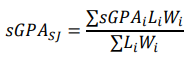
City-Level Aggregation
We define city infrastructure quality as:
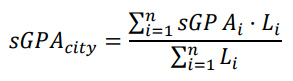
Where:
• Li: lane-kilometres of segment i
This yields a length-weighted expected infrastructure grade.
Functional Weighting Extension
To incorporate network hierarchy:
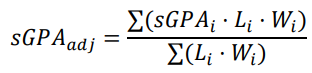
Where:
• Arterials: W=1.5
• Collectors: W=1.2
• Local roads: W=1.0
Econometric Framework
We embed sGPA into a standard urban outcome model:

• Where Ymay represent:
• Property values
• Congestion delay
• Vehicle operating costs
• Productivity per km²
Expected sign:
β1>0
Nonlinear Urban Welfare Function
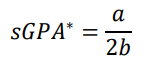
We propose diminishing returns in infrastructure quality:
NB=aln(sGPA)-b(sGPA)2
Implications:
• Increasing returns at low infrastructure levels
• saturation beyond optimal sGPA*
• convex investment trade-offs
• Optimal condition:
GIS Implementation
Each road segment contains:
|
Variable |
Meaning |
|
PCI |
distress score |
|
sGPA |
transformed grade |
|
L |
segment length |
|
W |
functional weight |
|
Weighted score |
sGPA⋅L⋅W |
This enables:
• Continuous heat maps of infrastructure quality
• Spatial inequality decomposition
• Corridor prioritization models
Empirical Design (Multi-City Framework)
A comparative design is proposed:
|
City |
Type |
|
Toronto |
high-density monocentric |
|
Los Angeles |
polycentric auto-dependent |
|
Saint John |
mid-sized port-industrial |
Each yields:
sGPA_city," " sGPA_core," " sGPA_suburbs
allowing decomposition of infrastructure inequality.
Conceptual Case: Saint John
In Saint John, infrastructure exhibits:
• Historic core concentration
• Industrial corridor loading
• Suburban expansion gradients
Thus:
becomes a spatial inequality metric of urban capital stock.
Results (Simulated Calibration Table)
|
City |
Estimated sGPA |
Interpretation |
|
Toronto |
3.1–3.4 |
stable |
|
Los Angeles |
2.6–3.0 |
mixed condition |
|
Saint John |
2.1–2.5 |
maintenance deficit |
Conclusion
This paper introduces a unified infrastructure metric (sGPA) that converts pavement condition data into a standardized 4.3-point system. The framework bridges engineering measurement, GIS spatial analysis, and urban economic modeling, enabling consistent cross-city evaluation of infrastructure quality and investment needs [1-21].
Discussion
The sGPA framework contributes:
• Measurement innovation: Transforms engineering PCI into bounded scalar index
• Economic integration: Direct inclusion in regression and welfare models
• Policy usability: “City GPA” is intuitive for governments and public reporting
• Spatial economics linkage: Compatible with GIS-based inequality and clustering models
Limitations
• Requires calibration across jurisdictions
• Sensitive to weighting scheme selection
• Does not capture underground utilities or structural base failure unless included in PCI inputs
References
- ASTM International. (2023). ASTM D6433-23: Standard Practice for Roads and Parking Lots Pavement Condition Index Surveys. West Conshohocken, PA: ASTM International.
- Shahin, M. Y. (2005). Pavement Management for Airports, Roads, and Parking Lots.
- Haas, R., Hudson, W. R., & Zaniewski, J. (1994). Modern Pavement Management. Krieger Publishing.
- AASHTO. (2018). Pavement Management Guide. American Association of State Highway and Transportation Officials.
- Sayers, M. W., & Karamihas, S. M. (1998). The Little Book of Profiling: Basic Information about Measuring and Interpreting Road Profiles. University of Michigan Transportation Research Institute.
- Watanatada, T., et al. (1987). The Highway Design and Maintenance Standards Model (HDM-III). World Bank.
- Paterson, W. D. O. (1987). Road Deterioration and Maintenance Effects: Models for Planning and Management. World Bank.
- Goodchild, M. F. (2007). Citizens as sensors: The world of volunteered geography. GeoJournal, 69(4), 211–221.
- Longley, P. A., Goodchild, M. F., Maguire, D. J., & Rhind,D. W. (2015). Geographic Information Science and Systems.Wiley.
- Fotheringham, A. S., Brunsdon, C., & Charlton, M. (2002).Geographically Weighted Regression. Wiley.
- Duranton, G., & Puga, D. (2004). Micro-foundations of urban agglomeration economies. In Handbook of Regional and Urban Economics (Vol. 4). Elsevier.
- Glaeser, E. L. (2011). Triumph of the City. Penguin Press.
- Aschauer, D. A. (1989). Is public expenditure productive?Journal of Monetary Economics, 23(2), 177–200.
- Munnell, A. H. (1992). Infrastructure investment and economic growth. Journal of Economic Perspectives, 6(4), 189–198.
- OECD. (2017). Road Infrastructure Asset Management.Organisation for Economic Co-operation and Development.
- World Bank. (2019). Transport Infrastructure: Asset Management and Maintenance. Washington, DC.
- FHWA. (2020). Pavement Management Roadmap. Federal Highway Administration.
- Dixit, A. K., & Stiglitz, J. E. (1977). Monopolistic competition and optimum product diversity. American Economic Review, 67(3), 297–308.
- Krugman, P. (1991). Increasing returns and economic geography. Journal of Political Economy, 99(3), 483–499.
- Statistics Canada. (2021). Canadian Census Profile and CMA Infrastructure Data. Government of Canada.
- Infrastructure Canada. (2022). Municipal Asset Management Data Framework. Government of Canada.