

International Journal of Media and Networks(IJMN)
ISSN: 2995-3286 | DOI: 10.33140/IJMN
Impact Factor: 1.02



Research Article - (2024) Volume 2, Issue 10
A Review of Identifying and Analyzing Black Holes using Machine Learning
Received Date: Sep 25, 2024 / Accepted Date: Oct 18, 2024 / Published Date: Oct 28, 2024
Copyright: ©Â©2024 Samyukthaa A M. This is an open-access article distributed under the terms of the Creative Commons Attribution License, which permits unrestricted use, distribution, and reproduction in any medium, provided the original author and source are credited.
Citation: Samyukthaa, A. M. (2024). A Review of Identifying and Analyzing Black Holes using Machine Learning. Int J Med Net, 2(10), 01-04.
Abstract
A black hole is an area in space with immense gravity that nothing (not even light) can escape from it. They are formed usually when a star dies. These black holes can be found by the detectors in space. They detect the gravitational waves by the ripples’ effect. The isolated black holes that are invisible can be found using a method called gravitational lensing. Various black holes have been found using these methods. These black holes do not emit any light. This makes it difficult for scientists to observe the black holes directly. The effects of black holes on the nearby matter and light were observed by the scientists to detect a black hole. In this paper, a comprehensive review is presented about the techniques that can be used to detect and analyze black holes using machine learning. Information regarding the technique along with the conditions has been summarized in the paper. Other issues regarding the technology limitations, research challenges, and future trends are also discussed.
Introduction
Black holes are some regions in space. Here an extensive amount of mass is packed into a tiny volume .This will result in a gravitational pull which will be so strong. Nothing can escape from a black hole. It also includes light and electromagnetic radiation [1]. Anything that crosses the Roche Lobe of the black hole, can’t be saved further. It is believed that black holes are formed when massive stars collapse at the end of their lives without a supernova explosion or when an explosion occurs in a proto-neutron star [2]. When a star dies, its core becomes unstable and collapses. The outer layers of the star will be blown away. The weight of matter falling from all sides of the star compresses the star in such a way that its volume becomes zero and density becomes infinity. Based on their mass, black holes are classified into three types as stellar-mass black holes, intermediate-mass black holes, and supermassive black holes [1].
Black holes are usually detected using two methods. One is done by observing their gravitational influence. Usually it will be an empty spot surrounded by a lot of stars. The stars could be seen circling around the spot like they were orbiting a dense mass. The second method is by observing the matters that are falling into a black hole. When a matter falls into a black hole, it settles in a disk around the black hole. Here we can also notice some light. This light is generated from some of the energy liberated from the matter when falling in. The gravitational waves of black holes are too strong and any matter that crosses the Roche Lobe does not have any chances to get saved. This also includes light. We already discussed that even light can’t escape from the black hole. As scientists use instruments that depend on light to observe objects in space, this ends as a barrier to detect the black holes. These lights can be either visible light, X-rays or ultraviolet.
In 2016, the Laser Interferometer Gravitational-wave Observatory (LIGO) detected the gravitational waves during the merger of two black holes. The process of understanding the motion of black holes is complex. It requires either time-consuming simulations on superconductors or approximation techniques. The drawbacks here are, the simulations are expensive. The approximation techniques can lead to errors. They may also break down when applied to complicated black hole systems. To overcome these difficulties a machine-learning based technique capable of automatically deriving a mathematical model for the motion of binary black holes from raw gravitational wave data was discovered by a multidisciplinary team including an LLNL [Lawrence Livermore National Laboratory] mathematician. This team designed an algorithm which could learn differential equations describing the dynamics of merging black holes. This algorithm was applied for a wide range of cases. This algorithm makes use of the waveform inversion strategy. This strategy could quickly solve the complex simulations and give the output of them as a simple equation with the same accuracy. Usually it takes around several years to solve it. This also takes weeks of time to run on supercomputers.
This review is based on the idea of developing machine learning techniques for analyzing binary black holes. This paper aims to develop a computational framework to learn binary black hole dynamical models from gravitational waves. This review will give a brief idea of how the first machine learning method was developed to overcome the drawbacks of analyzing a black hole. This may also help to understand the methods involved and may lead to new machine learning techniques to analyze black holes. In this paper, how other machine learning techniques can be employed to analyze black holes are discussed briefly. Firstly, Generative Adversarial Network (GANs) is discussed along with the methods of applying this technique to analyze some particular areas of black holes in a brief manner. Secondly, Principal Component Analysis (PCAs) is discussed along with some methods of applying this technique to analyze some particular areas of black holes in a brief manner. Finally, Support Vector Machines (SVMs) are discussed along with some methods of applying this technique to analyze some particular areas of black holes in a brief manner.
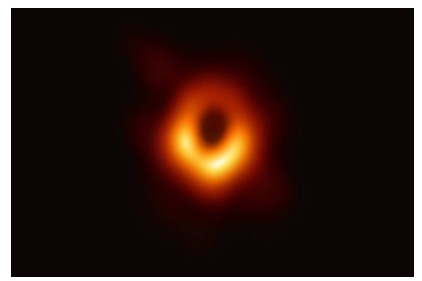
Figure 1: Image of a Black Hole
Generative Adversarial Network (GANs)
GANs are a powerful class of machine learning models. It can be used in various ways to analyze a black hole. GANs can be trained on existing black hole images to produce additional images. These additional images can be used to augment training datasets for other machine learning models. By using this method, the amount of training data available can be increased. It also improves the performance and provides enhanced datasets.
These GANs can also be trained to generate realistic simulations based on physical models and observational data. This would be helpful to study the physical processes around the black holes and predict observational signatures. These results can also be compared with real data to test theoretical models.
This method was used by Arya Mohan et al, 2024 [3]. They proposed a data augmentation methodology involving a Conditional Progressive Generative Adversarial Network (CPGAN). This model was used to generate new images of black holes based on their electric spin and electron distribution parameters.
This CPGAN consists of three convolutional neural networks. they are,
• A generator: This produces synthetic images based on the spin (a*) and R high (a thermal electron distribution and seven values of the temperature ratio of electrons to protons were assumed and parametrized as R high).
• A critic: This distinguishes between the real and synthetic images.
• A auxiliary regressor: It predicts the spin of the given image.
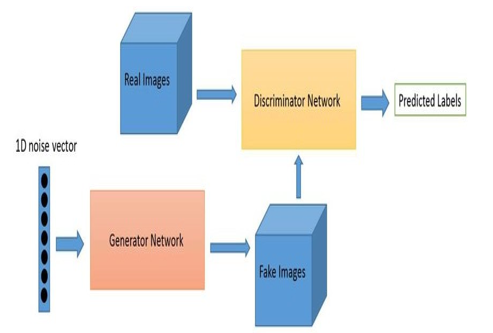
Figure 2: Principal Functioning of GANs
This model was able to generate new images for any spin in the range of [-1,1]. This model helps to increase the size of the available training data set, and this can be used to get more accurate parametrization of a black hole image. So, we can conclude that deep learning algorithms can be trained to estimate the black hole parameters accurately from the available observational data. This method is
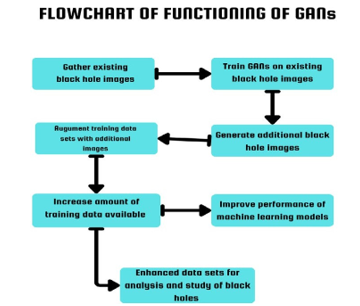
Figure 3: Flowchart Representing the Process Followed by GANs
also used to detect Ringed galaxies. But applying it to identify black holes is not utilized by many. Very few papers were published after making use of this method. This can be utilized to further estimate the black hole accurately which helps to understand a lot of parameters of the black hole.
Principal Component Analysis (PCAs)
PCAs are also a powerful class of machine learning models. Usually they are used to reduce the dimensionality of large datasets. They are considered powerful in reducing the dimensionality of large datasets as they reduce the dimensionality and also retain the most significant features. It can also be used to standardize the data. By doing this each feature will end up having a mean of 0 and a standard deviation of 1. This will help to ensure that all the features contribute equally to the analysis. It also prevents features with larger ranges from dominating. It can also be employed to detect underlying patterns in the data that may correspond to physical phenomena. The outcome of this process provides insights into common characteristics and differences among black holes.
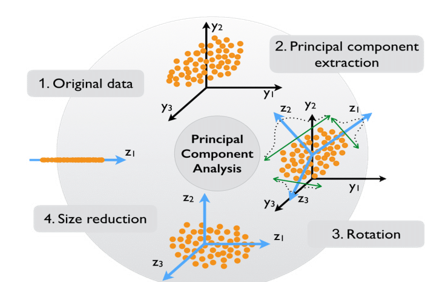
Figure 4: Principal Functioning of PCAs
Tim Grimbergen et al, 2024 used this method of PCA to generate higher order modes from Binary Black Hole mergers [4]. They used this PCA to decompose each mode by amplitude and phase and also to reduce the dimensionality. They employed six PCA components for the phase model(for each mode) and four PCA components for the amplitude. From the results, they found that this model offers two orders of magnitude speed up over the training model, without trading for accuracy.
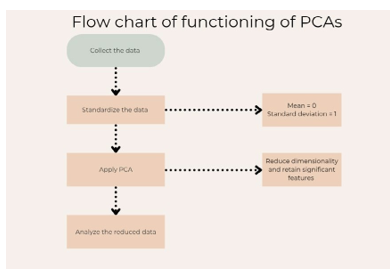
Figure 5: Flowchart Representing the Process Followed by PCAs
Lia et al, 2018 used PCA to characterize the high-fidelity simulation and interferometric observations of the millimeter emission that originates near the horizons of the accreting black holes [5]. In their work, they have shown that PCA can generate a compact orthogonal set of basis eigenimages which can be used to represent the ensemble of images generated in a suite of high- fidelity General Relativistic magnetohydrodynamic (GRMHD) accurately. They have also shown that PCAs can be made to recognize outliers in the typical source morphology and identify it in both the simulations and observations. The applied PCA to a set of simulated black hole images at 1.3 mm wavelength of observations of the Event Horizon Telescope. FRom the results they found out that PCA offers compact representation of the theoretical millimeter images.
Support Vector Machines (SVMs
These methods are mainly used for the classification tasks. These can be used particularly when dealing with high - dimensional data. This mechanism can also be used to distinguish between different types of astrophysical objects or phenomena. These are known for their robustness and accuracy in various classification problems. A trained SVM model is also capable of classifying new observations or predicting properties based on the learned patterns.
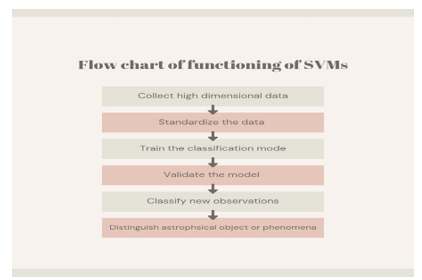
Figure 6: Flowchart Representing the Process Followed by SVMs
Krishna Kumar Singh et al, 2022 used a machine learning approach to predict the Black Hole mass in Blazars using Broadband Emission Model Parameters [6]. They used several machine learning algorithms like Linear Regression, Adaptive Boosting, Bagging etc. Here they also made use of SVMs. We already saw that SVMs can be used when dealing with high- dimensional data. In their paper, they used SVM to create the best line or decision boundary which is used to separate higher- dimensional space into classes. Because of this a new data point may be associated with a correct category. This method has high accuracy compared to linear regression algorithms as the dimensions of the hyperplane depends on the features of the data set and support vectors.
Gonzalez et al, 2019 used this method to classify black hole spin by analyzing the images generated by two different matter distributions around the black hole in a single wavelength [7]. They assumed the disk and spherical matter models with monochromatic emission with 4mm wavelength. They applied this approach to the specific mass of the Supermassive Black Hole which is present at the centre of the MIlky Way Galaxy. To determine the accuracy of the SVM in terms of image resolution, three resolutions (16*2, 32*2, 64*2 pixels). From the results, we get to know that, the results are very accurate for disk distributions. But it was found to be less accurate for the spherical distribution as they rely on the image resolution and angle of vision. The number of classes should be increased to reduce the uncertainties. It can be done by training the SVMs properly.
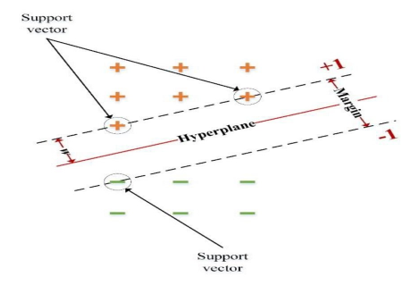
Figure 7: Principal Functioning of SVMs
Conclusion
This review highlights the first discovery of a machine learning method and briefly explained the techniques that were involved in it. The key output of that paper was recognized. The algorithm used there was also discussed briefly. The strategy involved there was also noted and discussed. The advantages of using those techniques and strategies were analyzed. Based on these observations, we discussed three different types of machine learning techniques each with their own advantages. We also discussed how they can be used to analyze black holes. The strategies involved in each method and the outputs we receive by using these techniques were also discussed.
In conclusion, an idea of how machine learning techniques can be used to identify and analyze black holes was discussed. These methods can be utilized further. This comprehensive review makes use of significant discovery to find new pathways. The technique in the paper guided us to engage with some other techniques. These are now being used by many people to discover way more easier techniques to analyze black holes. In future, these techniques can be developed for further analysis and many more machine learning techniques can be made use in the field of astrophysics.
References
- Mar Mezcua. Black Holes, page 1–8. Springer Berlin Heidelberg, 2021.
- Mirabel, F. (2017). The formation of stellar black holes.New Astronomy Reviews, 78, 1-15.
- Mohan, A., Protopapas, P., Kunnumkai, K., Garraffo, C., Blackburn, L., Chatterjee, K., ... & Ricarte, A. (2024). Generating images of the M87* black hole using GANs. Monthly Notices of the Royal Astronomical Society, 527(4), 10965-10974.
- Grimbergen, T., Schmidt, S., Kalaghatgi, C., & van den Broeck, C. (2024). Generating higher order modes from binary black hole mergers with machine learning. Physical Review D, 109(10), 104065.
- Medeiros, L., Lauer, T. R., Psaltis, D., & Özel, F. (2018). Principal component analysis as a tool for characterizing black hole images and variability. The Astrophysical Journal, 864(1), 7.
- Singh, K. K., Tolamatti, A., Godiyal, S., Pathania, A., & Yadav, K. K. (2022). A Machine Learning Approach for Predicting Black Hole Mass in Blazars Using Broadband Emission Model Parameters. Universe, 8(10), 539.
- González, J. A., & Guzmán, F. S. (2019). Classification of a black hole spin out of its shadow using support vector machines. Physical Review D, 99(10), 103002.