

Journal of Applied Surface Science(JASS)
ISSN: 2993-5326 | DOI: 10.33140/JASS


Research Article - (2026) Volume 4, Issue 1
A Proposal on Measurement Methods of the One-Way Speed of Light
Received Date: Jan 13, 2026 / Accepted Date: Feb 16, 2026 / Published Date: Mar 02, 2026
Copyright: ©2026 Junchi Ye. This is an open-access article distributed under the terms of the Creative Commons Attribution License, which permits unrestricted use, distribution, and reproduction in any medium, provided the original author and source are credited.
Citation: Ye, J. (2026). A Proposal on Measurement Methods of the One-Way Speed of Light. J Applied Surf Sci, 4(1), 01-09.
Abstract
The ability to measure the exact one-way speed of light had often been thought to be impossible [1,2]. Under most simplified theoretical conditions, there appears to be no intuitive method of measuring the strict one-way speed of light, with the main problem being the synchronization of clocks at point A and B [1,2]. The significance proving or disproving the illusion of invariant lightspeed may shed light on the incompleteness and possible improvements of special relativity [3], while leading to new discoveries and verifications of hypotheses and theories. However, as of relative recency experiments designed to measure the one-way speed of light appears to still be highly limited, where special cases may give false positives [4]. The experiment designed in this paper can provide a precise measurement, when performed under ideal conditions will produce no false positives, while taking time dilation into account. Two spacecraft launched together are sent into a stable solar orbit between the Earth and Mars, spaced out a significant distance (>10 light minutes). Both spacecraft will be synchronized to constantly observe a pulsar - counting pulses, our start signal. Upon reaching a specified number of pulses the probes send signals to each other while starting their timer, ending their timer when they receive the signal from the other side. The experiment is performed once when the probes form an isosceles triangle, with atomic clocks that start as a documentation of their orbital period. The observation of the pulse rate differences should overlap at certain points on orbit where light is hitting the two probes simultaneously, where the experiment can be performed again to provide a measurement.
Keywords
One-Way Speed of Light, Relativity, Speed of lightIntroduction
The speed of light has only ever been measured with “two ways”, that is the round trip of pulses of photons towards a reflector, and back to a detector, which generally pass the photons through some sort of moving filter to calculate the time it took for light to travel the distance sum. The conundrum comes from the speculation that there is a theoretical possibility of the speed of light being different on the way to the reflector and on its way back. So far, our methods have been used to test the two-way speed of light, and there appear to be no trivial and reliable method to prove that light does actually have a constant velocity regardless of its direction [1,2]. It’s perfectly possible that lightspeed is instant from A to B, but from B to A [1].
Proposal - Earth, Mars, and Pulsar
The one-way speed of light is generally composed of two parts: is used to refer to the speed of light from A to B, and c' is used to represent the speed of light from B to A.
Two spacecraft are launched from Earth from the same launch vehicle, with their own internal atomic clocks. The atomic clocks are to be used as a stopwatch, and as long as the two spacecraft are travelling at the same velocities, their passage of time will be identical [5].

Figure 1: Graph Showing the Profile of Experienced Time Relative to Pulses. Not to Scale
In this case in order to ensure the start signal is received at the correct “universal time”, we need to define what is our reference frame for time. In our case, we’ll use the source of the pulse signals (x axis grid, not to scale) as our reference, the pulsar. No matter the time dilation differences between the two probes, the number of pulses of the pulsar serves as an absolute frame of time. Experiencing time faster, the pulses will count faster, experiencing time slower, the pulses will count slower. To an outside observer the probes will simultaneously detect each pulse, therefore counting pulses eliminates the problems of time dilation.
Notice on Figure. 1, The length of the line is the perceived time, while the x-axis increment is actual time that is relative to the number of pulses received at any given time by some constant multiple. Therefore, as you travel faster, the pulse rate you perceive slows down, synchronizing with the perceived pulses of the other probe or to any nearby outside observer.

Figure 2: Mission Trajectory and Matching Velocities
The mission will require us to launch two probes simultaneously, with synchronized time and synchronized counts of pulses from the pulsar. Both probes will count a specific number of pulses simultaneously. Both probes are first delivered to high Earth orbit, of which then one will separate and orient itself to constantly face the pulsar. An orbit with its axis perpendicular to the pulse source is necessary to observe the pulsar continuously. HEO is selected for the minimization of gravitational lensing messing with the path of light, and therefore its measurement.
The second probe will remain with the main spacecraft’s transfer stage, which will now embark to Mars. To simplify the mission and reduce dV costs, a well-timed fly-by mission can be plotted where the relationship of geometry between point Earth, Mars, and Pulsar forms an isosceles triangle.
(Labeled E, M, and P on the following graph)

Figure 3: Isosceles Triangle Formed by Earth, Mars, and PSR J1748-2336ad
Note that the vertical location of the Pulsar does not matter, as it will form an isosceles triangle none the less. This is not the only method to form the triangle. Additionally, due to the difference in the orbital velocity of Earth and Mars, the orbits must also be oriented so that at a certain point, this difference is cancelled out. Transmissions can start near this point.
The pulsar we will use in this example will be PSR J1748−2446ad. It’s specifically chosen for its great distance from the solar system (~18,000 LY) and its high pulse rate of 716.35Hz [6]. Both of those statistics enhance the precision of our measurements, as it minimizes the half angle of the triangle at its peak, with two base angles approaching 90°. If the one-way speed of light is truly different, the minimization of target angular difference for photons emitted during pulses should theoretically minimize the lightspeed difference caused by angular differences in space.
Simplification with Sacrifices
The orbits of probes from Earth and Mars complicates our problem significantly with their trajectories and orbit requirements. There’s a much simpler method that can achieve a similar result: Two probes are launched simultaneously, escaping into a circular orbit between the trajectory of the Earth and Mars. Both probes will be synchronized on their count on pulses, and then one probe is accelerated into an eccentric orbit, upon completing one full revolution, the orbit is corrected back to circular, matching the other probe’s orbit but offsetting themselves by ~5-10 light minutes.

Figure 4: Escape Trajectory, Initial Orbits of the Two Satellites
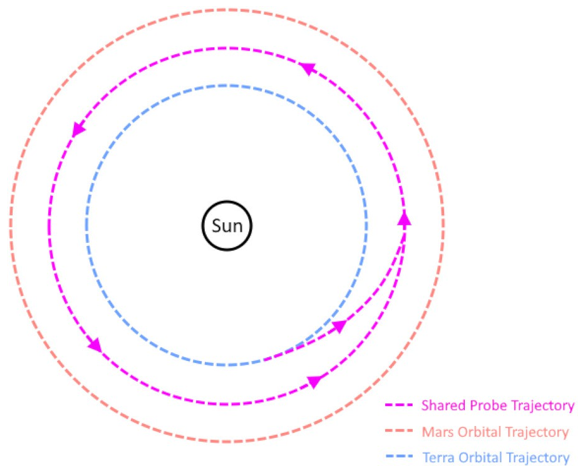
Figure 5: Two Probes are Carried Together to Desired Orbit

Figure 6: Probe B Accelerates to An Elliptical Orbit Necessary to Create an Offset
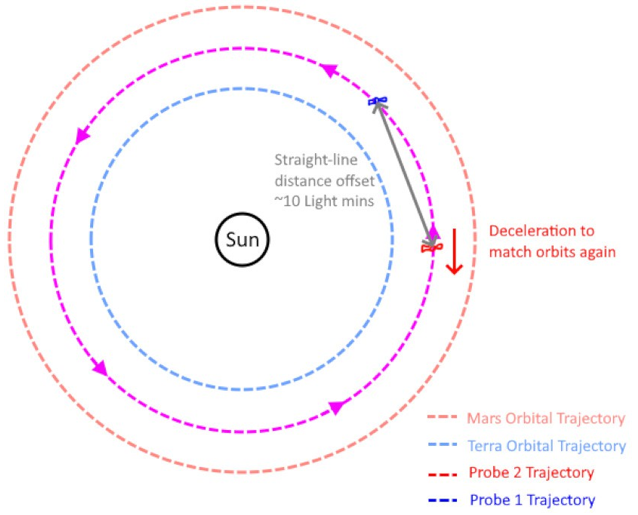
Figure 7: Probe B Decelerates Upon Completing One Orbit, Matching Orbits and Velocities with Probe A
On a specified number of pulses, the probes will signal each other and start a local clock. The velocities of the probes are identical, therefore no time dilation differences. As the probes are travelling around the sun at a constant velocity, red/blueshifting will occur due to the doppler effect. This can be accounted for if the relative velocity difference can be calculated between the two probes, and subtracted from the leading probe while added to the trailing probe. The clock is stopped upon receiving the signal from the opposing probe.
The downside to this approach is that the experiment can be repeated only twice an orbit, and the probes will be active for > 1 year, continuously counting approximately, or over 4 × 10¹⁰ pulses with no downtime. The Earth-Mars approach can be timed to work at a specific window, and the launches can be timed to minimize equipment active time.
Contradictions and Implications
Even though the pulsar is very far away, the isosceles triangle can be broken down into two separate right-angle triangles, which allows us to break it down into resultant vectors. Those resultant vectors say that the left half will be measuring the left side speed of light, and the right side will be measuring the right-side speed of light.

Figure 8: Propagation of Light Due to Difference of Lightspeed Due to Resultant Vector
In the case that the one-way speed of light is not the same, the pulses will hit one probe first and hit the other one second, and it’s going to be measuring the two-way speed of light anyway. However, there is a way to address such a problem.
Upon running the experiment, the first time, we start the atomic clock on each probe and if we observe the pulses, there must be places in our orbit where the two probes are lined up with the propagating pulses of light. If you were to compare the observed pulse rate of the two probes, you should observe what looks like to be almost sine waves.
At points of intersection of the two sine waves are when the pulse rates are identical in certain points of their orbit.
In the case where lightspeed is constant, the pulses should hit the two probes at the same time, starting them with identical pulse rates once every one-half of its completed orbit. The atomic clocks onboard do not do anything other than act as a frame of reference for time, now that the probes are travelling at the same velocity their clocks should be in sync. They are used to document pulse rates and the probe’s point in orbit, given the orbital period is known.
As the orbits are perfectly circular to keep the two probes in sync with velocity, it is simply the circumference divided by orbital velocity. Technically, the probes are experiencing time a little differently, so calculating this value is of little use. Documentation of pulse rate differences should show a clear graph in the end allowing us to map out the exact orbital period.
Theoretical pulse rate difference observations if the one-way speed of light is not constant:
[Note: The probes are revolving clockwise, not counterclockwise. Technically we are rotating by − 2π but the graph is labeled 0 to 2π]

Figure 9: Lines of Propagating Pulses of Light Not Perpendicular to its Direction Vector
Intersections of the two graphs represent a point in orbit where the two probes are hit by the same pulse at the same time, i.e. experiencing the same pulse rates.
Theoretical pulse rate difference observations if the one-way speed of light is invariant:
[Note: The probes are revolving clockwise, not counterclockwise. Technically we are rotating by − 2π but the graph is labeled 0 to 2π]

Figure 10: Lines of Propagating Pulses of Light Perpendicular to Their Direction Vector
Like the prior graph, points of intersection represent positions of matching pulse rates of the two probes. The two graphs show completely different profiles. Theoretically this should make the results of the experiment obvious.
It’s important to note here that lower angle variances, the waves appear to add onto each other, but as we are able to compute the theoretically perfect graph for the revolution of our probes with invariant lightspeed, we can compare the results to that graph.
The hypothesis is that light travels at some absolute speed relative to absolute space, and relative distance is not defined by light due to the expansion of the universe (we see redshifted light from galaxies), absolute distance is. Because we are always moving, light will not travel at the same speed both ways as our local frame of reference is different from the absolute frame of reference of the universe. Note if we have the same relative velocity, blue/ redshifting should not occur.
Absolute space refers to 1m on a ruler, defined by ½ measured 2way speed of light (what we measured). Absolute space is the distance that we travel when we wish to get from point A to point B in relative space.
Relative space refers to distance between galaxies, defined as a changing factor in the accelerating expanding universe.
This means physical distance (absolute space) and the exponentially expanding universe (relative space) are separate things, which leads to strange phenomena. If we throw a rock in absolute space with a certain velocity, acceleration of relative space eventually catches up to it, therefore energy is “not conserved” in relative space. Between galaxies, the rock will seemingly stop, but if we do measure its absolute velocity, it should obey Newtonian motion.
It also appears as if gravity is what keeps pockets of absolute space that are moving apart from each other due to the expansion of the universe. Lightspeed should be constant propagating from the center of this expansion, referring to this as the absolute space of light. As we are expanding with relative space in our own bubble of absolute space, we are travelling through the absolute space of light propagation, therefore our lightspeeds must be different in two ways. Shining a laser on a fast-moving spacecraft will not make the photons go faster, they have zero mass, travelling at the speed limit of the universe. It will make it appear that light is going slower in one way and faster the other way relative to your own frame of reference.
Another hypothetical is that relative space is curved and warped by the effects of “pockets of absolute space”, but Light obeys some sort of absolute velocity of propagation of its own. This causes light to travel not in straight lines through absolute and relative space; Its trajectory is affected by gravity, which bends and shapes space in odd ways.
Conclusion
There are multiple setups for an experiment that will give a relatively accurate measurement of the one-way speed of light, involving the use of pulsars as absolute clocks could eliminate time dilation of probes, or synchronization issues. A setup of two probes that are travelling at identical velocities forming an isosceles triangle with a high pulse rate pulsar extremely distant from the Solar System can be useful to measure the time variances between the two probes, effectively allowing us to measure the one-way speed of light at certain points in the probes' orbits. If we take one synchronization pulse to sync the probes to the pulses arriving at an angle, and measurements taken from across the orbit effectively allows us to observe the absolute grid that lightspeed appear to travel in space, proving that the lightspeed we have / can measure has been different in two ways.
References
- Spavieri, G. (2012). On measuring the one-way speed of light. The European Physical Journal D, 66(3), 76.
- Veritasium. (2020). Why No One Has Measured The Speed Of Light [Video]. YouTube.
- Gift, S. J. (2007). Light speed invariance is a remarkable illusion. arXiv preprint arXiv:0708.2687.
- Greaves, E. D., Rodríguez, A. M., & Ruiz-Camacho, J. (2009). A one-way speed of light experiment. American Journal of Physics, 77(10), 894-896.
- Rayhan, A. (1990). Limitations of Einstein's special theory of relativity. World Sci. Lect. Notes Phys.: Spec. Relativ, 33, 197-204.
- Hessels, J. W., Ransom, S. M., Stairs, I. H., Freire, P. C., Kaspi, V. M., & Camilo, F. (2006). A radio pulsar spinning at 716 Hz. Science, 311(5769), 1901-1904.