

Journal of Educational & Psychological Research(JEPR)
ISSN: 2690-0726 | DOI: 10.33140/JEPR
Impact Factor: 1.4

Research Article - (2026) Volume 8, Issue 1
A Mixed Methods Evaluation of Traditional versus Musical Climate Change Communication
2Department of Environmental Science and Policy, Marist University, United States
Received Date: Feb 20, 2026 / Accepted Date: Mar 27, 2026 / Published Date: Apr 13, 2026
Copyright: ©2026 P. Zion Klos, et al. This is an open-access article distributed under the terms of the Creative Commons Attribution License, which permits unrestricted use, distribution, and reproduction in any medium, provided the original author and source are credited.
Citation: Byrne, R., Fabrizi, O., Duarte, B., Klos, P. Z. (2026). A Mixed Methods Evaluation of Traditional versus Musical Climate Change Communication. J Edu Psyc Res, 8(1), 01-06.
Abstract
Climate change is an important issue that affects all aspects of human life and the environment. Through this project, we wrote an original pop song about the local impacts and solutions to climate change in the Northeast U.S. We used a mixed-methods evaluation to test the effectiveness of musical science communication in relation to traditional methods, to change the mindsets of college students and encourage them to take political action. Marist students responded to surveys asking about their sustainability and lifestyle choices, as well as their opinions on climate change. After watching either treatment: the traditional presentation, or listening to the pop song, participants answered whether their stance toward climate change had changed, whether they had learned more, and whether they plan to take specific steps to make their lifestyles more sustainable. Through a Fisher Chi-Square analysis, we determined that the change in stances between the two treatments was not significant (p-value = 0.33). However, to an 84% confidence level, there were differences between the two treatments in whether students learned about climate change, and whether they were more likely to change their lifestyle. We found that the traditional science presentation was better at teaching new information (p-value = 0.08), while the song was better at convincing students to act in the future (p-value = 0.16). In summary, we found that traditional science communication is better at teaching someone about climate change, but if the goal is to convince someone to take action to do something about it, then communicating that message through music is the better option. Examples of these types of communication can be found on Youtube under “Life Underwater” by Brennan Duarte for the song, and under the title Climate Change and Intensified Precipitation by the same author for the traditional presentation.
Keywords
Informative Presentation Strategy, Persuasive Communication, Global Warming, Environmental Science, Public Speaking
Introduction
The issue of climate change is a major problem in society today and will continue to increase in severity into the future. Many people in society are not aware of the urgency of the issue. This is, in part, due to ineffective communication of this information from the scientific community to the general public. This information must be displayed in a way that everyone can understand but also inspire them to act. Previous studies manage to discuss what specific topics to focus on when communicating with individuals on climate change issues; however, there is less research on the strongest ways to present information on climate change to individuals [1]. This lack of knowledge is a problem because it prevents scientists from clearly and effectively sharing research on climate change with non-scientists. This lack of communication can also slow the willingness of people to act on climate change.
In regards to how music can aid in this communication and drive people to act, previous studies primarily focus on music’s ability to teach concepts to individuals and maintain engagement with learning material in school settings; however, studies like these do not go into detail on music’s ability to teach environmental concepts to individuals [2-5]. This lack of information on the role music could play in climate science communication could mean that scientists and educators are missing a potentially effective way to engage with individuals unfamiliar with the concept of climate change.
The objective of this study is then to determine if music is an effective communication strategy with the public that could spread awareness and encourage action on climate change issues in comparison to traditional climate communication strategies. The hypotheses for this experiment are that communication through music will be a more effective way to both inform individuals on climate change and more effective at convincing them to take action, when compared to traditional scientific presentations.
Methodology
This study was conducted among college students attending Marist University in the spring semester of 2021. The students participated in the study of their own volition and were recruited generally across campus. Statistical analysis was performed using the Fisher Chi square analysis in R programming.
Before the experiment began, the participants were surveyed on a series of questions. They were first asked if they consented to being a part of the project, those who did not consent were not included in the dataset. Next, they were asked whether or not they were majoring in at least one of the fields of Science, Technology, Engineering, or Math. Next, they were asked what their background in music was and they were divided into categories depending on their answer. Ample (7 or more years), Moderate (4-6 years), minimal (1-3 years), or none (0 years). After that, the participants were asked how they typically receive their scientific information, and their responses were recorded. Following that question, the participants were asked what their current stance on climate change was, and once again their responses were recorded. After that, the participants were asked to rate how sustainable they believed their lives to be on a scale of 1-6. They were then asked to check any of the following statements that they believed complied with their lifestyle (Do you recycle, do you use reusable water bottles, do you shower for more than 15 minutes on average, are you a vegetarian or a vegan, do you drive your car for more than 3 days a week, do you keep lights on). Following this, the answers the participants responded to for the rating question were compared with an objective score based on their answers. After that, the participants were asked whether or not they voted in the recent presidential election. In addition to this, they were asked for their age and gender.
After the initial survey, the participants were randomly assigned to either watch the traditional scientific presentation, which can be viewed here: https://youtu.be/gbf6cTDNp18, or the musical form of communication, which can be viewed here: https://youtu. be/gXedvKkpLGs. After the participants viewed their respective videos, they were called back for a second round of questioning. They were first asked which video they viewed, presentation or song. Next, they were asked if their stance on climate change had shifted from what it was previous to watching the video. After that, they were asked whether they felt they knew more about climate change after watching the video than before. After that, they were asked to state one way they believed they could be more sustainable in their day to day lives. Following that question, the participants were asked whether or not they will actually take this step in their lives.
Results
The initial survey responses from the participants are listed in Figure 1. Overall, participants had majority backgrounds in STEM majors and had voted in the last election, with more even diversity across variations in age, gender, music experience, and sources for musical experience. Figure 2 demonstrates that most participants came with a moderate amount of sustainability background. Figure 3 displays the post-treatment survey question responses. Graphs show the results for those who watched the traditional presentation treatment are on the left, and the song treatment are on the right. Statistical results via Fisher Chi square analyses completed using the R Statistical Software indicate the likelihood the differences in the treatments were due to chance for the first question climate stance resulted in a p-value of 0.33, then 0.08 for the second question regarding climate learning, and 0.16 for the third on intention to act on climate.
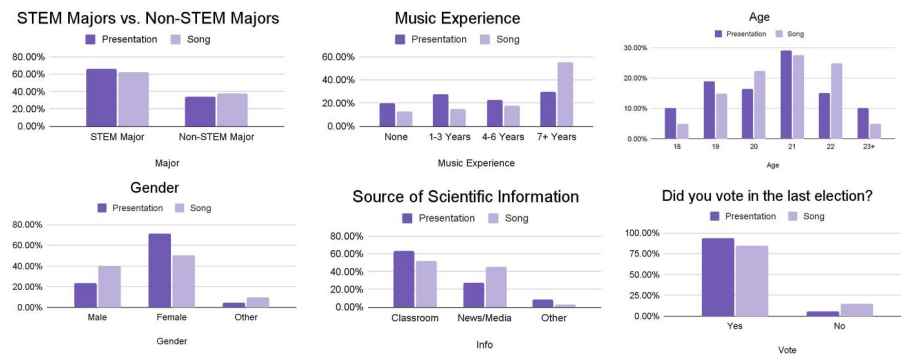
Figure 1: Answers to Preliminary Survey Questions. The dark purple bars represent the participants who watched the presentation. The light violet represents the individuals who listened to the song
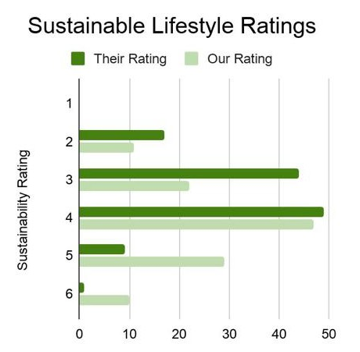
Figure 2: Ratings of Sustainability Lifestyles. The dark green bars represent the ratings that the participants gave themselves. The dark green bars represent the objective ratings based on the lifestyle questions they answered
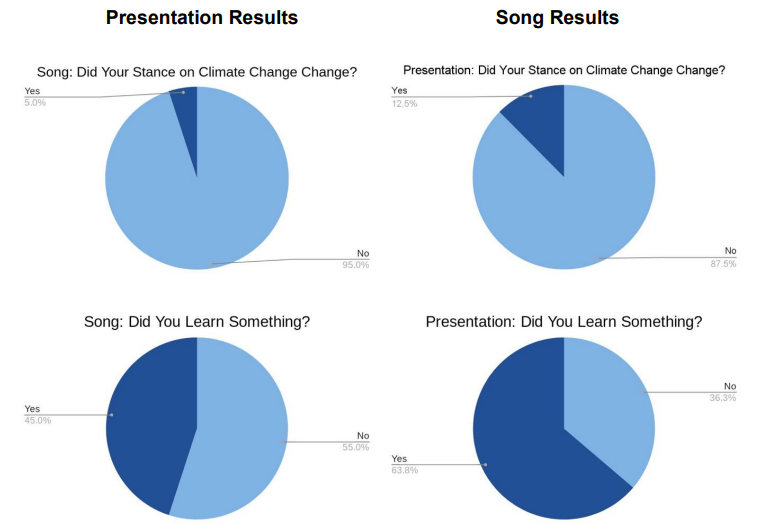
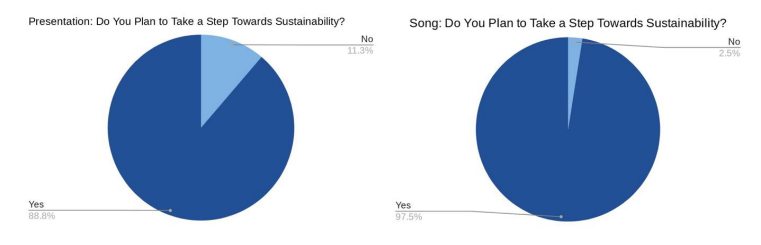
Figure 3: Answers to Post Treatment Survey Questions. Each graph is a representation of how the participants answered the post treatment survey questions. Statistical analysis of the likelihood the differences were due to chance for the first question resulted in a p-value of 0.33, then 0.08 for the second question, and 0.16 for the third. Analysis used a Fisher Chi square analysis in R
In Figure 3, When the participants were asked “Did your stance on climate change change?,” those who watched the presentation responded with 12.5% yes and 87.5% no while those who listened to the song responded 5% yes and 95% no. When the participants were asked “Did you learn something?,” those who watched the presentation responded 63.8% yes and 36.3% no and those who listened to the song responded 45% yes and 55% no. When the participants were asked “Do you plan to take a step towards sustainability?,” those who watched the presentation responded with 88.8% yes and 11.3% no and those who listened to the song responded 97.5% yes and 2.5% no.
Discussion
The results of this study suggest that music can be a useful tool in some aspects of environmental science conservation, but in different ways in regarding to changes in learning, versus changes in intention to act. The first question of Figure 3 demonstrates that there is no significant difference between the communication techniques of a traditional scientific presentation or a musical song in changing an individual’s stance on climate change. The second question of Figure 3 suggests that scientific presentations are more effective for teaching individuals than musical communication. The third question of Figure 3 suggests that musical communication is a better tool for convincing people to engage in environmental action than scientific presentations.
These findings build off other studies in music and learning, with similar studies titled “Using Music and Lyrics to Teach Political Theory” focused on music to teach in a school setting, “Remembering rhythm and rhyme: memorability of narratives for science communication” focused mainly on the use of rhythmic devices to communicate science, and “Teachers’ and students’ views on the use of songs in teaching and learning ionic bonds” focused on learner engagement through the use of music [6-8]. These other studies in this field of inquiry focus mainly on knowledge retention and not on teaching new things or intention to act. The results of this data suggest that traditional scientific presentations are better for teaching individuals something new, and musical communication is better than traditional scientific presentations for inspiring individuals to take action. These results are in-line with other research that discusses the role music can play in sparking political action, but studied devoid of any comparison to traditional scientific presentation [9,10].
This implies that scientific communication is more complex than was previously believed, when done in context of intention to foster change on an issue. Different strategies for science communication can be useful depending on the circumstances, the information being communicated, and reasons for communicating it in the first place. It is also entirely possible that different strategies of science communication can be better or worse depending on who is being communicated to; although, further testing will be required to validate this idea.
In addition, other research goes into the feasibility and potential challenges of teaching people through music [11]. It points out that not all people are musically talented and teaching through music may leave non-musically talented individuals behind. It also claims that it can be difficult to convey accurate information in song form. Often, people would have to sacrifice the accuracy of their information to make their song more sonically pleasing.
While this study was conducted as fairly and objectively as possible, there were a few limitations that may have potentially affected the results of the study. To begin, this study was conducted at Marist University among college students. This means that this study is in no way a representative study of the population as a whole. In addition to this, many of the students attending Marist University are already aware of climate change and its implications. Furthermore, the vast majority of students already believed that climate change was a problem, which is the reason for the results of Figure 3 question 1. Another possible limitation of this study is that the answers of students may not have been entirely honest. It is a widely explored phenomena that people will often lie on surveys to make themselves look good [12]. This phenomena could have easily affected the answers that the individuals gave.
For future studies of this concept, a study that better tests the true knowledge gained as a result of watching the traditional scientific presentation versus the musical presentation could be revealing. This could be accomplished by having the two videos convey almost identical information, and then creating a test for participants to answer based on that information. In addition to this, a study that includes a wider variety of people than only college students could be beneficial. This study could be conducted among those who do not believe climate change is a major issue to better test the two methods’ abilities to change the opinions of individuals. A similar study could also be conducted among students in lower levels of education to better test how well the two methods inform individuals.
Conclusion
In conclusion, the results of this study revealed new insight about how climate science communication can function differently when the goal is knowledge gain versus changing intention to act on the issue. The data from this study suggests that when informing others of new concepts, the traditional scientific approach will be more effective. The data also suggests that when invoking people to take action, the musical approach, with its stronger pulls towards emotional connection, was more effective. Overall, different approaches to science communication will be better or worse in achieving the communicators goals depending on the desired result from the members of your audience.
References
- Bruine de Bruin, W., & Bostrom, A. (2013). Assessing what to address in science communication. Proceedings of the National Academy of Sciences, 110(supplement_3), 14062-14068.
- Crowther, G. J.,Adjapong, E., & Jenkins, L. D. (2023). Teaching science with the “universal language” of music: alignment with the Universal Design for Learning framework. Advances in Physiology Education, 47(3), 491-498.
- Egüz, Å?. (2022). Social studies instruction with educational music: Write, compose, and apply. Sage Open, 12(3), 21582440221120651.
- Governor, D., Hall, J., & Jackson, D. (2013). Teaching and learning science through song: exploring the experiences of students and teachers. International Journal of Science Education, 35(18), 3117-3140.
- Palmer, T. A., & Booth, E. (2024). The effectiveness of song and music as pedagogical tools in elementary school science lessons: A systematic review of literature. International Journal of Education & the Arts, 25(7).
- Rozinski, T. (2015). Using music and lyrics to teach political theory. PS: Political Science & Politics, 48(3), 483-487.
- Negrete, A. (2021). Remembering rhythm and rhyme: memorability of narratives for science communication. Geoscience Communication, 4(1), 1-9.
- Omollo, O. D., Massam, W. E. (2022). Teachers’ and students’ views on the use of songs in teaching and learning ionic bonds. Proceedings of the International Conference on Education, 8(1), 69-85.
- Clough, E. (2021). Introduction: Cultures of protest in American music. Comparative American Studies An International Journal, 18(3), 275-280.
- Pedelty, M., & Keefe, L. (2010). Political pop, political fans? A content analysis of music fan blogs. Music and politics, 4(1).
- Crowther, G. (2012). Using science songs to enhance learning: An interdisciplinary approach. CBE—Life Sciences Education, 11(1), 26-30.
- Kanazawa, S. (2005). Who lies on surveys, and what can we do about it?. The Journal of Social, Political, and Economic Studies, 30(3), 361.