

International Journal of Women's Health Care(IJWHC)
ISSN: 2573-9506 | DOI: 10.33140/IJWHC

Impact Factor: 1.011

Case Report - (2022) Volume 7, Issue 1
A Giant Pediculated Vulvar Lesion: A Case Report
Received Date: Jan 31, 2022 / Accepted Date: Feb 05, 2022 / Published Date: Feb 11, 2022
Copyright: ©Zahra Honarvar. This is an open-access article distributed under the terms of the Creative Commons Attribution License, which permits unrestricted use, distribution, and reproduction in any medium, provided the original author and source are credited.
Citation: Pegah Arfae, Zahra Honarvar. (2022). A Giant Pediculated Vulvar Lesion: A Case Report. Int J Women's Health Care, 7(1), 17-18.
Abstract
Angiofibroma is a benign mesenchymal tumor. Its clinical presentation is nonspecific and similar to other vulvar tumors. Angiofibroma has good prognosis, despite some risk of recurrence. We present a 44-year-old woman with a bulky left vulvar lesion.
Keywords
Angiofibroma, Mesenchymal, Tumor, Vulva
Introduction
Angiofibroma is a soft tissue tumor that occurs in vulvo vaginal region in females and inguino-scrotal region in males [1].
These tumors are well circumscribed, superficial and includes soft spindle cells and veins [2]. It is first described by Nucci et al.in 1997 in a series of 6 cases that occurred almost in the vulvar region of middle-aged women [1].
Since the first description by Nucci, few studies have been pub-lished about this kind of lesion in the literature. According to stud-ies, there is no known risk factor for angiofibroma.
Case Presentation
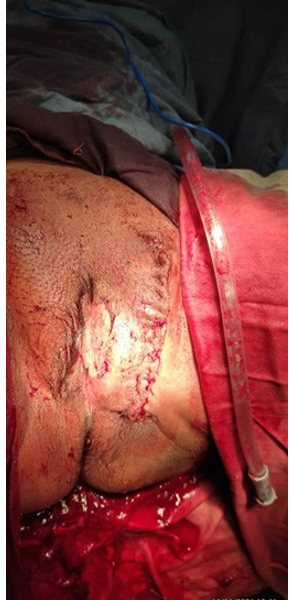
We present an unusual case of pediculated angiofibroma mass. A healthy virgin 44-year-old woman consulted for a painless vulvar mass. There was no previous infection or bleeding. The patient history revealed that the mass was first identified four years earlier, and it had gradually enlarged. It caused discomfort when sitting or walking due to its size. Gross examination showed a firm, freely mobile tumor measuring 25*20*17 cm in the left labia majora.

There was no family history of cancer. She did not report any use of OCP or hormone replacement therapy. The patient gynecolog-ical examination was normal, and no palpable inguinal lymph nodes were distinguished.
The patient underwent surgery with a diagnosis of vulvar mass. The mass was composed of large vessels and after resection had three kg weight. Microscopic evaluation showed a vulvar tissue with a well-defined neoplastic growth composed of fascicle of spindle cells with bland nuclei along with thick wall dilated blood vessels.
Discussion
Angiofibroma is considered benign. Surgical excision of the lesion seems to be the adequate management [3], not only to treat the patient but also to achieve a correct diagnosis. The potential recur-rence risk of these lesions is low [4]
However, Mc Cluggage et al. reported one case of recurrence in a 49-year-old woman that occurred 6 months after excision [5].Angiofibroma should be considered in the differential diagnosis of painless soft masses that may reach large dimensions in the vulva [6].
The present case is the largest angiofibroma defined in the litrature. There are many mesenchymal tumors, which enter into the differ¬ential diagnosis with angiofibroma as spindle cell lipoma, solitary fibrous tumor, mammary-type myofibroblastoma, angiomyofibro-blastoma, aggressive angiomyxoma and smooth muscle tumor. All these described tumors share similar morphologic features and are characterized by bland ovoid to spindle-shaped cells with wispy collagen; variably sized thich-walled blood vessels [7].
Conclusion
In summary, Pathologists should be aware of morphological vari¬ation to avoid diagnostic errors and therefore an aggressive treat¬ment. Angiofibroma in women represents a benign lesion, so a treatment of simple local excision of the lesion is adequate
References
- Nucci, M. R., Granter, S. R., & Fletcher, C. D. (1997). Cellular angiofibroma: a benign neoplasm distinct from angiomyo-fibroblastoma and spindle cell lipoma. The American journal of surgical pathology, 21(6), 636-644.
- Chen, E., & Fletcher, C. D. (2010). Cellular angiofibroma with atypia or sarcomatous transformation: clinicopathologic analysis of 13 cases. The American journal of surgical pathology, 34(5), 707-714.
- Kumar, P., Singh, S., Kumar, A., & Janoria, S. (2018). A rare case of cellular angiofibroma affecting the periurethral region in a 38-year-old woman. Case Reports, 2018, bcr-2018.
- Khmou, M., Lamalmi, N., Malihy, A., Rouas, L., & Alhama-ny, Z. (2016). Cellular angiofibroma of the vulva: a poorly known entity, a case report and literature review. BMC Clinical Pathology, 16(1), 1-6.
- McCluggage, W. G., Perenyei, M., & Irwin, S. T. (2002). Recurrent cellular angiofibroma of the vulva. Journal of clinical pathology, 55(6), 477-479.
- Aydın, Ü. Terzi, H., Turkay, Ü. Eruyar, A. T., & Kale, A. (2016). A giant vulvar mass: a case study of cellular angiofibroma. Case Reports in Obstetrics and Gynecology, 2016.
- Micheletti, A. M. R., Silva, A. C. A. L. D., Nascimento, A. G.,Silva, C. S. D., Murta, E. F. C., & Adad, S. J. (2005). Cellular angiofibroma of the vulva: case report with clinicopatho-logical and immunohistochemistry study. Sao Paulo Medical Journal, 123, 250-252.