

International Journal of Media and Networks(IJMN)
ISSN: 2995-3286 | DOI: 10.33140/IJMN
Impact Factor: 1.02



Research Article - (2025) Volume 3, Issue 1
A Concise Proof of Goldbach Conjecture
Received Date: Oct 10, 2024 / Accepted Date: Nov 20, 2024 / Published Date: Jan 07, 2025
Copyright: ©Â©2025 Xin Wang. This is an open-access article distributed under the terms of the Creative Commons Attribution License, which permits unrestricted use, distribution, and reproduction in any medium, provided the original author and source are credited.
Citation: Wang, X. (2025). A Concise Proof of Goldbach Conjecture. Int J Med Net, 3(1), 01-10.
Abstract
The Goldbach Conjecture, frequently abbreviated as “2 = 1 + 1”, has been a fascinating goal for many mathematicians over centuries. In spite of numberless painstaking attempts by various mathematicians, this question remains unconquerable until recently. Among them, a Chinese mathematician, Dr. Jingrun Chen, proved “1 + 2”, which is the best result the human beings had achieved previously. The complexity of this question is hinged with the notoriously random occurrence of prime numbers in natural numbers. Taking advantage of the periodicity of prime numbers revealed recently, here the author provides a concise, straight-forward, rigorous proof for the conjecture using mathematical induction.
Keywords
Prime Numbers, Periodicity, Goldbach Conjecture, Proof, Number Theory, Mathematical Induction
Introduction
Goldbach Conjecture states "Every even number greater than 2 is a sum of a pair of prime numbers" (frequently abbreviated as “2 = 1 + 1”). Although simple-appearing, the conjecture has been tantalizing mathematicians over centuries since 1742 and remains not fully and convincingly conquered [1-11]. Although the conjecture has been tested valid for all evens up to 4 x 10¹⁸ and several proofs were given for the conjecture, these proofs are too tediously long, complicated, or unclear to be accepted by the general public [5-7,11-13]. A simple, comprehendible but rigorous proof is still lacking. Taking advantage of periodicity of prime numbers revealed recently, the author gives a concise and rigorous proof for the conjecture using mathematical induction.
Techniques and Methods
The author first elucidates the periodicity of prime numbers. Basing on the revealed periodicity, the author proves that the valid scope of Goldbach Conjecture can be expanded from one super product of prime numbers to another, which increases rapidly into the infinite. This is a typical proving process used in mathematics, namely, mathematical induction.

|
n |
Pn |
Super Product |
Expression |
Value |
|
1 |
2 |
X1 |
1 |
1 |
|
2 |
3 |
X2 |
2 |
2 |
|
3 |
5 |
X3 |
2 x 3 |
6 |
|
4 |
7 |
X4 |
2 x 3 x 5 |
30 |
|
5 |
11 |
X5 |
2 x 3 x 5 x 7 |
210 |
|
6 |
13 |
X6 |
2 x 3 x 5 x 7 x 11 |
2,310 |
|
7 |
17 |
X7 |
2 x 3 x 5 x 7 x 11 x 13 |
30,030 |
|
8 |
19 |
X8 |
2 x 3 x 5 x 7 x 11 x 13 x 17 |
510,510 |
|
9 |
23 |
X9 |
2 x 3 x 5 x 7 x 11 x 13 x 17 x 19 |
9,699,690 |
|
10 |
29 |
X10 |
2 x 3 x 5 x 7 x 11 x 13 x 17 x 19 x 23 |
223,092,870 |
|
11 |
31 |
X11 |
2 x 3 x 5 x 7 x 11 x 13 x 17 x 19 x 23 x 29 |
6,469,693,230 |
Table 1: The first eleven super products of prime numbers
Results
Periodicity of Prime Numbers
Although prime numbers are notorious of their random occurrence, Dirichlet’s theorem did predict the regular occurrence of certain prime numbers in natural numbers. The theorem states that there are infinitely many prime numbers in the collection of all numbers of the form na + b, in which the constants a and b are integers without a common divisor except 1 (namely, being relatively prime) and the variable n is any natural number. It is easy to see that the numbers in the collection constitute an arithmetic progression (A.P.) with a common difference of a. This implication is clearly demonstrated in Figure 1 and 2

Figure 1: According to Dirichlet’s Theorem, the lack of a common factor > 1 shared between numbers on both sides of “+” implies potential primality for the sums on the right and a common difference of 30 between adjacent prime numbers on the right, with one exception of 187
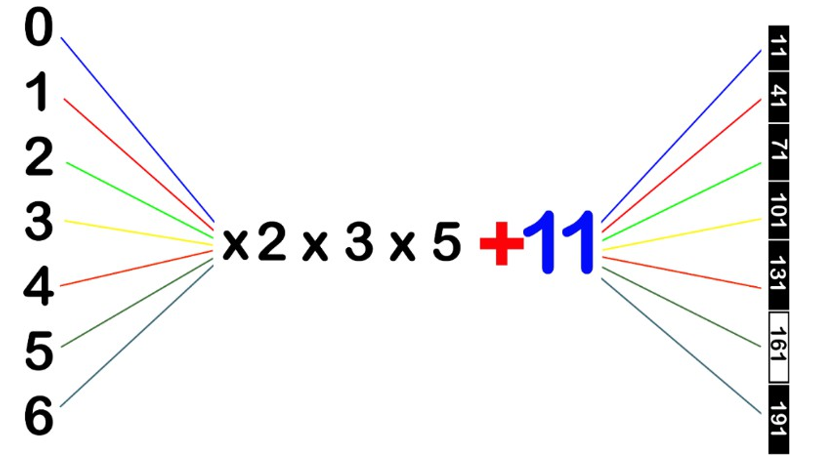
Figure 2: According to Dirichlet’s Theorem, the lack of a common factor > 1 shared between numbers on both sides of “+” implies potential primality for the sums on the right and a common difference of 30 between adjacent prime numbers on the right, with one exception of 161
The above cases of 7 and 11, shown in Figure 1 and 2 respectively, are not exceptional. Indeed, through similar operations shown in Figure 1 and 2, more arrays of seven prime numbers may be derived from greater prime numbers (i.e., 13, 17, 19, 23, 29, and 31), and these 7-element arithmetic progressions have a common difference of 30 and cover all prime numbers (and also rare composite numbers) in the scope [7, 211]. Arranging these arithmetic progressions orderly on radii of a circle, the regular distribution of prime numbers in [7, 211] (roughly the scope of X5) is demonstrated in Figure 3.

Figure 3: Combining the right sides in Figure 1, 2 as well as their counterparts corresponding to other prime numbers (13, 17, 19, 23, 29, and 31, data not shown), the distribution of all prime numbers in [7, 211] becomes regular: each prime numbers in [7, 31] has its own 7-element array of prime numbers with a common difference of 30 (= 2 x 3 x 5 = X4), with 12 exceptions. Modified from Wang [14].
After similar operations, regular distribution of prime numbers in [11, 2311] (roughly the scope of X6) can be obtained, as shown in Figure 4a-d.
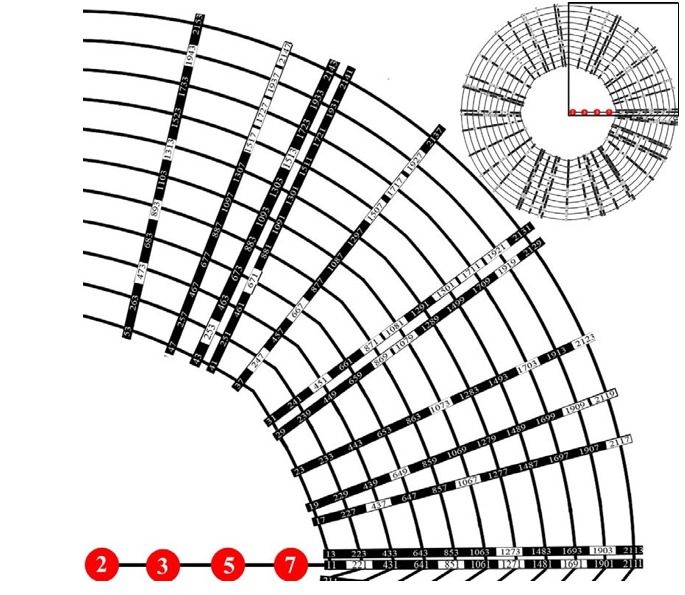
Figure 4a: After similar operation as in Figure 1-3, each prime number in [11, 53] can generate its own 11-element arithmetic progressions of prime numbers (with rare composite exceptions) with a common difference of 210 (= 2 x 3 x 5 x 7 = X5). Note that all numbers on the innermost circle are from Figure 3. Upper-right inset shows the position of the main figure in the whole figure. Modified from Wang [14].

Figure 4b: After similar operation as in Figure 1-3, each prime number in [59, 103] can generate its own 11-element arithmetic progressions of prime numbers (with composite exceptions) with a common difference of 210 (= 2 x 3 x 5 x 7 = X5). Note that all numbers on the innermost circle are from Figure 3. Upper-left inset shows the position of the main figure in the whole figure. Modified from Wang 14].
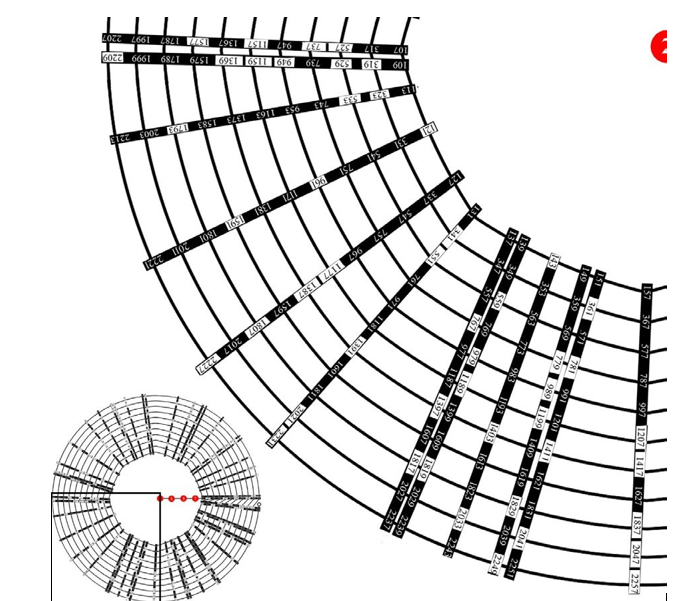
Figure 4c: After similar operation as in Figure 1-3, each prime number in [107, 157] can generate its own 11-element arithmetic progressions of prime numbers (with composite exceptions) with a common difference of 210 (= 2 x 3 x 5 x 7 = X5). Note that all numbers on the innermost circle are from Figure 3. Lower-left inset shows the position of the main figure in the whole figure. Modified from Wang [14].
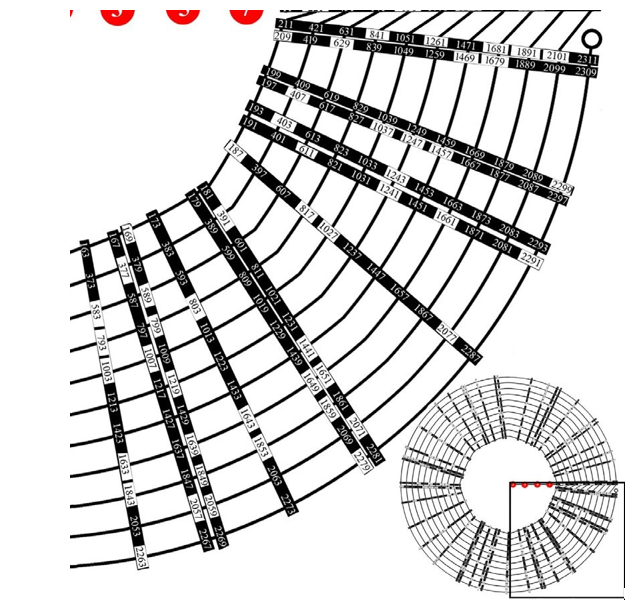
Figure 4d: After similar operation as in Figure 1-3, each prime number in [163, 211] can generate its own 11-element arithmetic progressions of prime numbers (with composite exceptions) with a common difference of 210 (= 2 x 3 x 5 x 7 = X5). Note that all numbers on the innermost circle are from Figure 3. Lower-right inset shows the position of the main figure in the whole figure. Modified from Wang [14].
Regular Sums of Prime Number Pairs
Since the Goldbach Conjecture is about sums of two prime numbers, let’s examine the sums of prime numbers first. Since we cannot obtain the sums of all primes, it does not hurt starting our examining from smaller prime numbers, e.g. prime numbers in [7, 31]. Starting from 7 to 31, we add each number and all greater prime numbers in [7, 31], obtain sums, and put all sums orderly as below. Finally, we put all these sums into the corresponding hashes, as in Figure 5.

Figure 5: Sums of all pairs of prime numbers in [7, 31] cover all evens in [18, 54]
It is easy to see from the above that all even numbers in [18, 54] are sums of two prime numbers. Given 4 = 2 + 2, 6 = 3 + 3, 8 = 3 + 5, 10 = 3 + 7, 12 = 5 + 7, and 16 = 3 + 13, it can be said that Goldbach Conjecture holds up to 54.
To be conservative, we put it as Goldbach Conjecture holds up to 30 (=X4).
Expanding the Valid Scope of Goldbach Conjecture
Suppose Pa, Pb, Pc are prime numbers, S1, S2 are integers, and
S1 = Pa + Pb (1)
S2 = Pa + Pc (2)
Pc = Pb + 30 (3)
If (2) - (1), we can obtain
S2 - S1 = (Pa + Pc) – (Pa + Pb,)
= Pc – Pb
= 30
As in Figure 3, the difference between two adjacent numbers (mostly prime numbers) on the same radius is 30. Since all prime numbers in [7, 31] are on the innermost circle of Figure 3, so if any prime number in [7, 31] is substituted by its neighbor on outer adjacent circle, its value increases by 30. If this prime number is in a prime number pair, then the sum of the prime number pair also increases by 30.
If we apply this operation for every single prime number in [7, 31], then the sums of former prime number pairs covering all evens in [18, 54] increases by 30, covering all evens in [48, 84]. Repeating the same operation six times, we can prove that all evens in ranges [78, 114], [108, 144], [138, 174], [168, 204], and [198, 234], respectively, are sums of a pair of prime numbers.
Since these ranges overlap each other, it can be said that all evens up to 234 are sums of a pair of prime numbers. Namely, Goldbach Conjecture holds up to 234.
To be conservative, we put it as Goldbach Conjecture holds up to 210 (=X5).
Referring to Figure 4a-d, which show arrays of numbers (most prime numbers, some composite numbers), applying the same proving process, it is not hard to prove that Goldbach Conjecture holds up to 2310 (=X6).
Extending to the Infinite Using Mathematical Induction
As seen above, we have proven that Goldbach Conjecture holds up to 30 (=X4). Taking advantage of revealed periodicity of prime number shown in Figure 3 and 4, we have expanded the valid scope of Goldbach Conjecture from X4 to X5, and further X6.
It is apparent that, compared to the standard steps of mathematical induction, all proving steps required for mathematical induction have been fully implemented above. Considering super product Xn can be expanded into the infinite as n increases, the above proves that the valid scope of Goldbach Conjecture can be expanded into the infinite, namely, Goldbach Conjecture holds.
Discussions
The above reasoning is based on an assumption that all numbers shown in Figures 3 and 4 are prime numbers. However, this assumption is apparently not true, as there are obvious exceptions (composite numbers) in the figures. The existence of these exceptions appears to undermine the validity of the above proof. It is necessary to remove the danger brought by these exceptions (composite numbers).
S = Pa + Pb
= (Pa + C) + (Pb - C)
If Pb is not a prime number (a composite number) and Pa is the only prime number smaller than S, the compositeness of Pb would make S an exception even number that negates Goldbach Conjecture. However, if there are extra prime numbers smaller S, then there may still be other prime number pairs, Pa + C and Pb – C, that have their sum equal to S. Our challenge is to find a constant C satisfying S = (Pa + C) + (Pb - C), namely, a common difference between two prime numbers.
Vertical Shifting
In Figures 3 and 4, the expected constant C (common difference between prime numbers) is 30 and 210, respectively. For example, 119 is an exception (a composite number) in Figure 3, and 186 = 119 + 67. We have to replace 119 with a prime number to satisfy Goldbach Conjecture. To offset the influence introduced to the sum by this replacing (as there must be a difference between 119 and a prime number), the other prime number in the pair (67) has to be increased or decreased correspondingly.
In Figure 3, there are 5 alternative prime number on the same radius to replace 67. The differences between 67 and these alternatives are either X4 (= 30) or its multiples. We can easily obtain the following five alternatives.
186 = 119 + 67 = (119 + 30) + (67 – 30) = 149 + 37
= (119 + 60) + (67 – 60) = 179 + 7
= (119 - 30) + (67 + 30) = 89 + 107
= (119 - 60) + (67 + 60) = 59 + 127
= (119 - 90) + (67 + 90) = 29 + 157
In Figure 4, X5 (= 210) or its multiples are ideal candidates for the constant C.
To generalize, in any scope of Xn+1, Xn and its multiples are ideal candidates for the constant C during vertical shifting.
Horizontal Shifting
We still use 186 = 119 + 67 as an example.
There are limited choices for the values of differences among 8 prime numbers on the innermost circle in Figure 3. For example, 6 = 29 – 23 = 23 – 17 = 19 – 13 = 17 – 11 = 13 – 7 = 11 – 5. Please note that this value equals to X3 = 6.
Starting from 119 in Figure 3, we may shift left or right (horizontally), and find new prime number replacement for 119.
186 = 119 + 67 = (119 - 6) + (67 + 6) = 113 + 73
= (119 - 12) + (67 + 12) = 107 + 79
= (119 - 30) + (67 + 30) = 89 + 97
In addition, we may still find more prime number replacements with other differences.
186 = 119 + 67 = (119 - 16) + (67 + 16) = 103 + 83
= (119 + 8) + (67 - 8) = 127 + 59
= (119 + 20) + (67 - 20) = 139 + 47
To generalize, in any scope of Xn+1, Xn-1 and its multiples are ideal candidates for the constant C during horizontal shiftings.
Block-Shifting
Again, we still use 186 = 119 + 67 as an example.
186 = 150 + 36
In Figure 3, there are four alternative prime number pairs having a sum of 36, if only all prime numbers smaller than 32 are taking into consideration.
36 = 5 + 31
= 7 + 29
= 13 + 23
= 17 + 19
As 150 = 30 x 5, we may allocate zero to five blocks of 30 to each prime number in above four prime number pairs. We use the second prime number pair, 7 + 29, as an example to find more alternative prime number pairs having a sum of 186.
186 = 150 + 36
= 150 + (7 + 29)
= 157 + 29 = 127 + 59 = 97 + 89 = 37 + 149 = 7 + 179
Certainly, you may try other prime pairs yourselves to find other alternative solutions.
In summary, in either of the above three shiftings, there are more than one alternative prime number pairs that satisfy Goldbach Conjecture, as Goldbach Conjecture requires only ONE such pair to hold.
It is noteworthy that the number of alternative solutions is hinged with the total number of prime numbers in the scope of certain super product of prime numbers that increases monotonously (Table 2), the number of potential alternative solutions grows monotonously, too [15].

Table 2: Statistics of various features within the scope of each super product of prime numbers
Conclusions
Taking advantage of periodicity of prime numbers in scopes defined by super products of prime numbers, the validity of Goldbach Conjecture is proven using mathematical induction. Although the periodicity shown in Figure 3 and 4 is imperfect, negative influence brought by this imperfectness may be offset by increasing number of alternative solutions.
Acknowledgement
The APC is paid by the author's personal fund.
References
- Chen, J.-R. (1966). On the representation of a larger even integer as the sum of a prime and the product of at most two primes. Kexue Tongbao 17, 385-386.
- Chen, J. R. (1973). On the representation of a large even integer as the sum of a prime and the product of at most two primes. Sci. Sinica, 16, 157-176.
- Hua, L.-G. (1979). Introduction to number theory. Science Press, Beijing.
- Guy, R. K. (2007).Unsolved problems in number theory. Science Press, Beijing.
- Wang, X. (2021). Two ways to prove Goldbach conjecture. London Journal of Research in Science: Natural and Formal, 21, 1-9.
- Brun, V. (1920). Le crible d'Eratosthène et le théorème de Goldbach. Videnskaps. Skr., Mat. Natur. Kl. Kristiana.
- Liang, Z. (2022). A new method to prove Goldbach’s Conjecture. Advances in Pure Mathematics, 12(1), 1-9.
- Liang, Z. (2018). Rigorous Proof of Goldbach’s Conjecture. Journal of Applied Mathematics and Physics, 6(9), 1783-1792.
- Guiasu, S. (2019). Remarks on Goldbach’s Conjecture on prime numbers. Natural Science, 11(12), 336-344.
- Guiasu, S. (2019). The proof of Goldbach’s conjecture on prime numbers. Natural Science, 11(09), 273-283.
- Oliveira e Silva, T., Herzog, S., & Pardi, S. (2014). Empirical verification of the even Goldbach conjecture and computation of prime gaps up to 4x10¹⁸¸. Mathematics of Computation, 83(288), 2033-2060.
- Qin, Z. (1996). A proof of the Goldbach's conjecture. The Economic Daily Press, Beijing.
- Chen, K. & Chen, G. (2000). Golabahc hypothesis and method prime radiation. Northwestern Polytechnical University Press, Xi'an.
- Wang, X. (2021). The genesis of prime numbers—revealing the underlying periodicity of prime numbers. Advances in Pure Mathematics, 11(1), 12-18.
- Wang, X. (2023). Unmysterious prime numbers and the Goldbach Conjecture. Index of Sciences, London.