

World Journal of Forest Research(WJFR)
ISSN: 2994-5569 | DOI: 10.33140/WJFR



Research Article - (2025) Volume 4, Issue 2
A Concept of Energy, Embracing Earth’s Environmental Mechanisms
Received Date: Jul 02, 2025 / Accepted Date: Aug 01, 2025 / Published Date: Aug 11, 2025
Copyright: ©2025 Robert C Kempton. This is an open-access article distributed under the terms of the Creative Commons Attribution License, which permits unrestricted use, distribution, and reproduction in any medium, provided the original author and source are credited.
Citation: Kempton, R. C. (2025). A Concept of Energy, Embracing Earth
Abstract
The universal force of attraction between all matter dominates Earth’s ‘environmental mechanisms’ through the Moon’s orbit and Man’s concept of gravitational forces, creating intricate relationships between energy flow and the planet’s ecosystems, such as photosynthesis, geothermal activity, biogeochemical movements and hydrological cycles. These dynamic reactions shape both the stability and evolution of the planet’s systems. The Moon’s gravitational pull regulates tidal movements, influencing marine ecosystems and coastal landscapes. Similarly, the intricate balances within biogeochemical cycles ensure the seamless transfer of nutrients between living organisms and the inert components of Earth's surface, sustaining life across the biosphere. The Oceans cover over 70% of Earth’s surface and are in perpetual motion due to earth’s natural environmental mechanisms, providing vast natural ‘energy storage’ reservoirs for major kinetic energy resources around the globe. The development of Man’s Science ‘fluid mechanics’ techniques, to harness this energy, will provide long-term sustainability for mankind. Human activities are now impacting on all major ecosystems and the biogeochemical cycles they influence, and urgently requires careful identification and analysis. This requires new international laws on Climate Change and other related issues causing severe harm to all matter on our planet.
Man’s present approach to nature’s biogeochemical cycles for Earth’s ‘matter’ must be addressed, particularly related to present laws of Physics and Chemistry, and with reference to the modern framework for the Periodic Table.
Keywords
Environmental Mechanisms, Fluid Mechanics, Boundary Conditions, Stratification, Kinematic Viscosity, Energy, Biogeochemical Process, Matter, Periodic Table
Appendices
[To be read in conjunction with]
Appendix 1: Fluid Mechanics
Appendix 2: Additional Methodologies / Regional High Seas and Oceans
Addendum
[for general reference]
1.) Periodic Table – Basic format / structure
2.) Structure of the Atom
3.) Atmospheric Prevailing Winds
Introduction
The universal force of attraction between all matter dominates Earth’s environmental mechanisms, with the Moon’s location prominent.
This gravitational concept embraces the intricate relationships between energy flow and the planet’s ecosystems, such as photosynthesis, geothermal activity, biogeochemical cycles, and hydrological cycles. Indeed, it provides an approach towards a better understanding of these mechanisms in a sustainable manner.
Atmosphere1
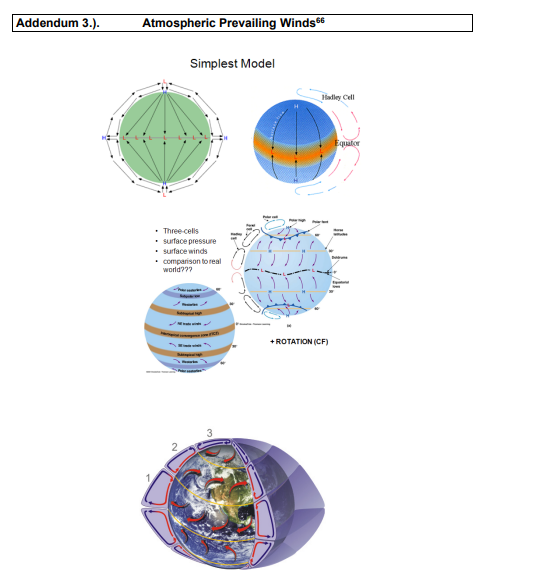
The energy from the Sun heats the atmospheric matter, which rotates in unison with Earth and is responsible for creating the circulation of all ‘elastic fluidised’2 matter. The curvature of Earth creates the variation of heat between the equator and the poles, producing two atmospheric (Hadley) cells; less dense air at the equator rises creating low pressure, and cold dense air falls at the poles.
The environmental mechanism on earth allows the air to rise at the equator and flow to the 30O latitudes, creating three cells for each hemisphere, (Hadley / Ferrel / Polar)3. [Ref: Addendum 3].
The earth ‘s rotation on a tilted axis, produces perpetual motion of the oceans in the southern hemisphere, while there is a greater land mass in the northern hemisphere.
This creates complex global weather patterns across the six cells around the planet.
The dynamic of combined mechanism switching between temperature and pressure, drives the movement of air masses, influencing weather patterns and climatic zones.
The atmospheric mechanisms also facilitate the distribution of moisture, shaping ecosystems and weather systems across the planet, including atmospheric pollution4.
Anthropology defines the Coriolis effect, resulting from earth’s rotation, as the pattern of deflection taken by objects not firmly connected to the ground as they travel long distances around earth, and which is responsible for many of the critical weather patterns. At the equator a maximum distance is travelled in one day, approaching 1,000 miles5, while the distance travelled at the poles, approaches zero travel. In the northern hemisphere the motion is to the east, while in the southern hemisphere it is to the west. The build-up of trade winds and cyclones are examples of the Coriolis effect.
Oceans6
The Sun’s energy is directly responsible for the stratification process to earth’s oceans, which creates the environmental mechanisms to produce layers of transition boundaries through the ocean’s depths, vital for all marine life, as we know and understand it. In Lakes and small bodies of water, the warm surface layer is less dense and forms a thermocline boundary condition, above which is the ‘epilimnion’, with the cooler water disconnected below as the ‘hypolimnion’.
In the Oceans, the thermocline's environmental mechanism is influenced by the depth of the ocean’s waves, which creates a mixing process boundary layer condition in the upper 100 metres. The temperature decreases rapidly from the mixed upper layer of the ocean (epipelagic zone) to the much colder deep water in the thermocline (mesopelagic zone).
Below the thermocline are colder, denser waters, and below 3,300 feet to a depth of about 13,100 feet, the water temperature remains constant7. The deeper (stratified) layers contain colder, denser bottom waters where rare and unknown life forms exist8.
The relationship between depth and temperature is significant, as different marine species thrive in specific layers. This environmental mechanism may be a key area for studying the origins of life.
Creatures who live at great depths do not have air in their bodies such as the swim bladders found in fish that live in more shallow waters. Without air in their bodies, the pressure problem is solved. Fish, crab, octopus, worms, limpets and clams are just some of the creatures found in the depths of the oceans.9
Despite its central role in the global climate, the Southern Ocean circulation is still one of the least understood ocean circulation systems of the planet10.
The term El Nino (Spanish for 'the Christ Child') refers to a warming of the ocean surface, or above-average sea surface temperatures, in the central and eastern tropical Pacific Ocean11. The low-level surface winds, which normally blow from east to west along the equator (“easterly winds”), instead weaken or, in some cases, start blowing the other direction (from west to east or “westerly winds”). El Niño recurs irregularly, from two years to a decade, and no two events are exactly alike. El Niño events can disrupt normal weather patterns in the United States and globally.
The structural intricacies of ocean layers are further influenced by nutrient cycles and biological activity. In the epipelagic zone, where sunlight penetrates most effectively, primary producers like phytoplankton perform photosynthesis, generating the foundation of oceanic food webs. These upper layers are teeming with life due to nutrient upwelling, a phenomenon driven by ocean currents and the movement of tectonic plates. As depth increases, the availability of sunlight diminishes, creating stark contrasts in biodiversity and energy dynamics between the epipelagic and mesopelagic zones.
The mesopelagic zone, often referred to as the "twilight zone," hosts unique adaptations among its inhabitants, such as bioluminescence and specialized feeding mechanisms, enabling survival in low- light conditions.
This zone also serves as a transitional environment where carbon and nutrients are sequestered, playing a critical role in the global carbon cycle.
For example, phytoplankton, which are tiny plant-like organisms, flourish in sunlight-rich zones, whereas, zooplankton, which feast on these nutrients, occupy various depths depending on the time of day.
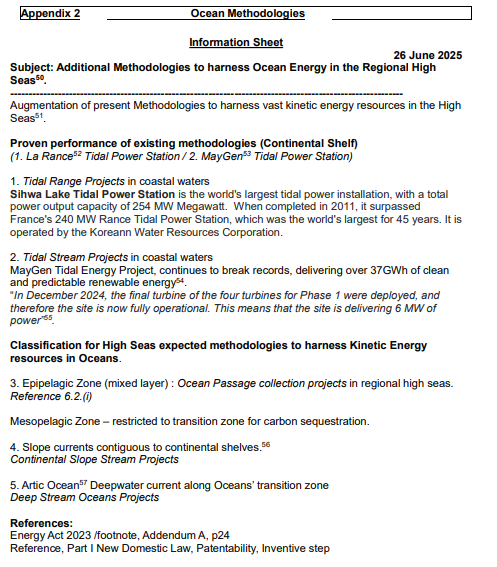
The ‘high seas’ is in perpetual motion, embracing vast kinetic energy resources12, sufficient for long-term sustainability, and the Oceans are earth’s ‘natural Energy Storage reservoirs’ for all mankind. Man’s Science is now sufficiently developed to co- ordinate and organise a Structure Plan embracing the additional methodologies13 to harness all earth’s natural energy resources, based on ‘Fluid Mechanics’ concepts.
New Environmental Laws14 to embrace the high seas vast energy resources are beyond the scope of this paper, but mention should be made that the high seas remain beyond national jurisdiction, at this time, and the new laws, when ratified, will require expansive amendments in future to embrace these natural energy resources.15
Climate Change16
Climate change is a part of ‘Earth’s environmental balance mechanism’, defined by ‘boundary conditions’ and based on ‘Man’s Laws of Science’. Human activities are now impacting all major ecosystems and the biogeochemical systems they influence, necessitating careful identification and analysis. ‘Earth Systems Science’, encompassing geology and chemistry, pertains in part to ‘the movement and transformation of chemical elements and compounds between living organisms’, known as the biogeochemical cycle, which involves ‘fluxian’17 boundary conditions through anthropological boundaries, and land matter conditions.
Environmental Mechanisms, Embracing Greenhouse Gases (GHG)
Energy enters or leaves the Earth’s environmental system through electromagnetic radiations. It radiates from the surface by ‘infrared radiation’, ‘visible light’ and ‘ultraviolet radiation’. This temperature is controlled by the planet’s environmental mechanisms and when Earth’s surface absorbs as much energy as it releases, the planet’s energy budgets are balanced, and the temperature remains stable.18 The following points apply.
(i) Extremely high energy objects (Sun) emit high-energy electromagnetic radiation, classified as short wavelength, embracing ‘ultraviolet radiation’ and visible light.
For cooler energy objects, such as Earth’s surface, much less intense radiation has a longer wavelength radiation and is classified as infrared radiation.
(ii) Earth’s atmosphere is not totally transparent to all electromagnetic radiations, it behaves as a selective filter, which absorbs, reflects and allows through distinctive radiations bands, dependent on the atmospheric make-up of the gases.
(iii) The physical properties of some gases tend to be opaque to infrared radiations. When present in the atmosphere, they reflect a proportion of gases emitted from earth back towards the surface, and this causes an imbalance, warming the earth’s surface, both day and night. It prevents some of the heat absorbed from the Sun from being released back to space.
(iv) This balancing environmental mechanism appears to be unique to our small planet, Earth. The mechanism is critical to life. Without the ‘partial opacity’ of Earth’atmosphere to infrared radiation, the planet’s surface would reach sub-zero temperatures at night when cut-off from sunlight. Life forms would cease, as on the Moon.
Carbon dioxide is one of the primary contributors to the ‘greenhouse effect’, which traps heat within Earth's atmosphere. Its sources are varied, ranging from natural processes such as volcanic eruptions and respiration to human activities including the burning of fossil fuels and deforestation. The environmental impact of CO2 extends beyond the temperature rise condition; it influences ocean acidification, disrupts ecosystems, and accelerates biodiversity loss.
Matter
is anything that occupies space, has mass, and is made up of substances called elements, which are composed of extremely small particles called atoms19, and have specific chemical and physical properties. Man’s Science classifies three ‘body states’ of matter as, gaseous / fluid / solid states, with the Science ‘Fluid Mechanics’20, embracing gaseous as elastic fluids.
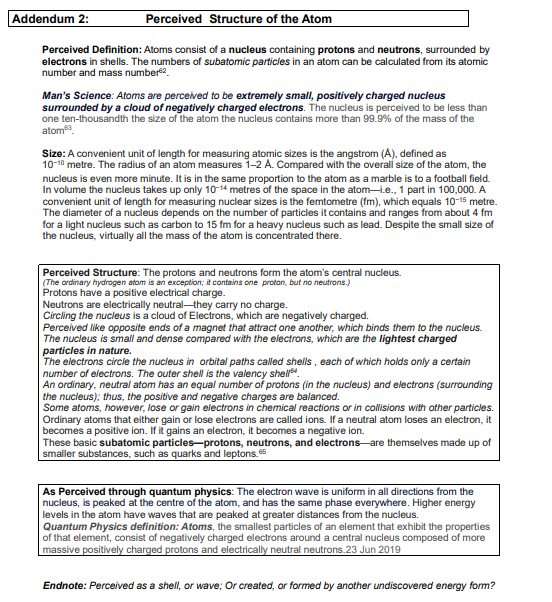
Man’s Science explains the atom structure as comprising, protons, neutrons, and electrons, perceived within a sphere of influence, controlled by ‘attraction’ and ‘repulsion’ forces, and not by a boundary condition around that perceived sphere of influence.
Size (Space): Man’s Science has no ‘real perception’ of size related to the world’s surroundings and our environment. He is unable to conceive the sheer magnitude of the Universe when related to the conceived size of the perceived atom, and is beyond the scope of this paper, except to mention a general observation in Addendum, 2.
The complete tabular array of all chemical elements is classified under the ‘Periodic Table’21. The structure co-ordination of the chemical elements, organized by atomic number, is from the element with the lowest atomic number, hydrogen, to the element with the present highest atomic number, ‘oganesson’ (Fig 1). Reference Addendum 1- Important Basic Facts of present Periodic Table.
The fundamental elements interact dynamically to form molecules, which are the building blocks of matter. For example, water (H2O), a critical molecule for life, exhibits unique properties like high ‘specific heat’ capacity, ‘cohesion’, and ‘surface tension’, which are essential for regulating Earth's climate and supporting ecosystems.
Fluid Mechanics22
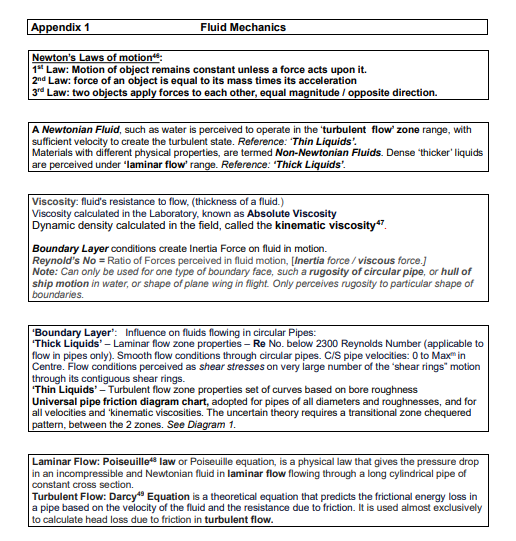
Under man’s perceived mechanism, if a fluid is moving slowly, within a constrained space, a shear stress is created within the liquid called ‘viscosity’. Sir Isaac Newton23 referred to this as the ‘coefficient of molecular viscosity’24.
“All forms of life on earth are immersed in a fluid or another, either the air of the atmosphere or the water of a river, lake or ocean; even, soils are permeated with moisture. So, it is no exaggeration to say that life, including our own, is bathed in fluids. A slightly closer look at the situation further reveals that it is the mobility of fluids that makes them so useful to the maintenance of life, both internally and externally to living organisms”.25
The study of ‘matter’ and its transformations26 is not merely academic; Man’s Laws of Science needs to underpin technological advancements and solutions to pressing global challenges, such as renewable energy and long-term sustainable resource management.
Energy / Matter Interactions
Energy, the capacity to do work, is intricately connected to matter. In physics, the ‘Law of Conservation’ states that energy cannot be created or destroyed but only transformed. This principle governs natural processes and Classifications27, from the photosynthesis that powers ecosystems, through biogeochemical processes, and to the geothermal activity driving tectonic shifts.
Fresh approaches towards a long-term Sustainable future: The connection between energy and matter is crucial in understanding Earth's systems and environmental mechanisms, as it determines the flow of nutrients, the cycling of carbon, and the dynamics of climate regulation.
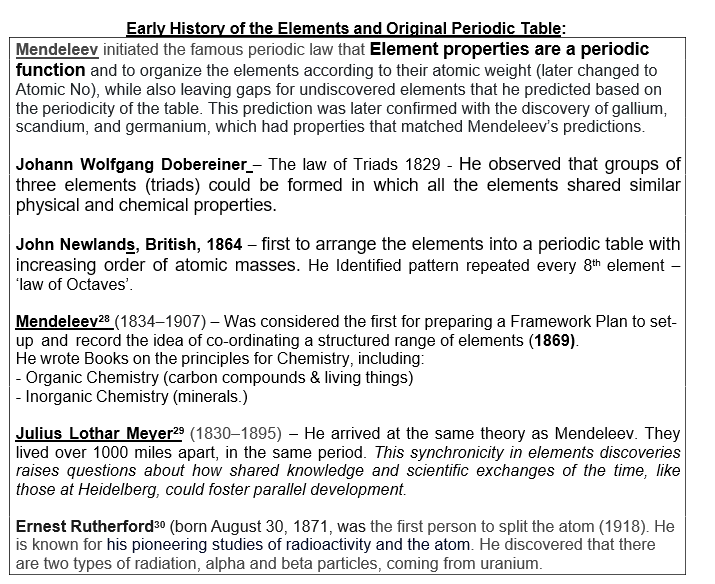
Figure 1
Global Long-Term Sustainability Project (Embracing Environmental Mechanisms):
At last, Man has the knowledge to develop new innovative methodologies required to harness earth’s natural energy resources. Vast kinetic energy reserves are available in the high seas, which cover over 70% of the surface of earth.
An early example of Man’s Innovative ideas, was recorded in the late 60s, following research work into ‘fluid mechanics’ relating to ‘thick liquids’ for municipal sewage sludges.
Research studies31 were successfully carried out on site to ascertain the effective range of ‘kinematic viscosity’ of ‘thick liquid’ municipal sludges, embracing the importance of ‘boundary conditions’, and ‘shear stress’ mechanisms within a fluid. (Table 1) The kinematic viscosity of water was recorded at 0.000012 ft2/sec. (Reference Appendix 1)
A research paper32 was presented to the UK, Institution of Civil Engineers in 1971 and awarded recognition in July 1972. The results were adopted in the Leicester City Corporation’s Sludge Disposal Project design works, to replace temporary facilities with a permanent structure, adjacent to their Compost Plant, and was successfully completed in 1970.
Table 1 furnishes the range of ‘Kinematic Viscosity’ figures used in the Design Works calculations for their successful “Sludge Tankering Project” at the Wanlip Sewage Treatment Works.

Range of Kinematic Viscosity values for Municipal Sludge
– Wanlip STW Sludge Project, 1971
(Imperial Units)
Table 1
With the Advent of the ‘Biodiversity Before NationalJurisdiction’ (BBNJ)33 Agreement being ratified, further important legislation is now required to embrace the additional methodologies for harnessing the natural kinetic energy storage in the Regional High Seas.
This Agreement recalled the relevant provisions of the United Nations Convention on the Law of the Sea (UNCLOS)34 of 10 September 1982 and covered just the global surface for the territorial sea and its contiguous zone35.
New legislation must include the regional areas of the High Seas for coastal nations, and to be embraced under the UNCLOS ‘high seas sections’36, to embrace the methodologies for harnessing natural kinetic energy storage zones.
i.) One methodology to identify is in the ‘Epipelagic Zone’37 of the high seas, which could embrace the traversing of sailing vessels over vast areas. Fluid mechanics design techniques to be adopted to provide hulls of ships to be fitted with equipment during their passage journeys through the surface waters, to ‘collect / hoover / transfer / store’ the continuous kinetic energy produced. Major Energy Companies38 to be set up to prepare schedules for multiple passages across the regional seas, with destinations to many energy ports within the coastal management zones.
ii.) Slope Currents contiguous to the Continental Shelves.
- Japan’s Kuroshio currents: Japan’s coastline, due to unstable Teutonic plates, appear unsuitable for fixed turbines to the seabed. Reference ‘Experimental verification of a floating ocean current turbine with single rotor for use in the Kuroshio current.’39
- European “Slope Current around the British Isles, potential location for European Slope Current Project, embracing stabilised bathymetric seabed profile40.
Summary, and Linkages to Relevant Environmental References
The Incompleteness and uncertainties of Man’s Laws of Science towards a Long-term Sustainable Future have revealed much about the complexities of Earth's systems, and they also underscore the fragility of our small planet. By leveraging the principles of matter, energy, and environmental mechanisms, a sustainable future may be envisioned. This involves not only technological innovation but also a harmonious integration of human activities with the planet's natural cycles, ensuring that the balance essential for life is maintained for generations to come.
Pressure: Relentless increase in ‘pressure’s mechanism’ throughout Earth’s Ocean depths produce multiple linkage to other mechanisms, creating ever evolving environmental conditions which may be key areas for studying the origins of life as we currently understand it. Life’s stratified layers, down to the Mariana Trench depth, are vital research areas for mankind.
It is now essential to restructure an intelligent approach towards setting out a UK structured framework for ‘air pollution’ controls based upon ‘common but differential responsibility’41.
Vast Kinetic Energy resources are available, once additional methodologies have been developed, to harness earth’s natural energy resources, as it will provide a long-term sustainability for all mankind, once the World’s legislation has been ratified and brought into force42. An approach towards a Structure Plan Model for Oceans total energy methodologies is recommended, based on proven modern project management services techniques. (APMS)43.
Fluid Mechanics embraces the major ‘environmental mechanisms’44 within ‘Man’s Science’.
The protocol on environmental protection to the Antarctic treaty to be considered as a suitable model45.
End Note: Temperature has a major effect on the viscosity of any fluid.
Bibilography
Table of Legislation:
1. Climate Change Act 2008, UK Public General Acts, 2008 c.27.
2. UNCLOS - Agreement under the United Nations Convention on the Law of the Sea on the Conservation and Sustainable use of Marine Biological Diversity of Areas Beyond National Jurisdiction, New York September 2023 [The Agreement is not yet in Force].
3. UNCLOS, Oceans and Law of the Sea, Division for Ocean Affairs and the Law of the Sea, United Nations Convention on the Law of the Sea of 10 December 1982.
4. Patents Act 1977, UK Public General Acts, 1977c. 37, Part 1, Patentability, 4 Industrial application.
5. Energy Act 2023, UK Public General Acts, 2023 c. 52.
References
- Bell, S., et al. (2017). Environmental Law, Ninth Edition, Air and atmospheric pollution, p 530-538.
- Cushion-Roisin, B., et al. (2008). 1st Edition, “Fluid Mechanics of Environmental Interfaces”, ABSTRACT – Chapter, Environmental fluid mechanics: Current Issues and future outlook.
- Cushman-Roisin, B., et al. (2008). “Environmental Fluid Mechanics: Current issues and future outlook”, 1st Edition, Abstract, 1st paragraph.
- Darcy, 17th century Paris: Darcy measured the discharge of a tube by measuring the volume of water that flows out of the outlet during a fixed period of time.
- Earth System Science, Earth Labs, Lab 4: It’s all connected; Global Circulation, Part A: Tracing Pathways, Caption.
- Energy and Power Supply Statistics, Forms of known Energy/ Addendum A, Information Sheet, - Energy / Addendum B-Information Sheet – Energy storage.
- Flow Conditions in Pipes due to Thick Liquids, 1971. Paper presented at the North-West Institution of Civil Engineers Student and Graduate Meetings in March 1971, ICE Miller Prize Award recognition in July 1972. – Open Research work, 1971, referenced in this paper.
- Fluid Mechanics definition and terminology, Appendix 1:
- Fluid Mechanics: At that time literature and knowledge available was somewhat limited to movement of ‘thin liquids’ through circular pipes. Flow charts were readily available to the student or engineer, giving a variety of curves for flow through pipes of various roughness, age, and material.
- Francis, J. R. D. (1962). A Textbook on Fluid Mechanics, TheProperties of Fluids, 2nd Edition, 1.1 Definition of a Fluid.
- Francis, J. R. D., A Textbook on Fluid Mechanics, The Properties of Fluids, p 2-3 / The pipe friction diagram for pipes, Fig. 13.10, p207.
- Francis J.R.D, B Sc (Engineering) London, Assoc. I.C.E, with Contribution on Gas Flow from Jackson M.A. (Cantab). (1958). ATextbook of Fluid Mechanics, p3, top of page.
- Geoinformatics & Geostatistics. (2025). A Scientific Journal,SciTechnol: An Overview, Review Article, 13.4, p6.
- Glossary of Archaic Chemical Terms, Part II (C-F), elasticfluid definition.
- Gwam, C. U. (2010). World Meteorological Organization(WMO), Technical references.
- Howarth, W., McGillivray, D. (2001). Water Pollution and Water Quality Law, Chapter 18 International Marine Environmental Law.
- Hughes, D. et al, Environmental Law, fourth edition, Reference to Chapter 17, Atmospheric pollution, pages 543-578.
- Kempton, R. (2025). Approach to ‘Climate Change’ Sustainability Project, for ‘Our Common Future’ - The High Seas in Perpetual Motion, para 1, p7. International Journal Evolving Sustainable and Renewable Energy Solutions, 1(1), p7.
- Japan’s Kuroshio currents (hindered by unstable Teutonic plate conditions.
- Kempton, R. (2024). Approach Towards a Total UK Environmental Energy Master Plan for Clean Renewable Energy, Reviewing the Incompleteness of the British Energy Security Strategy after Brexit, and Embracing Tidal Waters and other Innovative Sources. Reviewing the Incompleteness of the British Energy Security Strategy after Brexit, and Embracing Tidal Waters and other Innovative Sources (May 17, 2024).
- La Rance Tidal Power Station – Appendix 2.
- M Auger, P Prandi, JB Sallée - Scientific Data, 2022 - search.ebscohost.com.
- Mayer Benoit, The International Law on Climate Change, Cambridge University Press, 2018, Introduction, p 2, 1st para.
- MayGen Tidal Power Project – Information Sheet – Appendix2.
- NASA, ‘Glen Research Center’ 27 June 2024 - Sir Isaac Newton worked in many areas of mathematics and physics. He developed the theories of gravitation in 1666 when he was only 23 years old. In 1686, he presented his three laws of motion in the “Principia Mathematica Philosophiae Naturalis.”
- National Geographic, Education, The Coriolis Effect: Earth’s Rotation and its Effect on Weather.
- National Weather Service (.gov) https://www.weather.gov › winds › Flight Environment, Prevailing Winds.
- Newton Issac, Sir, Expression used to explain ‘particular boundary’ condition. / Reference also Glossary of Archaic Chemical Mayer Benoit, The International Law on Climate Change, Cambridge University Press, 2018, Introduction, p 2, 1st para.
- Periodic Table - Addendum 1 – Basic Format / Structure.
- Periodic Table Reference comment: after La(Z = 57) filling of 4f-orbital starts which is complete at atomic number 71. They have different properties and are placed separately at the bottom of the structure in f-block.
- Poiseuille was a physician who had been trained in physics and mathematics. In 1846, Jean Louis Poiseuille published a paper on the experimental research of the motion of liquids in small diameter tubes.
- Reference to Addendum A, Energy Paper titled: “Approach Towards a Total UK Environmental Energy Master Plan for Clean Renewable Energy, Reviewing the Incompleteness of the British Energy Security Strategy after Brexit, and embracing Tidal Waters and other Innovative Sources”.
- Reference to early Fluid Mechanics Text-Book, “A Textbook of Fluid Mechanics”, Francis J.R.D, B Sc (Engineering) London, Assoc. I.C.E, with Contribution on Gas Flow from Jackson M.A. (Cantab), 1958.
- Sands P et al, Principles of International Environmental Law, fourth Edition, Chapter 11, Oceans, Seas and Marine Living Resources.
- Shen, H. H., et al. (2002). books, google.com, “Environmental fluid mechanics: theories and applications”.
- Structure of the Atom, Addendum2: [Man’s Laws of Science conception].
- The Role of Oceanic Thermoclines in Marine Biology / https://www.nature.com › articles.
- Kempton, R. (2025). Approach to ‘Climate Change’ Sustainability Project, for ‘Our Common Future’- 3.1.1 The Earth’s Wind Pattern Forces. World J Forest Res, 4(1), 01-17.
Technical Science References
1. Structure of the Atom
2. Periodic table
3. Britanica, British Physicist
4. The Atom
5. Origins, Current Events in Historical Perspectives
6. Oxford, Quick Reference
7. Volcanos and molten lava pasta viscosities, with medium silica content, range 10,000 to 100,000 times water. Bridgewater State University
8. Water Pressure at Ocean depths
9. Chem Talk
10. Slope Current reference: Towards a Total UK Environmental Energy Master Plan, Embracing Tidal Waters, 5.2.1 slope current, footnote 34
11. Atmospheric Prevailing Winds
Foot notes
1. Hughes D et al, Environmental Law, fourth edition, Reference to Chapter 17, Atmospheric pollution, pages 543-578
2. Glossary of Archaic Chemical Terms, Part II (C-F), elastic fluid definition.
3. National Weather Service (.gov) https://www.weather.gov › winds › Flight Environment, Prevailing Winds.
4. Bell S et al, Environmental Law, Ninth Edition, 2017, Air and atmospheric pollution, p 530-538
5. National Geographic, Education, The Coriolis Effect: Earth’s Rotation and its Effect on Weather.
6. Sands P et al, Principles of International Environmental Law, fourth Edition, Chapter 11, Oceans, Seas and Marine Living Resources.
7. The Role of Oceanic Thermoclines in Marine Biology / https://www.nature.com › articles
8. Water Pressure at Ocean depths https://www.pmel.noaa.gov/eoi/nemo1998/education/pressure.html
9. Water Pressure at Ocean depths https://www.pmel.noaa.gov/eoi/nemo1998/education/pressure.html
10. M Auger, P Prandi, JB Sallée - Scientific Data, 2022 - search.ebscohost.com
11. Earth Labs, Earth System Science, Lab 4: Its all connected; Global Circulation, Part A: Tracing Pathways, Caption
12. Kempton R C,” Approach towards a total UK Environmental Energy Master Plan for clean renewable energy, reviewing the incompleteness of the British Energy Security Strategy, after Brexit, and embracing tidal waters and other innovative sources.”, 5.0 Identify Research into various methodologies to harness tidal energy, https://ssrn.com, written: May 17, 2024
13. Ibid, 6. Energy and Power Supply Statistics, Forms of known Energy / Addendum A, Information Sheet, - Energy / Addendum B -Information Sheet – Energy storage.
14. Reference: Howarth W, McGillivray D, Water Pollution and Water Quality Law, 2001, Chapter 18 International Marine Environmental Law.
15. Ibid, 7. Approach towards New Priority Legislative Regulatory Powers, para 7.4, Agreement under UNCLOS, on the Conservation and sustainable use of Marine Biological Diversity of Areas Beyond National Jurisdiction (BBNJ).
16. Climate Change Act 2008, UK Public General Acts, 2008 c.27
17. Expression used by Sir Issac Newton, to explain ‘particular boundary’ condition. / Reference also Glossary of Archaic Chemical Terms.
18. Mayer Benoit, The International Law on Climate Change, Cambridge University Press, 2018, Introduction, p 2, 1st para.
19. Addendum2: Structure of the Atom. [Man’s Laws of Science conception]
20. Reference to early Fluid Mechanics Text-Book, “A Textbook of Fluid Mechanics”, Francis J.R.D, B Sc (Engineering) London, Assoc. I.C.E, with Contribution on Gas Flow from Jackson M.A. ( Cantab ) , 1958.
21. Addendum 1 – Periodic Table - Basic Format / Structure.
22. Appendix 1: Fluid Mechanics definition and terminology
23. NASA, ‘Glen Research Center’ 27 June 2024 - Sir Isaac Newton worked in many areas of mathematics and physics. He developed the theories of gravitation in 1666 when he was only 23 years old. In 1686, he presented his three laws of motion in the “Principia Mathematica Philosophiae Naturalis.”
24. “A Textbook of Fluid Mechanics”, Francis J.R.D, B Sc (Engineering) London, Assoc. I.C.E, with Contribution on Gas Flow from Jackson M.A. ( Cantab ) , 1958, p3, top of page.
25. Cushman-Roisin B et al “Environmental Fluid Mechanics: Current issues and future outlook”, 1st Edition, 2008, Abstract, 1st paragraph
26. Volcanos and molten lava pasta viscosities, with medium silica content, range 10,000 to 100,000 times water. Bridgewater State University, https://www.bridgew.edu/
27. ” Approach towards a total UK Environmental Energy Master Plan for clean renewable energy, reviewing the incompleteness of the British Energy Security Strategy, after Brexit, and embracing tidal waters and other innovative sources.”, 6. Addendum A, Information Sheet, - Energy: Classification Types, https://ssrn.com, written: May 17, 2024,
28. Origins, Current Events in Historical Perspectives, https://origins.osu.edu/milestones/mendeleev-periodic-table-UN-chemistry- radioactivity-noble-gases
29. Oxford, Quick Reference, https://www.oxfordreference.com/display/10.1093/oi/authority.20110810105408716
30. https://www.britannica.com/biography/Ernest-Rutherford
31. At that time literature and knowledge available was somewhat limited to movement of ‘thin liquids’ through circular pipes. Flow charts were readily available to the student or engineer, giving a variety of curves for flow through pipes of various roughness, age, and material.
32. Title: “Flow Conditions in Pipes due to Thick Liquids”, 1971. Paper presented at the North-West Institution of Civil Engineers Student and Graduate Meetings in March 1971. It received ICE Miller Prize Award recognition in July 1972
33. Agreement under the United Nations Convention on the Law of the Sea on the Conservation and Sustainable use of Marine Biological Diversity of Areas Beyond National Jurisdiction, New York September 2023 [The Agreement is not yet in Force]
34. Oceans and Law of the Sea, Division for Ocean Affairs and the Law of the Sea, United Nations Convention on the Law of the Sea of 10 December 1982
35. Ibid, PART II, Territorial Sea and Contiguous Zone, Sections 1-4, Articles 2-33
36. Ibid, Part VII, High Seas, Sections 1-2, Articles 86-120
37. Reference, Appendix 2, Information Sheet: Information Sheet – Additional Methodologies / Regional High Seas and Oceans
38. Patents Act 1977, UK Public General Acts, 1977c. 37, Part 1, Patentability, 4 Industrial application.
39. https://doi.org/10.20944/preprints202312.0085.v1 , “Towards a Total UK Environmental Energy Master Plan, Embracing Tidal Waters”, 5.2.1 slope current, footnote 34
40. Ibid, footnote 33.
41. Research Article, World Journal of Forest Research: Approach to Climate Change Sustainability Project, for ‘Our Common Future’, 25 April 2025, 3.1.1 The Earth’s Wind Pattern Forces Volume 4, Issue 1, p5.
42. International Journal Evolving Sustainable and Renewable Energy Solutions, Vol 1, Issue 1, 20 March 2025, The High Seas in Perpetual Motion, para 1, p7,
43. International Journal Evolving Sustainable and Renewable Energy Solutions, Volume 1, Issue 1, Research Article, 20 March 2025, 6.4 Explanatory Note: Advanced Project Management Solutions (APMS).
44. Shen HH et al2002 , books,google.com, “Environmental fluid mechanics: theories and applications”
45. Geoinformatics & Geostatistics: An Overview, Review Article, 2025, 13.4, p6 / Reference 2, Gwam CU (2010) World Meteorological Organization (WMO) , Technical references.
46. NASA, ‘Glen Research Center’ 27 June 2024 - Sir Isaac Newton worked in many areas of mathematics and physics. He developed the theories of gravitation in 1666 when he was only 23 years old. In 1686, he presented his three laws of motion in the “Principia Mathematica Philosophiae Naturalis.”
47. Francis J.R.D, A Textbook on Fluid Mechanics, The Properties of Fluids, p 2-3
48. Poiseuille was a physician who had been trained in physics and mathematics. In 1846, Jean Louis Poiseuille published a paper on the experimental research of the motion of liquids in small diameter tubes.
49. Darcy, 17th century Paris: Darcy measured the discharge of a tube by measuring the volume of water that flows out the outlet during a fixed period of time
50. Kempton, Robert, Approach Towards a Total UK Environmental Energy Master Plan for Clean Renewable Energy, Reviewing the Incompleteness of the British Energy Security Strategy after Brexit, and Embracing Tidal Waters and other Innovative Sources (May 17, 2024). Available at SSRN: https://ssrn.com/abstract=4831998 or http://dx.doi.org/10.2139/ssrn.4831998
51. Reference to: Energy Paper titled: “Approach Towards a Total UK Environmental Energy Master Plan for Clean Renewable Energy, Reviewing the Incompleteness of the British Energy Security Strategy after Brexit, and embracing Tidal Waters and other Innovative Sources”, Appendix 4 – Information Sheet, MayGen tidal power project, footnote 69.
52. Ibid, Appendix 3, Facts Sheet – La Rance Tidal Power Station
53. Ibid, Appendix 4, Information Sheet – MayGen Tidal Power Project
54. Tethys, https://tethys.pnnl.gov/project-sites/meygen-tidal-energy-project
55. https://tethys.pnnl.gov/
56. Footnote 53, Ibid, 5.2 .1, last line. / Also, Japan’s Kuroshio currents (hindered by unstable Teutonic plate conditions
57. Footnote 53, Ibid, 5.2,1
58. https://www.britannica.com – periodic table.
59. Reference comment: after La(Z=57) filling of 4f-orbital starts which is complete at atomic number 71. They have different properties and are placed separately at the bottom of the structure in f-block.
60. Reference 2.
61. Chem Talk, https://www.chemistrytalk.org
62. https://www.bbc.co.uk/bitesize/guides/zwn8b82/revision/3
63. https://www.bbc.co.uk/bitesize/guides/zwn8b82/revision/3
64. Your step-by-step guide to find valence electrons, last updated May29, 2024 by Nourhan Essam.
65. https://www.britannica.com/science/atom
66. https://www.weather.gov/source/zhu/ZHU_Training_Page/winds/Wx_Terms/Flight_Environment.htm