

Journal of Veterinary Health Science(JVHS)
ISSN: 2831-3887 | DOI: 10.33140/JVHS

Impact Factor: 0.762

Review Article - (2025) Volume 6, Issue 2
A Brief Review of Chronic Fluoride Poisoning in Domestic Goats (Capra hircus) In India
Former Department of Zoology, Government Meera Girls College, Udaipur, Rajasthan, India
Received Date: Jul 18, 2025 / Accepted Date: Aug 12, 2025 / Published Date: Sep 11, 2025
Copyright: ©2025 Shanti Lal Choubisa. This is an open-access article distributed under the terms of the Creative Commons Attribution License, which permits unrestricted use, distribution, and reproduction in any medium, provided the original author and source are credited.
Citation: Choubisa, S. L. (2025). A Brief Review of Chronic Fluoride Poisoning in Domestic Goats (Capra hircus) In India. J Vet Heal Sci, 6(2), 01-08.
Abstract
In most villages of India, poor people generally prefer to raise domestic goats (Capra hircus) for sustainable income as they can be raised in less space and the cost of their maintenance is also low. Most of the livestock farmers also raise them as a business as they get sufficient income from their milk, meat, leather, fibre, manure, and bones. But when these animals are repeatedly exposed to fluoride contaminated water, air, and food, they suffer from chronic fluoride poisoning or toxicity in the form of a dangerous disease called fluorosis, which not only makes them physically weak but also deforms their bones and teeth. When the disease is severe, these animals often start limping. Thousands of animals in rural areas of the country have been found to be suffering from chronic fluoride poisoning. Due to this, their teeth get damaged and break down quickly, due to which these animals often die at an early age due to hunger and weakness as they are unable to masticate their food. But most of the livestock owners are not aware of this. Most of the hand- pumps, bore-wells, and perennial ponds in rural areas of the country are contaminated with fluoride. Its quantity in them is much more than the prescribed standards of 1-0 ppm or 1.5 ppm. In the rural areas of the country, many coal-burning industries and certain manufacturing units emit fluoride into the atmosphere, thereby contaminating the surrounding air, water, soil, vegetation, agricultural crops, etc. on which these animals depend. While grazing in forests and fields, these animals are usually exposed to these fluoride-rich sources. Excessive exposure or ingestion of fluoride usually results in fluoride getting deposited in the bones and causing a variety of deformities, collectively called skeletal fluorosis, causing the goats to limp. In the country, 25% and 30% of goats are found to be suffering from fluoride poisoning or fluorosis due to drinking of fluoridated water and exposure to industrial fluoride, respectively. Fluoride toxicity also has a profound impact on the productivity of these animals, affecting the economy of goat rearers. The present paper briefly reviews the various possible sources of fluoride exposure, chronic fluoride toxicity in goats and its prevention, and the economic losses due to fluorosis in goat farmers. It also highlights various research gaps on fluoride toxicity in goats to enable researchers to do more in-depth research on this subject.
Keywords
Dental Fluorosis, Drinking Water, Fluoride Exposure, Fluoride Poisoning, Fluorosis, Goat (C. hircus), Industrial Fluoride Emission, Skeletal Fluorosis, Toxicity
Introduction
Animal husbandry is important for India's rural economy, as it provides livelihood, food security, and agricultural support. It is an important source of income for farmers, especially in rural areas, and contributes significantly to the country's gross domestic product (GDP). Animal husbandry provides milk, meat, hair, leather, dung, etc., which gives a good income to animal keepers. People in villages who are financially capable usually rear cows and buffaloes. But people from the poor section mostly rear goats (Capra hircus) because these animals can be easily raised in less space and at low cost. Moreover, they do not require any special care to raise them. In fact, it is a relatively low-cost animal husbandry option, making it attractive for both small and commercial operations. This is why goats are the second most commonly reared animal husbandry in India after cows or cattle (Figure 1). According to the 20th Livestock Census, the total number of domesticated goats in the country in 1919 was 148.88 million. This shows an increase of 10.1% compared to the previous census.

Figure 1: Graph Showing Livestock Population 2019-Share of Major Species
Chronic fluoride poisoning in the form of fluorosis in humans and animals is the result of long-term excessive fluoride intake or exposure to fluoride through inhalation and is a global health concern and endemic in many countries [1,2]. In India, fluoride poisoning is more prevalent in rural areas in both humans and various species of domestic animals due to fluoridated drinking water (hydrofluorosis) and/or industrial fluoride emissions (industrial fluorosis) [3-44]. Industrial fluorosis has also been reported in some species of wild herbivores such as deer and antelope in other countries [45-50]. However, hydrofluorosis is more prevalent in India than industrial fluorosis and has received considerable research studies. Among various species of domestic animals, most research work on chronic fluoride toxicity has been done in cattle and buffaloes [51,52]. Although research studies on fluorosis have been carried out in economically important goats, however, these are very limited [53]. This communication presents a comprehensive and concise review of various possible potential sources of fluoride exposure, chronic fluoride poisoning in goats and its prevention, and economic losses due to fluorosis in goat farmers. It also highlights research gaps for researchers to carry out further studies. The findings of this review may be useful in designing and implementing health programmes to protect the health of these animals from chronic fluoride toxicity in rural areas of the country.
Fluoride Exposures for Goats
In rural areas, villagers raise goats according to their convenience and financial status. Most villagers raise goats in small numbers while some keep them in large numbers. Most villagers feed these goats water from nearby hand- pumps, bore-wells, and dug deep-wells (Figure 2). These water sources are available in sufficient numbers in almost every village. Those who have more goats often feed them water from seasonal and perennial freshwater reservoirs. Water from most hand- pumps and bore- wells in the country is contaminated with fluoride which has been found to be in varying quantities [27]. In most of these water sources, its quantity has been found to be more than the prescribed standard of 1.0 ppm or 1.5 ppm [1,54, 55]. There are many reservoirs in rural areas whose water is also fluoridated. Therefore, these water sources are the primary and major sources of long-term fluoride exposure for these animals. Prolonged drinking of water from these water sources leads to fluoride poisoning and goat animals develop several health hazards or fluorosis (hydrofluorosis) [53]. If goat herders drink water from these water sources repeatedly for a long- time, they may also develop fluorosis disease.
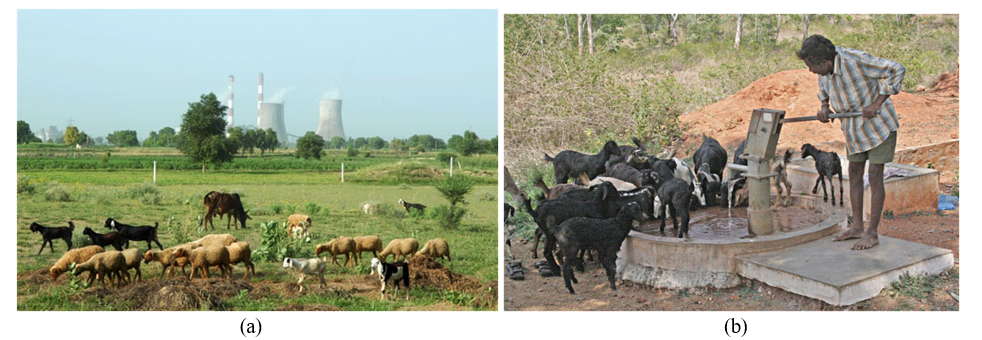
Figure 2: Goat animals are exposed to industrial fluoride pollution (a) and fluoridated water from hand- pump (b) while grazing during the day.
The second major source of fluoride exposure to goats is industrial fluoride emissions. In the country, especially in rural areas, many coal-burning power plants and brick kilns and industries producing aluminium, iron, steel, zinc, chemical fertilizers and hydrofluoric acid emit fluoride-containing gases into the surrounding environment (Figure 2) [56-58]. These emitted fluoride gases (industrial fluoride emissions) contaminate soil, freshwater reservoirs, air, soil, food chains, agricultural crops, plants, etc. in the vicinity of these fluoride emitting industries, on which goats usually depend for food and water. Usually, goats are exposed to industrial fluoride emissions during daytime grazing near fluoride emitting industries. They are also exposed to fluoride contaminated fodder (fresh leaves of plants and shrubs) and pond water. If goats are regularly exposed to fluoride-contaminated air, fodder and water, they develop fluoride poisoning, commonly called industrial fluorosis, food-borne fluorosis, and hydrofluorosis, respectively. In India, industrial and hydrofluorosis have been well studied and reported in goat herds, but food-borne fluorosis has not yet been observed or reported in these animals.
Fluoride Poisoning in Goats
When goat animals are exposed to any contaminated source of fluoride such as air, water, and food items, the fluoride is absorbed through the digestive and/or respiratory tract through ingestion or inhalation and then finally reaches various organs in the body through the blood circulation system. Fluoride also has the ability to cross the placental barrier and reach the developing foetus. More than 50% of the absorbed fluoride is excreted from the body through excretory products and sweat, while the remaining fluoride remains in the body where it accumulates slowly in various organs. However, maximum fluoride accumulation occurred in calcified tissues, bones and teeth compared to their counterparts. In general,the process of fluoride bioaccumulation is found to be higher in younger aged or immature animals [59].
Although fluoride is not an essential element in the growth and development of humans and animals and is an undesirable substance in animal feed, it plays an important role in the formation or mineralization of teeth and enamel. However, in some animals, fluoride is considered an essential element because fluoride-deficient diets affect fertility and growth [60,61]. Nevertheless, the accumulation of fluoride in various organs interferes with many vital biological processes such as physiological, biochemical, and metabolic activities, causing the development of a variety of abnormalities or adverse changes in goats. These fluoride-induced changes or abnormalities are collectively called fluorosis [1,62]. These changes are clinically visible in teeth and bones which are permanent, irreversible, and not treatable and can be easily identified visually [62]. But other fluoride-induced changes in soft organs are reversible and disappear when fluoride exposure is checked.
Whether goat animals are suffering with chronic fluoride poisoning or not this can be identified visually by the presence of dental mottling (dental fluorosis) in animals which is the first irreversible clinical sign of chronic fluoride toxicosis. In goats, dental fluorosis is generally characterised with homogenously light to deep brownish staining in enamel of teeth (Figures 3). However, dental fluorosis becomes more pronounced in the baby goats (kids). With aging and increased exposure to fluoride, the fluoride-induced staining on the teeth becomes darker, excessive tooth wear, receding and swelling of the gums and loss of teeth are symptoms of severe dental fluorosis (Figure 3).
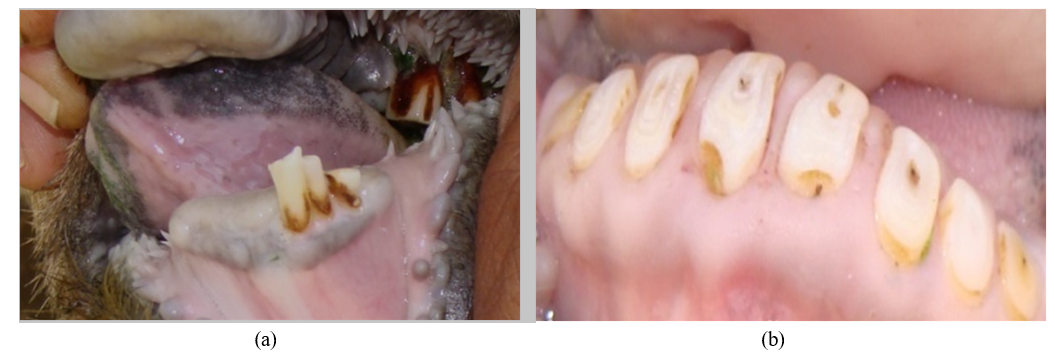
Figure 3: Severe dental fluorosis in goats due to drinking of fluoridated water (a) and industrial fluoride emission (b), respectively. In general, dental fluorosis is appeared in the form of light to deep homogenous brownish staining on teeth. Excessive wearing and falling of teeth indicate severe dental fluorosis (a). A unique and rare appearance of dental fluorosis in goat exposed to industrial fluoride pollution (b) characterized by excessive abrasion of the teeth which have a large deep-brownish spot surrounded by alternate light and deep stained thin layers located towards upper (incisal 3rd) region and the appearance of homogenous staining towards the lower (gingival 3rd) region of each incisor. Source: [28]
A unique form of dental fluorosis has also been observed in goats exposed to industrial fluoride emissions. In this form of dental staining, there is a large dark brown spot on each incisor tooth surrounded by thin layers of alternating light and dark colour and is located towards the upper (incisor III) region (Figure 3). Uniform staining was also found in the lower (gingival III) region of the incisor teeth. However, the cause of this form of dental fluorosis is not yet clear. However, it may be due to unregulated industrial fluoride exposure in goats. Interestingly, fluoride-induced dental staining in goats is slightly different from that in bovine ruminants. In these animals, it appears uniform and vertical, but in bovines it appears stratified and horizontal [18]. Exactly why this occurs is not yet known and is a


Figure 4: Old goat animal afflicted with severe skeletal fluorosis characterised with lameness in hind legs enlarged joints, debility, invalidism, wasting of body muscles and bony lesions in the mandibles, ribs, metacarpus, and metatarsus regions are well recognized(a) and having severe dental fluorosis (Figure 3a). The tail region indicates that the goat had diarrhoea. A male goat physically appears healthy but found to be afflicted with moderate dental fluorosis (Figure 3b) and mild skeletal fluorosis due to industrial fluoride exposure (b). Source: [28]
The highest prevalence of dental fluorosis in goats was found to be 32.9% when the fluoride content in drinking water was 1.65 to 4.4 ppm [63]. In the offspring of these animals, the maximum prevalence of dental fluorosis was 20.0%, even in fluoride endemic areas [64]. Apart from fluoridated water, industrial fluoride emissions (Figure 2) also cause dental fluorosis in goats. From the state of Rajasthan, a prevalence of 8.33% of industrial fluorosis in goat herd has been reported [30]. But such chronic industrial fluoride poisoning data in domestic goat herds in India are quite rare. Therefore, to know the current status of industrial fluoride poisoning in these animals due to various sources of fluoride emissions, extensive epidemiological research studies are needed in different industrial fluoride endemic provinces of the country.
Excessive bio-accumulation of fluoride in bones, muscles, and ligaments causes a variety of physical deformities, collectively called skeletal fluorosis. This condition is extremely dangerous and painful and restricts mobility in animals. In its severe form, animals become permanently disabled. Actually, skeletal fluorosis is resultant of various morphological changes in bones due to fluoride poisoning such as osteophytosis, periosteal exostosis, osteosclerosis, and osteoporosis [65-67]. These changes appear clinically as vague pains in the body and joints associated with stiffness, lameness, excessive bony growth, and detectable bone lesions in goats (Figures 4). These bony changes are generally progressive and irreversible and become severe with increasing of fluoride concentration and its duration and frequency of exposure and advancing the age of animals [25]. Intermittent lameness, enlarged joints, debility, invalidism, wasting of body muscles, and bony lesions in the mandibles, ribs, metacarpus, and metatarsus regions are also found in goats afflicted with chronic fluoride toxicity (Figures 4). At the range of fluoride, 1.5-4.4 ppm in drinking waters, the maximum prevalence of skeletal fluorosis in goats was found to be 29.1% [63].
Goats in a herd suffering from skeletal fluorosis can be identified by their weak bodies, atrophied muscles, lethargy or inactiveness, and inability to stand up easily [68]. Goats suffering from advanced skeletal fluorosis also show a drooping neck and cracking sound in their legs while walking. Excessive bone growth (exostosis) on bones such as ribs, femur, fibula, metatarsal, etc. can also be easily identified by simple palpation. Various bone changes induced by fluoride can be identified by radiological examination. The severity of fluoride-induced bone changes increases with age and duration and frequency of exposure to fluoride [25]. However, the severity of fluoride poisoning depends on many factors other than fluoride concentration and frequency of its exposure, such as age, nutrients, chemicals in drinking water, sensitivity, genetics, environmental factors, etc. [69-74]. How to diagnose in animals whether they are suffering from chronic fluoride poisoning has already been described earlier [68].
Chronic fluoride exposure or fluoride poisoning also affects the soft tissues or organs of animals and causes various pathological changes in their histology, biochemistry, and physiology [60,61]. Due to which animals develop several health problems. The most common health problems such as loss of appetite, abdominal pain, constipation, production or formation of excess gas, loose watery stools, muscle/body weakness, polydipsia, and polyuria have been observed and reported in animals suffering from chronic fluoride poisoning. However, other health issues such as allergic reactions, irregular reproductive cycles, frequent abortions, and stillbirths are also found in goats exposed to fluoride for a long time [60, 61]. These health problems are generally known as non-skeletal fluorosis [68]. Interestingly, these fluoride-induced health problems are usually temporary and often resolve in a short time after eliminating fluoride exposure or removing the goats from sources of fluoride exposure. However, it is not necessary that all these health problems are found in a single animal suffering from fluoride poisoning. However, at the primary level, these symptoms may indicate that the animal is suffering from fluoride poisoning and also help in diagnosing the early stage of fluoride poisoning in animals [68]. However, to confirm these fluoride-induced symptoms, experimental studies are reliable and more research studies are still needed on these health issues. Research work is also needed on long-term fluoride toxicity in reproductive organs as these are very important physiologically and are related to productivity of animals.
“The most dangerous aspect of fluoride poisoning in goats is that the milk and meat of these animals may also contain traces of fluoride. Therefore, these food items can be effective sources of fluoride exposure in humans. Repeated consumption of these fluoride contaminated food items can lead to fluoride poisoning in children, young people, and unborn babies(foetus). Therefore, there is an urgent need to conduct special research studies on this”.
Impact of Fluoride Toxicity on Economy of Goat Owners
It is well known that chronic fluoride poisoning in animals causes various health problems. However, most people are unaware that fluoride poisoning can also cause economic losses to goat farmers. In India, apart from fluorosis, waterborne disease trematodiases is also prevalent in small ruminants such as goats and sheep, causing huge economic losses to livestock farmers [75-79]. Indeed, fluoride poisoning can lead to weight loss and malnutrition, reduced milk production, reduced fertility (infertility, abortions or stillbirths, etc.), general weakness and lameness, increased mortality, medical costs, etc., causing significant economic losses to livestock farmers [29,34,53]. Dental fluorosis has a negative side as well. It often causes goat teeth to break at a very young age, putting these animals at a high risk of death. In fact, severe forms of dental fluorosis cause serious problems in grazing and chewing food, leading to starvation and weakness-related mortality in livestock [1,80]. Premature mortality of animals due to severe dental fluorosis causes huge economic losses to poor goat herders. Whatever the cause of fluoride poisoning in animals,it is responsible for weakening the rural economy in some way or the other. However, it is difficult to say how much economic loss is caused to the herders due to fluoride poisoning in goats. Therefore, more scientific studies to assess the economic losses caused by fluoride poisoning in goats may prove to be highly useful. The findings of these studies may be useful in formulating and implementing health and economic policies to prevent such economic losses.
Prevention of Fluoride Poisoning in Goats
Chronic fluoride poisoning in goats not only harms their health but also causes economic loss to their keepers. On the other hand, there is no cure for dental fluorosis and skeletal fluorosis, therefore, the only possible and easy treatment is prevention of fluoride poisoning in animals. This includes keeping the animals away from any source of fluoride and creating awareness about fluoride poisoning among the keepers. In goats, there are basically two major sources of fluoride exposure, fluoridated water and industrial fluoride pollution through which fluoride enters their body and causes fluoride poisoning or fluorosis in animals. In rural India, most hand-pump and deep bore-well water is fluoridated and fluoride content is found to be more than 1.0 ppm which is unsafe for animal health [27]. Fluoride poisoning can be prevented by feeding the animals water from surface water sources (perennial ponds, reservoirs, lakes, rivers, etc.) instead of these groundwater sources as these contain only traces of fluoride [1]. Defluoridation of fluoridated water is also an effective option to provide fluoride-free water to these animals [81]. To protect goats from industrial fluoride exposure, it is necessary to prevent them from going to areas where there are sources of fluoride emission. Shifting goat animals from fluoride affected areas to non-fluoride affected areas can also be an effective way to prevent long- term fluoride exposure. Feeding goat animals with diets supplemented with natural minerals and antioxidants can also be an effective way to reduce or prevent fluoride toxicity in these animals [82-85].
Conclusion
In India, thousands of goat animals have been found to be suffering from chronic fluoride poisoning or fluorosis due to drinking fluoride-containing water and/or exposure to industrial fluoride. Fluoride poisoning not only harms the health of goats but also causes economic loss to the livestock farmers due to weight loss and malnutrition, reduction in milk and meat production, reduction in fertility, general weakness and lameness, increased mortality, cost of treatment, etc. Despite these adverse consequences, neither the concerned department in the country is serious about protecting these animals from fluoride poisoning nor have extensive research studies been done on this health problem induced by fluoride exposure in these animals. While the results of these research studies prove useful in making health policy to protect goats from chronic fluoride poisoning or fluorosis. Most of the livestock farmers do not even have basic knowledge of fluorosis disease in animals. Therefore, it is very important to develop general health awareness among the livestock farmers in goat farming or capri culture in the country, which is useful in preventing this disease.
Acknowledgments
The author thanks to Dr Darshana Choubisa, Professor, Department Prosthodontics, Geetanjali Dental and Research Institute Udaipur 313002, Rajasthan, India and Dr Pallavi Choubisa, Assistant Professor, Department of Obstetrics and Gynaecology, R.N.T. Medical College and Pannadhay Zanana Hospital, Udaipur 313002, Rajasthan, India for cooperation.
References
- Adler, P., Armstrong, W. D., Bell, M. E., Bhussry, B. R., Büttner, W., Cremer, H-D., et al. (1970). Fluorides and human health. World Health Organization Monograph Series No. 59. Geneva: World Health Organization.
- Choubisa, S. L., Choubisa, D., & Choubisa, A. (2023). Fluoride contamination of groundwater and its threat to health of villagers and their domestic animals and agriculture crops in rural Rajasthan, India. Environmental Geochemistry and Health, 45(3), 607-628.
- Choubisa, S. L., Choubisa, D. K., Joshi, S. C., & Choubisa, L. (1997). Fluorosis in some tribal villages of Dungarpur district of Rajasthan, India. Fluoride, 30(4), 223-228.
- Choubisa, S. L. (1999). Chronic fluoride intoxication (fluorosis) in tribes and their domestic animals. International Journal of Environmental Studies, 56(5), 703-716.
- Choubisa, S. L. (2001). Endemic fluorosis in southernRajasthan, India. Fluoride, 34(1), 61-70.
- Choubisa, S. L, Choubisa, L., & Choubisa, D. K. (2001). Endemic fluorosis in Rajasthan. Indian Journal Environmental Health, 43(4), 177-189.
- Choubisa, S. L., Choubisa, L., & Choubisa, D. (2009). Osteo-dental fluorosis in relation to nutritional status, living habits, and occupation in rural tribal areas of Rajasthan, India. Fluoride, 42(3), 210-215.
- Choubisa, S. L. (2012). Fluoride in drinking water and its toxicosis in tribals of Rajasthan, India. Proceedings of the National Academy of Sciences, India Section B: Biological Sciences, 82(2), 325-330.
- Choubisa, S. L. (2018). A brief and critical review of endemichydrofluorosis in Rajasthan, India. Fluoride, 51(1), 13-33.
- Choubisa, S. L. (2022). Status of chronic fluoride exposure and its adverse health consequences in the tribal people of the scheduled area of Rajasthan, India. Fluoride, 55(1), 8-30.
- Choubisa, S. L., Choubisa, D., & Choubisa, A. (2024). Are children in India safe from fluoride exposure in terms of mental health? This needs attention. Journal of Pharmaceutics and Pharmacology Research, 7(11), 1-6.
- Choubisa, S. L. (2024). A brief review of fluoride-induced bone disease skeletal fluorosis in humans and its prevention. Journal of Pharmaceutics and Pharmacology Research, 7(8), 1-6.
- Choubisa, S. L. (2024). Focus on dangerous skeletal fluorosis, how it can be prevented in humans, Pollution and Health Effects, 2(2), 1-7.
- Choubisa, S. L. (2025). A brief review of fluoride exposur e and its adverse health effects among tribal children i n india. Journal of Clinical Medical health Care, 2(2), 1-9.
- Choubisa, S. L., & Choubisa, D. (2015). Neighbourhood fluorosis in people residing in the vicinity of superphosphate fertilizer plants near Udaipur city of Rajasthan (India). Environmental Monitoring and Assessment, 187(8), 497.
- Choubisa, S. L. (2025). Risk of fluorosis and other health hazards in humans from coal-fired brick kilns in India: People need to be aware. Clinical Medical Reviews and Reports, 7(1), 1-7.
- Choubisa, S. L. (2025). Are coal-based thermal power plants safe for human health in case of fluoride poisoning In India? People need to be careful and alert. Clinical Medical Reviews and Reports, 7(3) , 1-7.
- Choubisa, S. L. (1999). Some observations on endemic fluorosis in domestic animals in Southern Rajasthan (India). Veterinary Research Communications, 23(7), 457-465.
- Choubisa, S. L. (2007). Fluoridated ground water and its toxic effects on domesticated animals residing in rural tribal areas of Rajasthan, India. International Journal of Environmental Studies, 64(2), 151-159.
- Choubisa, S. L. (2010). Osteo-dental fluorosis in domestichorses and donkeys in Rajasthan, India. Fluoride, 43(1), 5.
- Choubisa, S. L. (2010). Fluorosis in dromedary camels in Rajasthan, India. Fluoride, 43(1), 5-10.
- Choubisa, S. L. (2012). Status of fluorosis in animals. Proceedings of the National Academy of Sciences, India Section B: Biological Sciences, 82(3), 331-339.
- Choubisa, S. L., Modasiya, V., Bahura, C. K., & Sheikh, Z. (2012). Toxicity of fluoride in cattle of the Indian Thar Desert, Rajasthan, India. Fluoride, 45(4), 371-376.
- Choubisa, S. L. (2013). Fluorotoxicosis in diverse species of domestic animals inhabiting areas with high fluoride in drinking water of Rajasthan, India. Proceedings of the National Academy of Sciences, India Section B: Biological Sciences, 83(3), 317-321.
- Choubisa, S. L., & Mishra, G. V. (2013). Fluoride toxicosis in bovines and flocks of desert environmen. International Journal of Pharmacology & Biological Sciences, 7(3), 35-40.
- Choubisa, S. L. (2014). Bovine calves as ideal bio-indicators for fluoridated drinking water and endemic osteo-dental fluorosis. Environmental Monitoring and Assessment, 186(7), 4493-4498.
- Choubisa, S. L. (2018). A brief and critical review on hydrofluorosis in diverse species of domestic animals in India. Environmental Geochemistry and Health, 40(1), 99-114.
- Choubisa, S. L. (2021). Chronic fluoride exposure and its diverse adverse health effects in bovine calves in India: an epitomised review. Global Journal of Biology, Agriculture and Health Sciences, 10(3), 1-6.
- Choubisa, S. L. (2024). A brief and critical review of skeletal fluorosis in domestic animals and its adverse economic consequences. Journal of Dairy and Veterinary Sciences, 16(4), 1-8.
- Choubisa, S. L. (2015). Industrial fluorosis in domestic goats(Capra hircus), Rajasthan, India. Fluoride, 48(2), 105-112.
- Choubisa, S. L., & Choubisa, D. (2016). Status of industrial fluoride pollution and its diverse adverse health effects in man and domestic animals in India. Environmental Science and Pollution Research, 23(8), 7244-7254.
- Choubisa, S. L. (2023). Chronic fluoride poisoning in domestic equines, horses (Equus caballus) and donkeys (Equus asinus). Journal of Biomed Research, 4(1), 29-32.
- Choubisa, S. L. (2023). Industrial fluoride emissions are dangerous to animal health, but most ranchers are unaware of it. Austin Environmental Sciences, 8(1), 1-4.
- Choubisa, S. L. (2023). A brief review of industrial fluorosis in domesticated bovines in India: Focus on its socio-economic impacts on livestock farmers. Journal of Biomed Research, 4(1), 8-15.
- Choubisa, S. L. (2025). Focus on fluorosis in domestic animals in India. Journal of Veterinary Health Science, 6(2), 01-06.
- Senthil Kumar, P., & Aravindakshan, C. M. (2015). Industrial fluorosis and its effects on serum biochemistry and haemogram in cattle of Kerala, India. Proceedings of the National Academy of Sciences, India Section B: Biological Sciences, 85(3), 867-872.
- Rao, D. N., & Pal, D. (1978). Cattle fluorosis problem around an aluminium factory. Environmental Physiology and Ecology of Plant, 2, 399-406.
- Ray, S. K., Behra, S. K., Sahoo, N., & Dash, P. K. (1993).Studies on fluorosis in cattle of Orissa due to industrial pollution. Indian Journal of Animal Science, 67, 943-945.
- Patra, R. C., Dwivedi, S. K., Bhardwaj, B., & Swarup, D. (2000). Industrial fluorosis in cattle and buffalo around Udaipur, India. Science of the Total Environment, 253(1-3), 145-150.
- Swarup, D., Dey, S., Patra, R. C., Dwivedi, S. K., & Ali, S. L. (2001). Clinico-epidemiological observations of industrial bovine fluorosis in India. The Indian Journal of Animal Sciences, 71, 1111-1115.
- Swarup, D., Dwivedi, S. K., Dey, S., & Ray, S. K. (1998). Fluoride intoxication in bovines due to industrial pollution. The Indian Journal of Animal Sciences, 68(7), 605-608.
- Jena, C. K., Gupta, A. R., & Patra, R. C. (2016). Osteo-dental fluorosis in cattle reared in villages on the periphery of the aluminium smelter in Odisha, India. Fluoride, 49(4), 503.
- Mandal, K. D., Das, M. R., Pati, M., Gupta, A. R., & Patra,R. C. (2019). Prevalence of fluorosis in calves reared in the vicinity of aluminium smelter plant, Odisha. International Journal of Chemical Studies, 7(1), 2502-2504.
- Pati, M., Parida, G. S., Mandal, K. D., Gupta, A. R., & Patra,R. C. (2020). Clinico-epidemiological study of industrial fluorosis in calves reared near aluminium smelter plant, at Angul, Odisha. The Pharma Innovation Journal, 9(6), 616-620.
- Shupe, J. L., Olson, A. E., Peterson, H. B., & Low, J. B. (1984). Fluoride toxicosis in wild ungulates. Journal of the American Veterinary Medical Association, 185(11), 1295-1300.
- Kierdorf, U., Kierdorf, H., Sedlacek, F., & Fejerskov, O. (1996). Structural changes in fluorosed dental enamel of red deer (Cervus elaphus L.) from a region with severe environmental pollution by fluorides. Journal of Anatomy, 188(Pt 1), 183 -195.
- Kierdorf, H., Kierdorf, U., Richards, A., & Sedlacek, F. (2000). Disturbed enamel formation in wild boars (Sus scrofa L.) from fluoride polluted areas in Central Europe. The Anatomical Record: An Oficial Publication of the American Association of Anatomists, 259(1), 12-24.
- Walton, K. C. (1987). Tooth damage in field voles, wood mice and moles in areas polluted by fluoride from an aluminium reduction plant. Science of the Total Environment, 65, 257-260.
- Kim, S., Stair, E. L., Lochmiller, R. L., Rafferty, D. P., Schroder,J. L., Basta, N. T., ... & Jr, C. W. Q. (2001). Widespread risks of dental fluorosis in cotton rats (Sigmodon hispidus) residing on petrochemical waste sites. Journal of Toxicology and Environmental Health Part A, 62(2), 107-125.
- Death, C., Coulson, G., Kierdorf, U., Kierdorf, H., Ploeg, R., Firestone, S. M., ... & Hufschmid, J. (2017). Skeletal fluorosis in marsupials: a comparison of bone lesions in six species from an Australian industrial site. Science of the Total Environment, 584, 1198-1211.
- Choubisa, S. L. (2023). Endemic hydrofluorosis in cattle (Bos taurus) in India: an epitomised review. International Journal of Veterinary Science and Technology, 8(1), 001-007.
- Choubisa, S. L. (2024). Is the water buffalo species ( Bubalus bubalis) relatively more sensitive to fluorosis than other species of domestic animals? Still, there is a need for more in-depth research on this. Journal of Veterinary medicine and Animal Sciences, 7(1), 1-6.
- Choubisa, S. L. (2022). A brief review of chronic fluoride toxicosis in the small ruminants, sheep and goats in India: focus on its adverse economic consequences. Fluoride, 55(4), 296-310.
- Choubisa, S. L. (2018). Fluoride distribution in drinking groundwater in Rajasthan, India. Current Science, 1851-1857.
- B. I. S. (2012). Indian standard drinking water-specification. 2nd revision. New Delhi: Bureau of Indian Standards, p. 2.
- Choubisa, S. L. (2025). Can smoke from coal-fired bric k kilns in india cause fluorosis in domestic animals? if yes, then livestock owners need to be made aware. Biomedical and Clinical Research Journal, 1(2), 1-7.
- Choubisa, S. L. (2025). Can coal-fired thermal power plants in India cause industrial fluorosis in domestic animals? Livestock owners are unaware. Journal of Veterinary Health Science, 6(1), 1-7.
- Choubisa, S. L. (2025). Is wildlife safe from coal-burning thermal power plants in India in the context of fluorosis? Journal of Veterinary Science and Research, 12(1),1-9.
- Choubisa, S. L. (2013). Fluoride toxicosis in immature herbivorous domestic animals living in low fluoride water endemic areas of Rajasthan, India: an observational survey. Fluoride, 46(1), 19-24.
- S. C. H. E. R. (2011). Opinion on critical review of any new evidence on the hazard profile, health effects, and human exposure to fluoride and the fluoridating agents of drinking water, pp 1-59.
- Alexander, J., Autrup, H., Bard, D., Carere, A., Costa, L. G.,Cravedi, J. P., et al. (2004). Opinion of the scientific panel on contaminants in the food chain on a request from the commission related to fluorine as undesirable substance in animal feed. The European Food Safety Authority Journal,100, 1-22.
- Choubisa, S. L. (2022). The diagnosis and prevention of fluorosis in humans. Journal of Biomedical Research and Environmental Sciences, 3(3), 264-267.
- Choubisa, S. L. (1996). An epidemiological study on endemic fluorosis in tribal areas of southern Rajasthan (a technical report), New Delhi: The Ministry of Environment and Forests, New Delhi, India.
- Modasiya, V., Bohra, D. L., Daiya, G., & Bahura, C. K. (2014). Observations of fluorosis in domestic animals of the Indian Thar desert, Rajasthan, India. International Journal of Advances Research, 2(4), 1137-1143.
- Choubisa, S. L. (1996). Radiological skeletal changes due to chronic fluoride intoxication in Udaipur district, Rajasthan. Pollution Research, 15, 227-229.
- Choubisa, S. L. (2012). Toxic effects of fluoride on humanbones. Advances in Pharmacology & Toxicology, 13(1), 9-13.
- Choubisa, S. L. (2022). Radiological findings more important and reliable in the diagnosis of skeletal fluorosis. Austin Medical Sciences, 7(2), 1-4.
- Choubisa, S. L. (2022). How can fluorosis in animals be diagnosed and prevented. Austin Journal of Veterinary Science and Animal Husbandry, 9(3), 1-5.
- Choubisa, S. L. (2010). Natural amelioration of fluoride toxicity (fluorosis) in goats and sheep. Current Science, 99(10), 1331-1332.
- Choubisa, S. L., Choubisa, L., & Choubisa, D. (2011). Reversibility of natural dental fluorosis. International Journal of Pharmacology and Biological Sciences, 5(20), 89-93.
- Choubisa, S. L., Mishra, G. V., Sheikh, Z., Bhardwaj, B., Mali, P., & Jaroli, V. J. (2011). Food, fluoride, and fluorosis in domestic ruminants in the Dungarpur district of Rajasthan, India. Fluoride, 44(2), 70-76.
- Choubisa, S. L. (2012). Osteo-dental fluorosis in relation to chemical constituents of drinking waters. Journal of Environmental Science and Engineering, 54(1), 153-158.
- Kinkrawali, L., & Morzonda, N. (2013). Why desert camels are least afflicted with osteo-dental fluorosis. Current Science, 105(12), 1671-1672.
- Choubisa, S. L. (2024). Are sheep and goat animals relativelymore tolerant to fluorosis. Journal of Veterinary Medicine and Research, 11(1), 1261.
- Choubisa, S. L., & Jaroli, V. J. (2013). Gastrointestinal parasitic infection in diverse species of domestic ruminants inhabiting tribal rural areas of southern Rajasthan, India. Journal of Parasitic Diseases, 37(2), 271-275.
- Choubisa, S. L., & Choubisa, P. (2024). Are freshwater sources safe for the health of humans and domestic animals in terms of deadly trematodiases. Med Discoveries, 3(1), 1102.
- Choubisa, S. L. (2024). Can gastrointestinal parasitic infections be eliminated among tribal people in India? Yes, this can happen with sustained effective efforts. Clinical and Laboratory Research, 2(2), 1-7.
- Choubisa, S. L. (2024). Are Freshwater Sources in India Safe for Wildlife with Regard to Trematodiases?. Open Access Journal of Veterinary Science & Research, 9(2), 1-7.
- Choubisa, S. L. (2024). Can ruminants become infected with trematode parasites through irrigation. Journal of Veterinary Health Science, 5(2), 01-04.
- Wang, J. D., Zhan, C. W., Chen, Y. F., Li, J. X., Hong, J. P.,Wang, W. F., & Cai, J. P. (1992). A study of damage to hard tissue of goats due to industrial fluoride pollution. Fluoride, 25(3), 123-128.
- Choubisa, S. L. (2023). Nalgonda technique is an ideal technique for defluoridation of water: its use can prevent and control hydrofluorosis in humans in India. Academic Journal Hydrology Water Research, 1(1), 15-21.
- Wang, J. D., Hong, J. P., & Li, J. X. (1995). Studies on alleviation of industrial fluorosis in Baotou goats. Fluoride, 28(3), 131-134.
- Kant, V., Srivastava, A. K., Verma, P. K., Uppal, S. K., & Rajinder, R. (2009). Ameliorative effect of aluminium sulphate on the milk fluoride levels in goats. Israel Journal of Veterinary Medicine, 64 (2), 45-46.
- Kant, V., Verma, P. K. P. N., Pankaj, N., Kumar, J., Raina, R., & Srivastava, A. (2009). Haematological profile of subacute oral toxicity of fluoride and ameliorative efficacy of aluminium sulphate in goats. Toxicology International, 16(1), 31-35.
- Liang, Z., Niu, R., Wang, J., Wang, H., Sun, Z., & Wang,J. (2012). Ameliorative effect of protein and calcium on fluoride-induced hepatotoxicity in rabbits. African Journal of Biotechnology, 11(73), 13801-13808.